Victor Ocheba
The recent flood disaster in Ghana and the sobering remarks of President John Mahama should serve as a moment of reflection not just for Ghana, but for every rapidly urbanising city in West Africa.
Beyond the immediate tragedy lies a deeper lesson about governance, foresight and the difficult choices leaders must make when confronting environmental realities.
Listening to the Ghanaian President outline measures aimed at preventing future disasters, one is struck by a remarkable observation: many of the interventions he identified as necessary for Ghana’s future are interventions that Lagos State, under Governor Babajide Sanwo-Olu, has been implementing for years.
This is not a claim that Lagos has conquered flooding. No serious person would make such an argument. Even some of the most sophisticated cities in the world—including New York, London, Tokyo, Amsterdam and Miami—continue to battle flooding despite investing billions of dollars annually in mitigation measures.
The more relevant question is this: How much worse would Lagos be today if those interventions had never been undertaken? That is the question critics rarely ask.
Uncelebrated Politics of Prevention
There is a fundamental problem with democratic politics. Citizens readily see the consequences of failure but rarely appreciate the value of prevention.
When a bridge collapses, government is blamed. When floodwaters overwhelm entire communities, government is blamed. When infrastructure fails, government is blamed.
But when investments made years earlier prevent a catastrophe from becoming far worse, those investments often go unnoticed. Prevention has no ribbon-cutting ceremony. There are no celebratory headlines for disasters that never happened. This is the challenge leaders like Babajide Sanwo-Olu face.
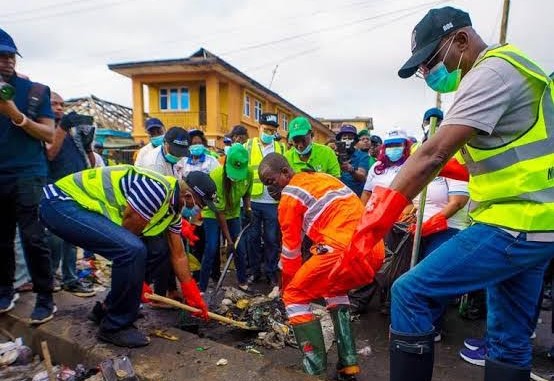
For years, Lagosians have complained about drainage enforcement exercises. They have criticised demolitions along drainage alignments. They have questioned restrictions on construction activities in environmentally sensitive areas.
They have condemned canal clearing operations that disrupted businesses and residential settlements. Many of those criticisms were understandable.
However, nature does not negotiate.Water obeys gravity, not public opinion. Floods respect neither political affiliations nor electoral sentiments. Eventually, every blocked drainage channel extracts a price.
Every encroached waterway seeks reclamation.
Every neglected canal demands attention. The only question is whether governments act before or after disaster strikes.
Climate Change and the New Conversation
The Ghanaian experience underscores a reality that policymakers increasingly acknowledge. Flooding can no longer be treated as a seasonal inconvenience. It has become one of the defining governance challenges of the twenty-first century.
Climate change has altered rainfall patterns across the world. Storms are becoming more intense. Rainfall events are becoming more concentrated. Coastal communities are becoming increasingly vulnerable. Sea levels continue to rise.
In many cities, infrastructure designed decades ago can no longer cope with present realities. This is particularly true in Africa, where urbanisation is proceeding at a pace that often outstrips infrastructure development. The result is predictable.
More people. More buildings. More concrete surfaces. Less natural drainage. More pressure on waterways. More severe flooding. Lagos faces all these challenges simultaneously.
Why Lagos is Different?
Any honest assessment must begin by recognising the unique vulnerability of Lagos. Lagos is not merely another Nigerian city. It is one of the largest urban centres in Africa. It is a coastal megacity. It sits on a complex system of lagoons, creeks and waterways.
It experiences one of the highest rates of urbanisation on the continent. Millions of people live and work within a relatively constrained geographical area.
The city generates a substantial portion of Nigeria’s economic activity. If flooding were to spiral out of control in Lagos, the consequences would extend far beyond environmental concerns.
The economic implications alone would be enormous. This reality explains why successive administrations have invested heavily in drainage infrastructure, shoreline protection, environmental management and urban planning.
Under Sanwo-Olu, these efforts have continued and, in some cases, intensified.
Leadership and Difficult Choices
One of the hallmarks of leadership is the willingness to make decisions that are unpopular in the short term but beneficial in the long term.
History is filled with leaders who paid political prices for reforms that later became widely accepted. Flood management falls squarely within this category.
No governor enjoys ordering the removal of structures. No administration enjoys confronting residents over environmental violations. No politician welcomes accusations of insensitivity. Yet responsible governance sometimes requires exactly that.
The Ghanaian president’s remarks reveal a government now confronting the necessity of measures that many citizens may not immediately embrace.
Lagos has been walking that path for years. The lesson is simple: The cost of prevention is always lower than the cost of recovery.
A Regional Perspective
What makes the Lagos story particularly significant is that it should be viewed within a broader West African context.
Across the region, governments are increasingly grappling with the consequences of rapid urban expansion and climate vulnerability.
From Accra to Cotonou, from Abidjan to Freetown, flood management is becoming one of the most pressing policy concerns facing public officials. The challenge is no longer whether floods will occur. The challenge is how prepared cities are when they do.
Measured against that standard, Lagos deserves recognition for attempting to stay ahead of the curve. The city still faces challenges. The work remains unfinished. But the direction of policy has been unmistakable.
Reassessing Sanwo-Olu’s Legacy
Perhaps the time has come to reassess some of the criticisms directed at Governor Sanwo-Olu’s environmental policies.
Criticism is healthy in a democracy. Governments should be scrutinised. Public officials should be held accountable. However, fairness demands that criticism be accompanied by context.
The context here is that Lagos sits at the frontline of climate vulnerability in West Africa. The context is that many of the measures now being discussed elsewhere as future solutions have already been implemented, at varying degrees, in Lagos.
The context is that every canal cleared, every drainage channel expanded, every environmental enforcement exercise undertaken and every infrastructure project completed contributes to a broader strategy of resilience.
These efforts may not eliminate flooding altogether. Nothing can. But they can reduce its impact. They can save lives. They can protect investments. They can preserve economic activity. And they can prevent a difficult situation from becoming a catastrophe.
Vindication Through Foresight
The flood crisis in Ghana is first and foremost a human tragedy deserving empathy and support. Yet it also provides an opportunity for reflection. It reminds us that governance is not merely about responding to crises after they occur.
It is about anticipating them before they arrive.
It is about making difficult decisions before they become unavoidable. It is about investing in resilience long before the public recognises its necessity.
Governor Babajide Sanwo-Olu’s flood mitigation policies have not always been popular. Some have attracted fierce criticism and resistance.
But as climate-related disasters become increasingly common across West Africa, those policies are beginning to look less like political risks and more like evidence of strategic foresight.
The true measure of leadership is not whether a city experiences challenges. Every city does. The true measure is whether a government recognised those challenges early enough to prepare for them.
On that score, the Lagos experience offers a compelling case study—one that may ultimately prove that some of the governor’s most criticised decisions were, in fact, among his most important.
*Ocheba wrote in from Lagos.