
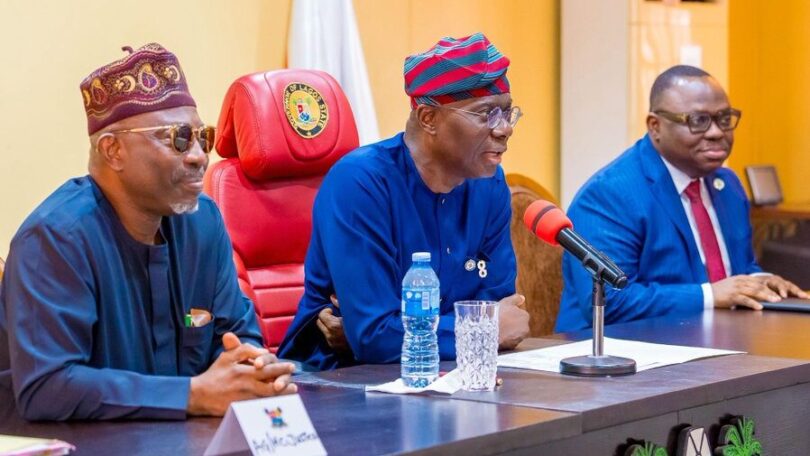
Governor Sanwo-Olu said the agreements had been revised to reflect market realities, noting that payments would now be tied to actual metered power delivered.
The Lagos State Government on Sunday signed Power Purchase Agreements (PPAs) with three electricity generation companies in a move aimed at expanding electricity supply and raising generation capacity to as much as 400 megawatts within three years.
The agreements involve Mainland Power Limited, Fenchurch Power Limited and Viathan Engineering, three of the four independent power plants currently operating in Lagos.
In a statement posted on X after the signing, Mr Sanwo-Olu said the agreements were structured to improve reliability in electricity supply to critical public infrastructure while addressing inefficiencies in previous arrangements.
“Today at Lagos House, Marina, I witnessed the signing of three power purchase agreements designed to build on existing capacity and address what has not been working,” the governor wrote.
He said Fenchurch Power would support major water facilities in Adiyan and Iju, while Mainland Power would continue supplying electricity to Ikeja, Oshodi and Anthony, with room for expansion.
He added that Viathan would sustain power supply to key public facilities on Lagos Island while deepening integration with the distribution network.
Mr Sanwo-Olu said the agreements had been revised to reflect market realities, noting that payments would now be tied to actual metered power delivered.
“We will no longer pay for power that is not delivered. Payments are now tied to actual, metered supply, helping us reduce waste and manage costs more effectively,” he stressed.
He added that the arrangement would support more reliable power for public infrastructure, improve resource management and create a pathway for scaling generation in the coming years.
Mr Ogunleye described the agreements as part of the state’s push to expand generation and revive dormant assets to support a sustainable energy supply.
He said the three companies currently have a combined generating capacity of about 60MW but could scale up to between 200MW and 400MW within two to three years through market-based investments rather than public spending.
According to him, Mainland Power, which manages the Ikeja GRA plant, has an installed capacity of 8.8MW and contracted capacity of 5.8MW, supplying power to strategic public facilities, including the Lagos State University Teaching Hospital and other substations within the state’s network.
He said the Akute Independent Power Plant, now to be operated by Fenchurch Power, has a contracted capacity of 26MW and is being repositioned as a major energy hub.
The commissioner said the plant, which had been dormant for about five years, is undergoing rehabilitation and upgrades under a long-term operational agreement and is expected to serve surrounding communities, including Adiyan Water Works.
For the Island corridor, he said Viathan Engineering would oversee the Peninsula Integrated Power Project with a combined installed capacity of 21MW — 6MW in Lekki and 15MW in Marina — supplying power to major government and health facilities, including Lagos Government House, Lagos Island General Hospital and Lagos Island Maternity Hospital.
Representatives of the partner firms commended the state government for creating an investment-friendly environment for the energy sector.
The agreements build on Lagos’ broader electricity reforms following the enactment of the Lagos State Electricity Law 2024, signed by Governor Sanwo-Olu in December 2024.
 The law seeks to establish an electricity market independent of the national grid, create a state electrification fund and attract investments to underserved areas.
The reform followed the constitutional amendment moving electricity from the exclusive to the concurrent legislative list, allowing states to participate in electricity generation, transmission and distribution, as well as the enactment of the Electricity Act 2023.
The state government had said the reforms are designed to reduce Lagos’ dependence on the national grid and support the government’s long-term ambition of round-the-clock electricity supply.
The latest agreements come amid longstanding challenges in Nigeria’s power sector, including transmission constraints, regulatory uncertainty, gas supply issues and repeated national grid collapses.
Although the federal government privatised generation and distribution assets in 2013 to improve efficiency, electricity supply has remained unstable.
In August 2023, the Lagos State government announced plans to attract up to $10 billion in private investment to improve power supply to nearly five million households, underscoring the scale of the state’s ambition to tackle energy deficits through private-sector participation.