
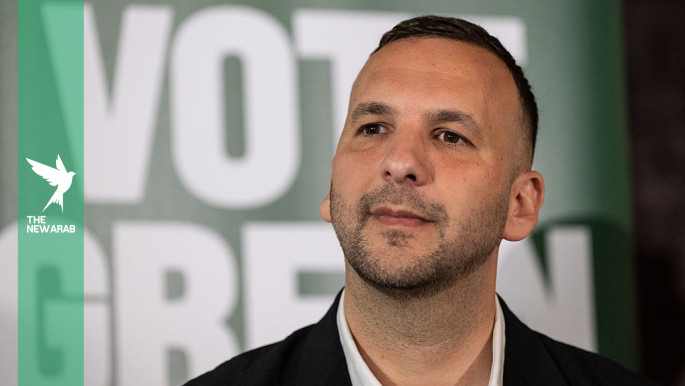
Whilst it’s abundantly clear that the party has struggled to adapt to its rising membership and jolt in the polls, the accusations thrown at it exhibit an establishment desperate to toxify the Green brand, writes Jonas Marvin. [GETTY]
With each passing moment, the British establishment loses its grip on the political destiny of the nation. The upcoming local elections feel like a watershed moment. Both major political parties, the Labour Party and their counterparts in the Conservatives, face the prospect of electoral oblivion. Populist contenders on their flanks might supplant the two longstanding parties of British capitalism.
Pollsters today speak of the Green-Reform divide replacing the traditional Labour-Tory contest. The leaderships of these two longstanding political parties fear they will lose their system and Green leader Zack Polanski is currently facing their desperate wrath because of it.
Since he was elected Green Party leader in September, Polanski has faced a number of attacks from the British establishment. But all of these attacks pale in comparison to the rapidly rising claim that the Greens, the only political party to be led by a Jewish person, are a hotbed for antisemitism.
This elite assault on the party has reached a crescendo in the past few weeks. Much controversy encircled the proposition of a Zionism is Racism motion. Calling for a total boycott of Israel, a rejection of the IHRA and JDA definitions of antisemitism, a one-state solution, and the release of all political prisoners, this motion was ultimately voted down. This didn’t stop the incoming assault, however.
The past few weeks of local election coverage have been replete with coverage of the Green Party’s candidate vetting process. Whilst it’s abundantly clear that the party has struggled to adapt to its rising membership and jolt in the polls, the accusations thrown at it exhibit an establishment desperate to toxify the Green brand.
Of the nearly 30 candidates being investigated by the party, accusations of genuine antisemitism are accompanied by a litany of investigations over legitimate criticisms – sometimes cackhandedly articulated – of the state of Israel. Among the accused are candidates supporting the proscription of the Israeli Defence Forces, endorsing punk rap duo Bob Vylan’s ‘Death to the IDF’ chant at Glastonbury, and advocating Hamas’ removal from Britain’s terror group list.
You may not share these political sensibilities, but the claim that they constitute antisemitism, rather than an earned hostility to the genocidal state of Israel and its institutions, is ludicrous.
The scale of the venom directed against Polanski’s Greens has only accelerated in the past week, since an armed man attacked three people: a Muslim man in Southwark and two Jewish men in Golders Green. In a heartfelt statement, Polanski responded to this instance of naked racial violence by showing his compassion and solidarity for the victims and their loved ones. But what caught the media’s eye was his reposting of a tweet taking umbrage with the disproportionate violence meted out by police officers after the attacker’s arrest.
After a storm of reaction, namely from Metropolitan Police Commissioner Mark Rowley, who massively overstepped his brief to communicate his disappointment with Polanski and his pride in his officer’s conduct, Polanski withdrew his comments.
These are the constitutive elements of the moral panic in practice. Instances of terrifying racial violence are held up to delegitimise left-wing political opponents and alienate alternatives in moments of deep-seated social and political turmoil.
Historian Barnaby Raine offers us a prism through which to understand this. Whereas historically Jews were mobilised as the epitome of the racial Other, alien to Western civilisation and its cultural norms, today some Jews are upheld as outriders of Western imperial interests, erected by Israel and its allies as a human shield against all opposition to capitalism, empire and settler colonialism. This isn’t to engage the old antisemitic trope of the conniving, all-powerful Jew. Far from it: these narratives are emboldened by the West’s insistence, against the wisdom of anti-Zionist Jews, that Jews and the genocidal state of Israel are one and the same.
Raine’s argument also means grasping how, in moments of social crisis, when languages and practices of anti-systemic politics have eroded but hostility to elites has ballooned, state actors and elites hold Jews up as a shield to protect themselves. Of course, as the violence in Golders Green, and the recent antisemitic murders outside a Manchester Synagogue highlight, the acute mobilisation of this moral panic only ever puts Jewish lives at greater harm.
There’s also a crucial domestic context for grasping the nature and form of this political assault on Polanski’s ‘eco-populist’ Greens. In the 2024 general election, five pro-Palestine, anti-austerity independents took seats off Labour politicians, as did four Greens. This electoral breakthrough was in no small part the consequence of the mass Palestine solidarity movement, which enthralled the streets of Britain throughout 2023-24.
The Palestinian struggle for liberation courses through the veins of political life in Britain, making mincemeat of politicians who might otherwise engage in homilies about ‘peace’ and ‘international law’. The unwillingness of many Labour politicians to even support a ceasefire represented a line crossed for millions.
If these politicians could not stand up for a people facing one of the most violent air wars in human history, made and financed by the British state itself, how on earth could they be trusted to represent the interests of their own constituents?
Against this political insecurity, the right wing of Labour, the most significant bulwark against genuine radical politics in Britain, has sought to wheel out the playbook it utilised to undermine Jeremy Corbyn’s Labour leadership and apply it to Polanski’s radicalising Greens. But why has the accusation of antisemitism and one’s fealty to the state of Israel been so central to efforts to undermine left-wing politics?
There is, of course, the central point made earlier, that Western strategic interests have made a great effort to rearticulate some Jews and the state of Israel as an outpost of Western civilisation in the Arab world, at great expense to Jewish communities the world over. But the British state’s fundamental commitment to the state of Israel, from a “loyal little Jewish Ulster” to the guard dog of US interests in the Middle East, cannot be underestimated.
To communicate a radical politics that remotely questions British foreign policy is anathema to this country’s politicians. The proliferation of popular anti-colonial politics across the country since the commencement of Israel’s genocide in Gaza, has shown the state that the internationalist genie must be put back in the bottle.
Polanski’s articulation of those popular sentiments, alongside his class politics and his questioning of NATO, makes him persona non grata.
On top of this is the accelerated repression of the country’s mass Palestine solidarity movement. In November 2023, then Home Secretary Suella Braverman was kicked out of her post because of her failure to face down some of the biggest protests in British history, which she termed “hate marches”. Today, it is the Labour establishment that has continued her legacy.
Four Palestine Actionists have recently been found guilty of raiding an Elbit Systems factory. Last month, Ben Jamal and Chris Nineham, organisers of the marches in solidarity with Palestine, were both charged and sentenced for allegedly breaching protest conditions. Both of these instances follow a recurring pattern of this Labour administration outlawing protest in solidarity with Palestine, such as the attempt to proscribe Palestine Action.
The mobilisation of this moral panic against their Green electoral rivals also operates as a tool to continue the marginalisation of support for the Palestinian people.
This, of course, is not the first time those of us invested in the liberation of the Palestinian people and the radical improvement of our lives in Britain have been subject to such monstrous attacks. Jeremy Corbyn’s tenure as Labour leader saw him face several years of these attacks until he was successfully constructed by his opponents – namely the Labour right, the same people banning protests and attacking Polanski – as alien to the British nation.
No amount of compromise on this front will save the Greens from the judgment of their opponents. To energise its base, live up to its ‘eco-populist’ commitments, and defend their long march to replace the Labour Party, it must insist upon the value of a politics which says Palestinians must be free, Jews must not be used as cannon fodder for those who seek to defend imperial violence, and everyone deserves a good life. Anything less is failure.
Jonas Marvin is the author of forthcoming The Breaking of the English Working Class, due out for Verso Books in August 2026. He also cohosts Life of the Party podcast and blogs at Marx’s Dream Journal.
Follow Jonas on X: mØØdyjonas
Have questions or comments? Email us at: editorial-english@newarab.com
Opinions expressed in this article remain those of the author and do not necessarily represent those of The New Arab, its editorial board or staff.