… Inaugurates Boards For Education Agencies, University Principal Officers
The Minister of Education, Dr Tunji Alausa, on Wednesday flagged four key threats undermining Nigeria’s education system, citing learning poverty, teacher quality gaps, infrastructure deficits, and the urgent need to strengthen research and innovation ecosystems.
Alausa said the sector must confront these challenges head-on as the government drives comprehensive, data-driven reforms under President Bola Ahmed Tinubu’s Renewed Hope Agenda to improve access, quality, equity, and relevance in education.
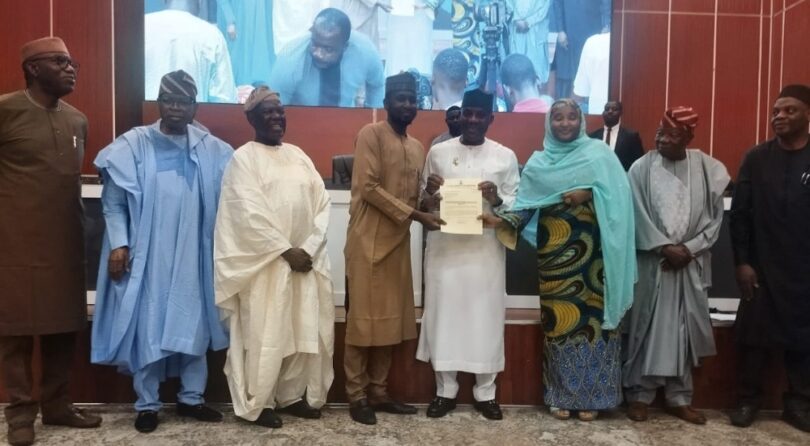
Alausa who was speaking during the inauguration of Governing Boards and Principal Officers of a university, including the appointment of a polytechnic rector in Abuja, described the inauguration as symbolic of the government’s commitment to repositioning education as the bedrock of national development and strengthening governance across all levels of the system.
He expressed appreciation to President Tinubu for his visionary leadership and unprecedented support, noting that the President’s bold investments and policy direction had created the enabling environment for the far-reaching reforms currently being implemented by the ministry.
Congratulating the newly appointed Chairmen and members of the Governing Boards, the Minister said their selection reflected proven competence, integrity, and commitment to national service.
He stressed that the governance of education agencies required clarity of vision, strong ethical standards, and alignment with national policy direction, and urged the appointees to provide strategic oversight, ensure accountability, and support management to deliver measurable outcomes.
He added that they must serve as a bridge between policy and implementation by inspiring confidence through transparency, discipline, and results.
Alausa also addressed the Principal Officers of the newly established Federal University of Agriculture and Entrepreneurship, Bama, describing the Vice-Chancellor, Registrar, Bursar, and Librarian as pioneer leaders with the historic responsibility of laying a solid institutional foundation that would define the university’s vision, culture, and long-term trajectory.
He charged them to lead with vision and integrity by building strong academic programmes, investing in faculty development, promoting solution-oriented research, ensuring student welfare, and fostering strategic partnerships.
To the reappointed Chief Executive Officers of the ministry’s parastatals, Alausa commended their continued service and institutional knowledge, saying their reappointment was a recognition of performance and stability.
He however cautioned that continuity must not breed complacency but should serve as a platform to consolidate gains, deepen ongoing reforms, and accelerate progress.
The task ahead, he said, demands innovation, responsiveness, and a relentless focus on improving outcomes across the education value chain.
The Minister told the newly appointed Rector of the Federal Polytechnic, N’Yak-Shendam, that the appointment came at a pivotal moment as polytechnics remain central to the drive for Technical and Vocational Education and Training, skills acquisition, and industrialization.
He urged the Rector to build an institution that produces graduates equipped with practical competencies, entrepreneurial capacity, and industry-relevant skills rather than certificates alone.
Alausa reaffirmed that the reforms underway are not optional but imperative for national competitiveness and sustainable development.
He called for prudent management of resources, strict adherence to due process, and unwavering compliance with all applicable laws and regulations, stating that public trust is earned through integrity, accountability, and service.
He further pledged the ministry’s commitment to strengthening policy coherence, enhancing monitoring and evaluation frameworks, and fostering collaboration across agencies and stakeholders in line with the One Government Approach doctrine to ensure that no Nigerian learner is left behind.
“Ultimately, the success of our education system will depend not only on policies and funding but on the quality of leadership that drives implementation. I therefore urge you to work collaboratively, lead with integrity, and remain steadfast in your commitment to excellence,” he urged them.