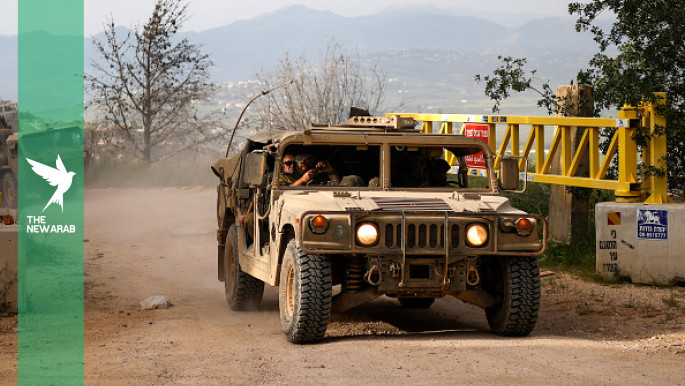
Israeli forces are currently deployed in southern Lebanon, attacking the country despite a ceasefire [Getty/file photo]
The Israeli military has reportedly begun using a new drone system equipped with nets in an effort to intercept Hezbollah drones launched at Israeli forces and at settlements close to the border, as strikes continue to intensify in the country, despite a ceasefire.
The Iron Drone Raider system, manufactured by Aerobotix, is an AI-driven, automated technology that combines a radar with interceptor drones, according to the Israeli newspaper Haaretz.
After detecting a threat, the interceptor is launched and automatically guides itself toward the hostile drone using radar. At this stage, the system can choose between tracking the “enemy” drone or using a net to capture it, according to the paper. A parachute can also be deployed to “gently” bring the captured drone to the ground, reducing the likelihood of it exploding.
The deployment of these new systems comes amid Hezbollah’s use of explosive-laden drones, at least some of which are controlled via fibre optics resistant to conventional electronic warfare techniques.
In recent weeks, such drones have killed and injured a number of Israeli soldiers deployed and fighting in Lebanon, as fighting continues despite the ceasefire agreed upon last month.
Dozens more soldiers have been injured in drone attacks since the start of the latest round of fighting in March.
Several members of the Israeli army have acknowledged that the military was “unprepared” to deal with Hezbollah’s extensive attack drones. One official told Haaretz that the existing counter-drone technology “either cannot sufficiently address the threat” or that it “is not always sufficiently available”.
The issue was addressed by Prime Minister Benjamin Netanyahu on Sunday, and he said he ordered “the establishment of a special project to counter the drone threat” in reference to Hezbollah.
In early April, the Directorate of Research and Development of Weapons and Technological Infrastructure at the Israeli Ministry of Defence issued a call for proposals from developers and companies seeking solutions to counter “fibre-tethered drones”.
Israeli ceasefire violations continue
This comes as Israeli forces continue to violate the ceasefire in Lebanon with a series of attacks on Sunday and Monday.
At least two people were killed by Israeli attacks in the town of Shahour in the Tyre district, the National News Agency (NNA) said on Monday morning.
Israeli warplanes targeted the town of Kafr Tibnit, while artillery shelling was renewed on the towns of Yahmar al-Shaqif, Burj Qalaouiyah, Zawtar al-Sharqiyah, and Zawtar al-Gharbiyah.
The Litani River was also shelled in the outskirts of the town of Buwayda, according to Lebanese media.
The Israeli army also issued evacuation orders for the towns of Qana, Dabaal, Qaqaiyat al-Jisr, and Srifa in southern Lebanon, demanding that they leave their homes and move at least 1000 metres away from them.
The military carried out bombings late on Sunday in the towns of Khiam and Qantara, and shelled the outskirts of the towns of Safad al-Battikh, Yater, Majdal Selem, and al-Shaitiya.
On Sunday evening, the Lebanese Ministry of Health said 20 people were killed in the past 24 hours, bringing the total number of those killed by Israel’s aggression to 2,679.
Lebanon was dragged into the wider Middle East war, triggered by the joint Israeli and US assault on Iran, on 2 March, after Hezbollah fired into Israel in response to the assassination of Iran’s Supreme Leader, Ayatollah Ali Khamenei.
Amid the war, Israeli forces have gone on to establish a “yellow” demarcation line in Lebanon, similar to the one in Gaza, triggering fears of occupation and annexation.
A 10-day, US-brokered ceasefire was announced in Lebanon on 17 April, and was extended for a further three weeks last Monday.
The talks saw Israel and Lebanon engage in direct negotiations for the first time in decades, drawing the ire of Hezbollah.
On Monday, the group’s leader, Naim Qassem, called any further direct negotiations with Israel “a gratuitous concession with no benefits, serving US President Donald Trump and Israeli Prime Minister Benjamin Netanyahu”.
“We support diplomacy that leads to a cessation of aggression and the implementation of the agreement,” Qassem said, who stressed the need for indirect talks instead, which have already “yielded results in the maritime and ceasefire agreements, and preserved Lebanon’s capabilities, which are its right”.
He also stressed that the group will continue “resisting” against Israel, in reference to Hezbollah’s ongoing retaliation against Israeli attacks.
“We are facing a dangerous phase in the history of our region and the future of our country and our generations, in which the enemy is attacking us with the support and direction of the oppressive American tyrant,” he said.