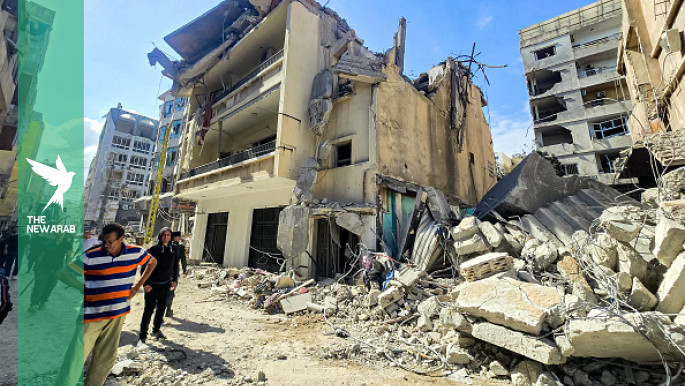
People stand by rubble and debris near damaged and collapsed buildings following overnight Israeli strikes on Tyre [Getty]
Hours after the United States announced a 45-day extension to the Lebanon-Israel ceasefire, Israeli strikes once again pounded southern Lebanon.
The US hosted two days of direct talks this week between Lebanese and Israeli officials, resulting in an agreement to extend the truce and continue negotiations next month.
Washington is pushing parallel political and security tracks, with another meeting scheduled for 2-3 June and US-facilitated military coordination expected to begin at the Pentagon later this month.
Israel’s ambassador to the US, Yechiel Leiter, described the negotiations as “frank and constructive” and said the chances of success were high. Lebanese officials also welcomed the talks as an important step towards protecting the country’s sovereignty and borders and ending the conflict.
Yet even as statements emerged from Washington praising diplomatic progress, Israeli bombs continued to pound southern Lebanon, with Israel claiming it was targeting Hezbollah positions.
Attacks on towns and villages overnight killed and wounded scores of people, while heavy strikes on the coastal city of Tyre on Friday evening damaged several buildings and wounded dozens more. Evacuation orders for villages in the south – much of which has already been forcibly displaced – also continued.
For many in southern Lebanon, the ceasefire exists largely on paper and has been rendered meaningless.
By facilitating diplomatic talks and presenting itself as a broker of regional stability, while failing to restrain Israel, the US is increasingly being seen as uncredible.
On the ground, this has translated to de-escalation rather than a ceasefire. Beirut, its southern suburbs, and other regions have largely been spared, but violence in southern Lebanon persists.
Empty claims
Israel’s continued strikes on south Lebanon have also defied US President Donald Trump’s claims.
Following the first round of direct talks between Lebanon and Israel at the State Department in April, Trump declared that Israel would halt its attacks.
“Israel will not be bombing Lebanon any longer,” Trump wrote on social media on 17 April. “They are PROHIBITED by doing so by the U.S.A. Enough is enough!!!”
A month later, his words ring hollow.
In comments to The New Arab, Lebanese political analyst Karim Bitar said the US cannot be trusted as an honest broker, and pointed to Israel managing to sideline France – a key Western ally of Lebanon – from the diplomatic process.
Bitar drew comparisons to the occupied West Bank, where he points to Trump saying last year that he “will not allow Israel to annex” the Palestinian territory, but a month later, the Israeli parliament voted on the annexation anyway.
The analyst says Lebanon must try to garner more support from its allies for these talks and be careful with reaching a broader peace agreement with Israel, which some Lebanese – particularly the Shia community, still broadly aligned with Hezbollah – would oppose.
Hezbollah has publicly dismissed the significance of the Washington negotiations. Fighting resumed between the Iran-backed militant group and Israel on 2 March in parallel to the US-Israel war on Iran.
Reckless military adventure
Lebanese leaders, including President Joseph Aoun and Prime Minister Nawaf Salam, have continued to defend diplomacy as the only viable path out of the conflict.
They have criticised Hezbollah for taking military matters into its own hands and unilaterally deciding to go to war with Israel
Salam on Friday said his country has had enough “reckless” wars for foreign interests, calling for Arab and international support in Beirut’s negotiations with Israel.
Speaking at an NGO dinner, Salam said that he hoped to “mobilise all Arab and international support to bolster our position in the negotiations” with Israel.
In an implicit rebuke to Hezbollah, Salam said the country had “enough of these reckless adventures serving foreign projects or interests, the latest being a war we did not choose but was forced upon us, which led to Israel occupying 68 towns and villages”.