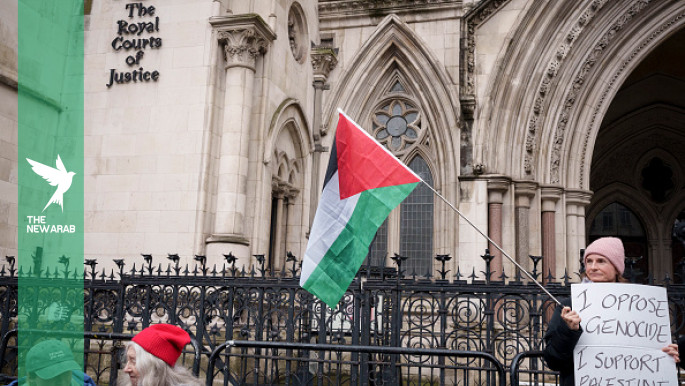
The European Legal Support Centre (ELSC) and the Public Interest Law Centre (PILC) have submitted a legal complaint to the Bar Standards Board [GETTY]
Two legal organisations have filed a complaint against three senior barristers from a prominent pro-Israeli organisation, two of whom are members of the House of Lords, alleging misuse of professional status in a campaign targeting Palestine solidarity organisations and individuals.
The European Legal Support Centre (ELSC) and the Public Interest Law Centre (PILC) have submitted a legal complaint to a legal regulator, the Bar Standards Board (BSB), against senior barristers, Lord David Pannick KC, Lord Anthony Grabiner KC, and Stephen Hockman KC in their role as patrons of UK Lawyers for Israel (UKLFI).
“UKLFI is a key actor in anti-Palestinian repression,” Anna Ost, ELSC’s Senior Legal Officer in Britain, told The New Arab.
The complaint was brought on behalf of a cross-sector coalition including teachers, migrant organisations, student unions, NGOs, healthcare professionals, cultural practitioners and “individuals who have done nothing wrong but express solidarity with the people of Palestine”.
“Those interventions have frequently relied on legal threats and/or the use of professional legal authority in ways that appear designed to chill speech and deter democratic participation,” the PILC told The New Arab.
“It was filed because we believe there are serious regulatory questions about whether senior barristers associated with UK Lawyers for Israel have acted consistently with the professional duties expected of members of the Bar.”
The complainants say UKLFI’s intimidation is part of the wider strategy to erase Palestine from public consciousness.
PILC says the question is whether professional legal status has been used in a manner inconsistent with the ethical obligations that come with it. They contend that where senior legal professionals are involved, regulators have a responsibility to examine that carefully.
“As we continue to provide legal support when possible, our actions in raising these concerns are to ensure that lawfare groups do not misuse the law, or undermine the legal profession, in order to silence lawful expression of solidarity and against genocide,” Ost explained.
“This is about ensuring that those who seek to intimidate people and work to suppress the right for free expression are held accountable.”
Ost explains that UKLFI uses legal authority to issue threats, often to people who lack legal representation or support. When these threats are issued by barristers, they project an authority and seriousness to the threats and create an environment of intimidation to individuals and organisations engaged in lawful advocacy for Palestine.
“Barristers occupy positions of significant authority and public trust in the UK. That professional status should not be used, or appear to be used, to intimidate individuals or organisations engaged in lawful political expression, democratic organising or public advocacy,” she said.
Threats often entail institutional escalation and pressure to withdraw or modify activities.
“Documented cases indicate that legal correspondence of this kind has had direct, tangible effects on individuals across everyday settings,” Ost explained.
Examples include schools halting Gaza-related fundraising or awareness activities, teachers facing disciplinary processes for participation in boycott initiatives outside working hours, and healthcare workers coming under professional scrutiny for expressing grief and condemnation of the situation in Gaza.
“It also extends to museum staff, retail workers, and other public-facing employees being pressured to remove or avoid visible expressions of solidarity with Palestine, including wearing badges or similar symbols,” Ost added.
She said that across sectors, individuals and organisations have had to adjust their conduct in anticipation of the perceived likelihood of challenge, sanction, or institutional consequences from UKLFI.
The two organisations are asking the BCB to determine whether this use of authority is in line with the Bar Standards Board Code of Conduct, including the duties of integrity and independence, and the requirement to maintain public confidence in the profession.
“We hope that the Bar Standards Board (BSB) will open an investigation into the role of UKLFI’s named patrons in granting legal authorities for UKLFI threats and provide guidance as to the suitability of this type of conduct in the context of barristers’ professional standards,” Ost told The New Arab.
“Ultimately, we want to protect those seeking to participate in public life and engage in lawful Palestine-related expression to be able to do so without the suppression these legal threats engender.”
PILC says they hope the complaint helps establish a clear principle that professional legal authority cannot be used to intimidate campaigners, silence civil society organisations, or chill lawful public debate, particularly regarding solidarity with Palestine.
“Confidence in the legal profession depends on the public knowing that legal status and professional privilege will be exercised ethically and not deployed as a tool to suppress democratic participation or freedom of expression,” PILC told The New Arab.
“We believe that UKLFI have been involved in a form of ‘lawfare’ to precisely do that.”
UKLFI has often been accused of intimidating Palestine solidarity campaigners. PILC had filed an earlier complaint to the Solicitors Regulation Authority concerning related issues, suggesting the concerns “are far from isolated”.
“Many organisations and individuals already feel significant pressure when speaking about Palestine,” PILC said.
“It is essential that regulatory bodies ensure professional legal status is not used in ways that deepen that climate of intimidation.”
“No one should feel deterred from public discussion, or community organising on issues of solidarity with Palestine because of the status or influence of those threatening legal action.”