
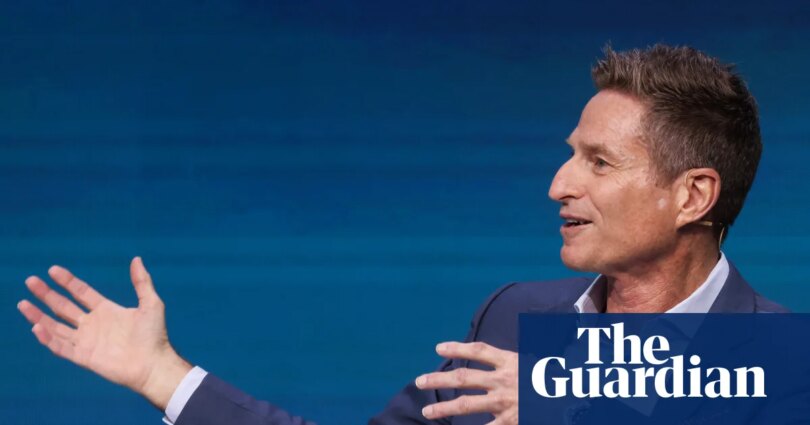
Lockheed Martin’s CEO has called the Trump administration a “golden opportunity” for the company as it expands its contracting work for the federal government amid the conflict in the Middle East.
In an earnings call on Thursday covering the first quarter of 2026, Lockheed Martin CEO Jim Taiclet told investors that the company is well positioned “based on more available resources for us”.
“This is a golden opportunity right now based on who’s in government,” Taiclet said, citing “their experience, their willingness to change, the demand that they have for what we do and what our partners in our industry do”.
He added that the company can move past the “burden” that came with government contracting and move it “towards a commercial contracting system”.
“I’m encouraged by all of this in the evolving landscape,” Taiclet said.
Lockheed Martin’s relationship with the US government spans from producing the Orion spacecraft for the Artemis II mission to manufacturing top-secret missiles that have been used in the conflict with Iran.
Since the start of the Iran conflict, the Pentagon has announced multiple contracts with the defense engineering company worth billions of dollars, on top of the existing contracts the government has with the company.
Earlier this month, the Pentagon announced two massive contracts with the company: first, a $4.7bn contract to accelerate production of its Pac-3 missile segment enhancement interceptors, followed by a $1.9bn contract to continue its C-0130J maintenance and aircrew training systems used to train members of the military.
Though the company missed profit expectations for the first quarter due to lower volumes in its F-16 fighter jet program and other classified programs, the company still reported revenue of $18bn, similar to the first quarter of 2025.
Lockheed Martin leaders told investors that a highlight for the company is the “real constructive engagement” between the company and the Pentagon that has allowed the company to build out a “more commercial-like business model for major weapons systems”.
“It really hasn’t been done before, and that’s because the leadership of the department at this point is willing to engage in topics such as risk mitigation,” Taiclet said.
For defense contractors like Lockheed Martin, scaling up production can come with high risks if, for example, the government terminates an order. But Taiclet told investors that the Pentagon has added a “recovery element” to its contracts with Lockheed Martin that would allow the company to receive payment even if a contract is eventually changed.
“If for whatever reason the government decides the production rate won’t be as high in year five, six, whatever, or there’s a change in Congress that changes that nature of how this agreement can actually be appropriated,” Taiclet said. “We will not be harmed by that.”
The White House has been trying to get Congress to pass its requested $1.5tn budget for the Pentagon, which would be a $445bn increase from last year. The proposal doesn’t mention any money for the war with Iran, which Republicans are trying to fund using a budget reconciliation legislation that would allow them to bypass Democratic buy-in.
To offset the higher defense budget, the Trump administration has proposed cutting $73bn in domestic agencies that support key housing, health and education programs. At a private lunch last month, Trump reportedly said that the government’s spending focus should be on “military protection”, according to the New York Times.
“It’s not possible for us to take care of daycare, Medicaid, Medicare, all of these individual things,” he said. “They can do it on a state basis.”