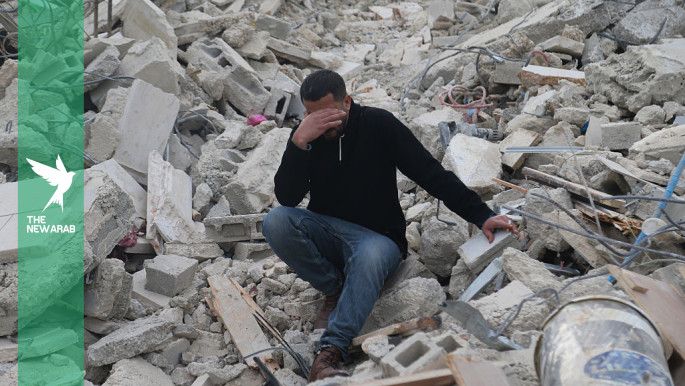
Israeli forces demolish a three-story Palestinian-owned house in the town of Tarqumiya, northwest of Hebron, West Bank on February 1, 2026. [GETTY]
On Sunday 14 June, the “Great Israeli Real Estate Event” is scheduled to arrive in London. Its promotional language will be familiar: investment opportunities, property portfolios and international buyers. Behind that respectable vocabulary lies a harsher reality. Palestinian land is being marketed abroad while Palestinians remain displaced, occupied, besieged and exiled.
Among the areas reportedly promoted is Gush Etzion, a settlement bloc in the occupied West Bank. Its inclusion gives the British government an immediate legal basis to act: successive governments have recognised Israeli settlements in occupied Palestinian territory as illegal under international law. Ministers cannot speak of a rules-based international order while allowing London to host the commercial promotion of property in places Britain itself regards as unlawful.
But the issue is not confined to settlement illegality. Palestinians are being asked to watch land from which their families were expelled, or to which they are denied access and return, converted into an investment opportunity for others.
For Palestinians in Britain, these places are not abstract locations on a sales brochure. They are towns and homes preserved in family memory. Their sale in London makes clear that dispossession is not confined to the past; it is reproduced through the language and machinery of private investment.
A property fair built on displacement
The Palestinian Youth Movement (PYM) launched the Stop Stolen Land Sales campaign because this event belongs to a longer history through which Palestinian land has been taken from its people, legally reorganised, politically normalised and offered to others as a commodity.
Through its campaign, PYM Britain has refused to let this event be treated as an ordinary property fair. By calling for public pressure through tactics like a digital day of action, advocating for MPs to condemn the event and call for its cancellation, and coordinating civil society and legal actions, the campaign identifies the sale of Palestinian land abroad as part of the same structure that denies Palestinians freedom and return.
It names what the language of “real estate” tries to conceal: that these are stolen land sales, made possible by occupation, expulsion and the displacement of Palestinians from their own homes. For this reason, if the event on Sunday is not cancelled, the campaign has committed to mobilising against it.
For more than a century, Palestinian land has been transformed into the material basis of a political project that has required Palestinian removal. Land acquisition, colonial administration, settlement-building, expulsion and exclusion are connected stages in the making of Palestinian absence.
Britain helped shape that history. The Balfour Declaration and the Mandate created conditions in which Zionist settlement could expand, and Palestinian opposition could be suppressed. British power protected a political order that privileged Zionist colonisation and collaborated with Zionist militias against Palestinian resistance to dispossession.
The 1936–39 Palestinian revolt was a mass uprising against land loss, colonial rule and the imposition of a political future that systematically excluded the people of the land.
After 1948, dispossession was institutionalised. The new Israeli settler state developed legal mechanisms that stripped displaced Palestinians of property rights, prevented refugees from returning and transferred vast areas of land into systems designed to preserve Zionist control.
That condition remains visible today. A Jewish person from Britain, the United States or France may be encouraged to buy property, move to Israel or a settlement, obtain citizenship and live under the protection of a state built to include them. A Palestinian refugee in Lebanon, Syria or Jordan, whose family may have been expelled from that same town or village, is denied return.
A Palestinian in Gaza may live under siege, only miles from land their family once owned. A Palestinian in the West Bank may face checkpoints, military raids and settler violence while nearby settlements are advertised abroad as desirable real estate.
This is the obscenity at the centre of the London event. The land is marketed as available because Palestinians have been made absent from it. The property brochure depends on the refugee camp. The investment opportunity depends on the demolished home, the confiscated field, the erased village and the legal order that keeps Palestinians from returning.
The issue does not stop at settlements
The inclusion of Gush Etzion raises an urgent legal question. Britain’s position on settlements is clear enough to require action. Yet the Palestinian objection reaches beyond the West Bank settlement enterprise.
For Palestinians, the geography of dispossession is not divided neatly between 1948 and 1967. Gaza and the West Bank are intrinsically linked to all of Palestine, to the surrounding region and to the refugee camps in Jordan, Lebanon and Syria.
The sale of land aims to fracture Palestinian unity, and the language of “real estate” seeks to obscure theft as investment. It turns homes into assets, exile into a marketing opportunity and Palestinian absence into a commercial opening. It asks buyers to see investment potential where Palestinians see expulsion, siege, occupation and the unfinished struggle for return.
Arab youth in the diaspora occupy a particular political position to challenge this. Many of us live in countries whose governments have helped sustain the political, military and legal conditions of imperialist violence in the region that led to our dispossession. We are not spectators to what happens in Palestine and across the region; we are positioned inside the states, institutions and markets that help make it possible.
To organise here is to take an important front in the Palestinian national liberation struggle by confronting the very systems that profit from Palestinian absence.
For Arab youth in Britain, opposing this event is also a refusal of enforced silence. We are often expected to treat Palestine as a private wound rather than a public political cause. But when stolen land is advertised in London, grief is not enough. We have a duty to expose the companies involved, pressure venues and MPs, mobilise our communities and make clear that dispossession will not be normalised here in Britain. Our right of return depends on it.
Palestinian land is being marketed in the country whose imperial policy helped make Palestinian dispossession possible.
If this event proceeds, Britain will once again be continuing its role in Palestinian dispossession: recognising Palestinian rights in speeches while allowing markets built on their denial to operate in practice. Venues, sponsors, estate agents, legal advisers and community institutions should understand that participation means helping make dispossession acceptable, respectable and profitable.
This campaign draws a clear line: stolen Palestinian land must not be sold in our communities. For Palestinians in Britain, exile cannot be reduced to an administrative detail in someone else’s investment portfolio. London must not help turn dispossession into an investment opportunity.
Tamara Alfarisi is a freelance writer and journalist covering culture, migration, and human rights in the Middle East and North Africa. She is also an organiser with the Palestine youth movement.
Have questions or comments? Email us at: editorial-english@newarab.com
Opinions expressed in this article remain those of the author and do not necessarily represent those of The New Arab, its editorial board or staff.