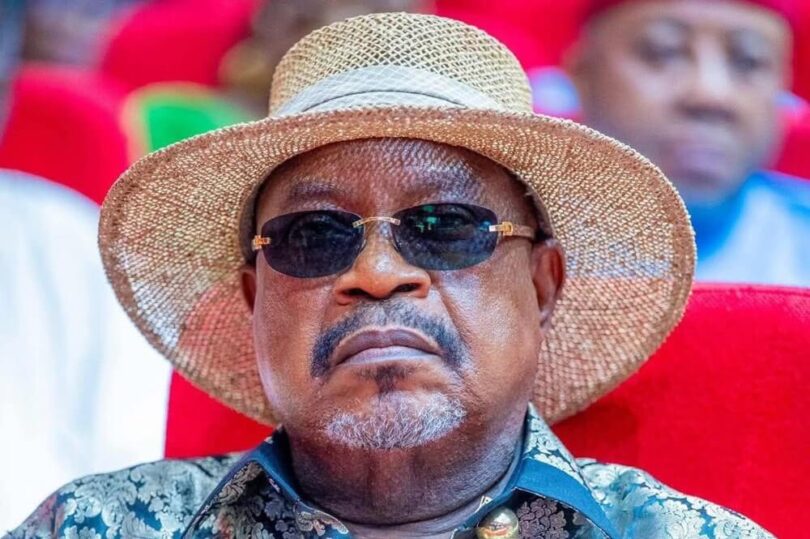
The Labour Party candidate for Abia North Senatorial District, Chief David Onuoha, popularly known as Bourdex, has proposed using surveillance systems, improved communication networks and community intelligence to tackle insecurity in the senatorial district.
Onuoha, who spoke on Magic 102.5 FM, Aba, monitored by THE WHISTLER on Tuesday, said the changing nature of crime requires security agencies to have faster access to information and better communication systems.
He said surveillance could be deployed at major entry and exit routes, junctions, transport corridors and other identified vulnerable areas, rather than indiscriminate installations across communities.
“The criminal environment has changed. Crime has become more mobile. And in many instances, more technologically enabled. Unfortunately, some of our methods of responding to crime have not changed at the same speed,” he said.
Onuoha believes technology could shorten the time between the occurrence of an incident, reporting the incident and the response by security personnel.
“Technology can provide additional eyes. It can provide additional ears. And perhaps most importantly, it can provide information quickly,” he said.
“Technology does not arrest criminals. Professional security agencies do. Technology does not conduct lawful investigation by itself. Technology does not prosecute anybody.”
According to him, the effectiveness of surveillance and communication infrastructure would depend on how information is collected, transmitted, protected and acted upon.
He said security planning should extend beyond urban centres to rural communities, where local knowledge and the understanding of terrain, movement patterns and access routes could help prevent and respond to crime.
He recalled his experience connecting his village, Abiriba, to Bourdex Telecom.
“There was a time when providing modern telecommunications services in many parts of Nigeria was considered extremely difficult. People looked at some rural communities and concluded that there was no commercial justification for extending modern communications there. But technology kept changing,” he said.
“Nobody is suggesting that we put expensive equipment on every tree in Abia North. That would make no sense. You begin strategically.”
Onuoha noted that installing cameras without an operational system for monitoring and responding to the information they generate would amount to wasting public resources.
He also said traditional rulers, town union leaders, village leaders and other community figures had roles to play because technology could not replace local knowledge.
According to him, residents often understood local roads, footpaths, farms, forests and normal movement patterns better than people outside the communities.
Onuoha, however, warned against turning community intelligence into unlawful enforcement.
“We do not want jungle justice. We do not want private armies. We do not want political talks masquerading as security personnel. And we certainly do not want innocent people victimized because somebody has a personal disagreement with them,” he warned.
He proposed a system in which technology, community intelligence and professional law enforcement operate through defined channels.
He said information should be reported to designated authorities, verified and handled in ways that protect innocent citizens from abuse.
The candidate also raised concerns about the possible misuse of surveillance technology by government authorities, saying security measures should include safeguards for citizens’ privacy and rights.
“If people believe security infrastructure is being used to settle political or personnel scores, public confidence collapses,” he stated.
On cybercrime and online fraud, Onuoha said the challenges had expanded as more economic and government activities moved online.
He urged residents to practise basic digital safety, including protecting passwords, avoiding suspicious links, verifying unusual financial requests and being cautious about information shared online.
“The same Internet that somebody can misuse for fraud can enable a young entrepreneur in Abyanoz to build a legitimate business and sell services around the world,” he noted.
The candidate said his telecommunications background had shaped his approach to security, particularly in relation to infrastructure, reliability and maintenance.
“I’m interested in architecture. I’m interested in reliability and maintenance. I’m interested in what happens at 2 o’clock in the morning when there are no cameras from television stations watching the projects. Does the system still work? That is the test,” he said.
Bourdex is seeking to unseat former Abia State governor Orji Uzor Kalu, who has represented Abia North in the Senate since 2019.
He urged residents to examine the records and proposals of candidates seeking their votes.
He also criticised Kalu over past comments about people in the South-East, saying a senator should distinguish criminals from innocent citizens and defend due process when addressing security issues.
“A representative must never casually stigmatize the people he represents,” he stated.
He urged voters to consider what kind of representation they wanted from Abia North and whether candidates could articulate the concerns of their communities.
“The mandate of the people is not a meal ticket. It is a sacred responsibility,” the aspirant stated.