During the visits, Dapo Olorunyomi, chief executive officer of CJID and publisher of PREMIUM TIMES, highlighted the impact of the organisations’ support on investigative journalism, fact-checking, press freedom and efforts to hold technology platforms accountable.
The MacArthur Foundation has reaffirmed its commitment to supporting accountability journalism and digital accountability in Nigeria. The leadership of the foundation stated this during a visit to the offices of the Centre for Journalism Innovation and Development (CJID) and PREMIUM TIMES in Abuja on Friday.
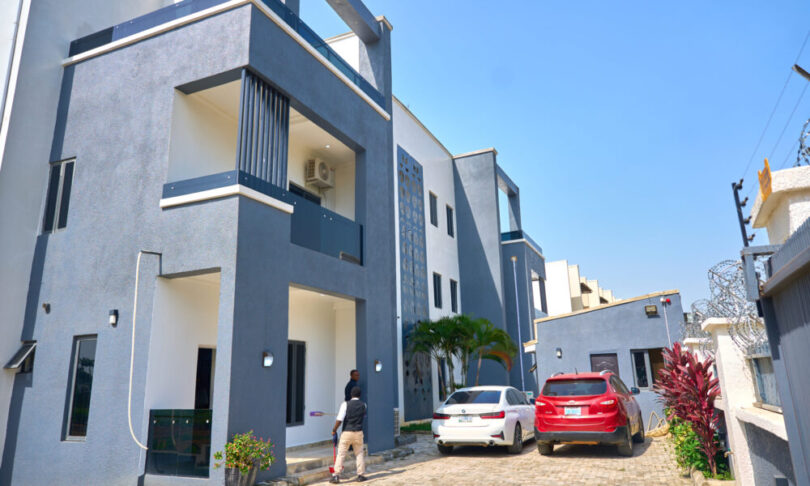
The MacArthur Foundation delegation also officially opened CJID and PREMIUM TIMES’ head offices in Nigeria.
Speaking during the MacArthur Foundation’s visit, Mr Olorunyomi said the foundation’s support had helped build CJID’s capacity since its establishment in 2014, when it was known as the Premium Times Centre for Investigative Journalism.
“MacArthur believed in us in 2014, the year we were founded, when we were still the Premium Times Centre for Investigative Journalism, a small team beside a young newsroom, trying to report on the 2015 elections, on human rights abuses and on the money committed to the war against insurgency,” he said.
He said the foundation’s subsequent support helped establish DUBAWA, a fact-checking platform, and UDEME, a civic technology initiative that enables journalists and citizens to track public spending.
“Those two ideas became DUBAWA and UDEME. Everything that has grown from them since, from our verification work and AI tools to our budget tracking, our press freedom work and the young journalists we train, carries the mark of that early faith,” he said.
Mr Olorunyomi cited UDEME’s reporting on an abandoned general hospital in Ukanafun Local Government Area of Akwa Ibom State as an example of how sustained investigative journalism can contribute to public accountability.
He said the hospital, which successive governments had left unfinished for about 20 years, was commissioned in November 2025, giving the community its first functioning general hospital.
“Somewhere in that story are the young reporters of UDEME, who kept going back to that building and kept asking where the money had gone, long after everyone else had stopped asking. And somewhere further back in the same story is the MacArthur Foundation,” he said.
Mr Olorunyomi said the foundation’s support had also contributed to legal action to protect press freedom. He recalled that CJID joined the Socio-Economic Rights and Accountability Project (SERAP) to challenge fines imposed on four broadcasters over a documentary about banditry in Zamfara State.
In June 2024, he said, the Federal High Court set aside the fines, ruling that the broadcast regulator could not sanction independent media on its own authority.
The foundation also supported initiatives to improve the sustainability of local newsrooms and train young journalists, including the Campus Reporter programme, which he said had expanded from 15 Nigerian universities to 49 institutions across six countries.
Mr Olorunyomi said the opening of the new office represented the centre’s commitment to sustaining its work beyond individual grants.
“When the On Nigeria programme came to an end, many people expected organisations like ours to shrink. We chose instead to put down roots,” he said. “This building is about permanence, not size. It is our way of saying that the institution you helped to raise intends to stay here and keep doing this work, long after any single grant has closed.”
He said CJID was preparing for emerging threats to public information ahead of Nigeria’s 2027 general elections, including synthetic media and coordinated influence operations.
The centre is also digitising historical records of the Nigerian press, with more than 13,000 newspaper pages processed so far, and aims to train 10,000 young Africans in artificial intelligence, digital technology and media technology by 2030, he said.
In his remarks, the MacArthur Foundation President, John Palfrey, said the organisation has been very proud to support the work of CJID over the years. “Our support has exceeded $6 million. Anywhere in the world, that represents a substantial investment by our foundation in a single organisation,” Mr Palfrey said.
“It demonstrates that we believe in what you are doing and recognise its profound importance to the values we uphold around the world. At the MacArthur Foundation, we consider our mission to be the advancement of justice, vibrancy and peace around the world. I believe all these values are represented as we walk through your building.”
He noted that the new office would represent several things beyond being a physical building. It is a facility and a studio where stories are produced. “We also see it as a boardroom where partnerships are forged. You have told us about the incredibly important work of connecting with INEC and television networks,” he said.
“Ultimately, I love the idea that you are recording the first draft of history, ensuring that events are documented and that we do not forget them. We know that the arc of history does not always bend towards justice. Sometimes, we need reminders of that, and your work helps ensure that we are continually reminded.
“We also understood that this building would provide workspaces, and it is wonderful to see every seat filled, alongside the talent being developed here and the talent that is already present. Fundamentally, I believe this is a strong sign that a civic organisation such as yours can build resilience, both within itself and across the broader Nigerian society,” Mr Palfrey said.
Also speaking at the event, Supreme Court Justice Olubunmi Oyewole commended MacArthur’s support for judicial reforms in Nigeria, including the legislation of the Administration of Criminal Justice Act, which has strengthened criminal justice in the country.
Mr Oyewole also commended CJID and PREMIUM TIMES for staying true to accountability journalism and advocacy.