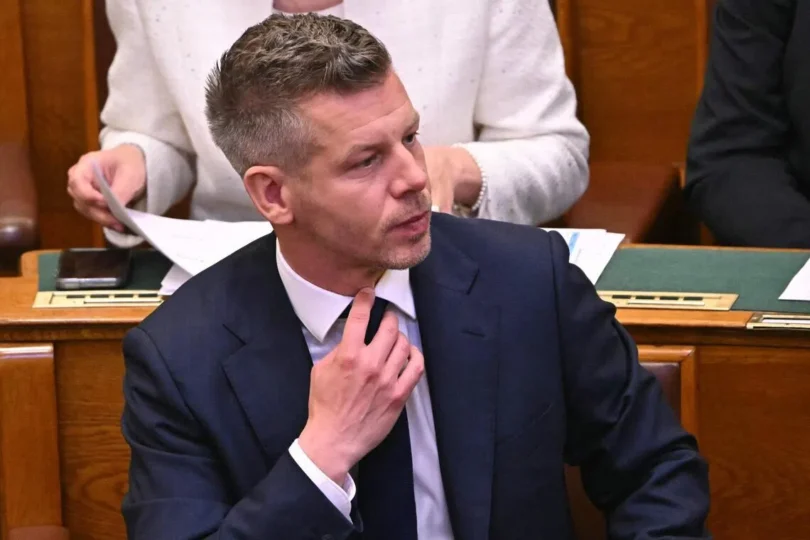
BUDAPEST – Pro-European conservative Peter Magyar arrived at Hungary’s Parliament on the morning of May 9 to be sworn in as prime minister, on a promise of “regime change” after nationalist Viktor Orban’s 16 years in power.
The former government insider-turned-critic scored a landslide victory in April, pledging wide-ranging reforms to fight corruption.
Hungarian President Tamas Sulyok opened the session, welcoming lawmakers elected in the April 12 general election, who are set to vote in the afternoon to appoint Mr Magyar as head of government.
Outside, hundreds of people gathered to watch the ceremony on large screens set up around the building overlooking the Danube.
“I had never experienced this joy, this friendly atmosphere before, because you can see that most people wanted this,” Ms Anna Horvath, a 66-year-old retiree, told AFP, adding she hopes for an end to corruption, the return of freedoms, and for Hungary to reclaim its place within the European Union.
Mr Magyar, 45, also wants to undo changes Mr Orban – who fostered close ties with US President Donald Trump and Russian President Vladimir Putin – made to institutions to control the judiciary, media, academia and other sectors.
Mr Magyar’s Tisza party won 141 of Parliament’s 199 seats in the April 12 polls, a comfortable two-thirds majority enabling it to change the constitution and push through key reforms.
As one of his most urgent tasks, Mr Magyar is trying to unlock billions of euros in EU funds locked by Brussels over rule-of-law concerns.
Lawmakers are set to elect Mr Magyar as prime minister in the afternoon, at around 2.30pm (1230 GMT), and he is then expected to address supporters outside Parliament.
Last week, Mr Magyar met European Commission chief Ursula von der Leyen for talks.
Hungary faces serious challenges, including a stagnating economy and falling public services, which analysts say need long-term structural reorganisation.
“There is a lot of patience and goodwill toward the new government, but the expectations are through the roof and need to be met in the short-term as well,” Ms Andrea Virag, director of strategy at the liberal Republikon Institute think tank, told AFP.
Mr Magyar has urged the president and other Orban allies to resign as part of his “regime change”. He has also called on the authorities to stop Mr Orban’s associates from moving capital abroad.
Mr Orban said in April that he would not sit in Parliament – giving up the seat he won – for the first time since the country’s democratisation in 1990.
The 62-year-old, who aimed to turn the country of 9.5 million into a model of “illiberal democracy” and widely restricted rights, has said he would focus on the “reorganisation of the national camp”.
On May 9, lawmakers are set to elect hotelier Agnes Forsthoffer as Parliament speaker, one of the many women Tisza has tapped for senior roles.
As the new ruling party pushes to deliver a more diverse representation than Mr Orban’s coalition, nominations also include lawyer Vilmos Katai-Nemeth as social and family affairs minister – Hungary’s first‑ever visually impaired minister. Roma history teacher Krisztian Koszegiwould become deputy parliament speaker.
The festivities on May 9 outside and inside Parliament are laden with symbolism, featuring flags and music that pays tribute to Hungary’s EU membership, its sizeable Roma minority and ethnic Hungarians in neighbouring countries.
“Magyar seeks to show that he represents a form of national unity and reconciliation after Orban’s politics of division,” Ms Virag said.
“With the festivities he also wants to show that it was not a mere change of government, but a start of a new era,” she added.
Left‑of‑centre and liberal parties will be absent from Parliament for the first time since 1990. AFP