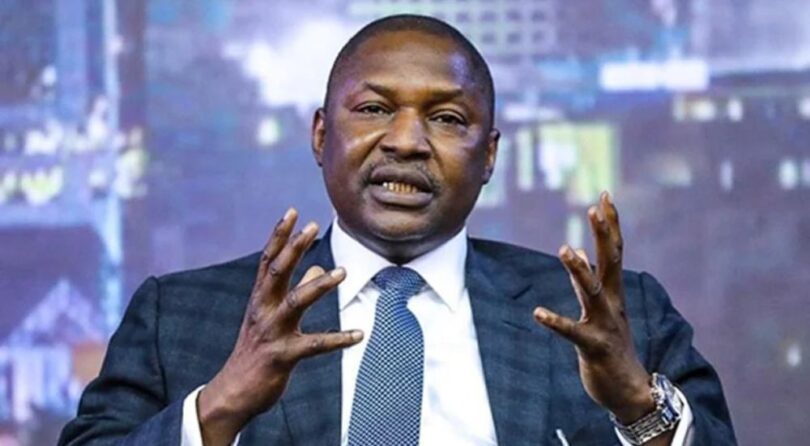
Former Attorney-General of the Federation (AGF), Abubakar Malami, has defended the controversial $200 million settlement agreement reached with Sunrise Power over the Mambilla hydropower project, insisting that the deal was negotiated in Nigeria’s interest and was not motivated by any promise of personal financial gain.
Malami’s defence comes days after an International Chamber of Commerce (ICC) tribunal in Paris found that the settlement agreement and a subsequent addendum were products of corruption and therefore unenforceable.
The tribunal also concluded that Malami and Leno Adesanya, promoter of Sunrise Power, had a common intention to secure a settlement favourable to the company at Nigeria’s expense.
However, in a statement issued on Tuesday by his media aide, Mohammed Bello Doka, Malami rejected the allegation that he entered into a corrupt arrangement with Adesanya.
“Malami rejects any suggestion that his official actions were undertaken pursuant to a corrupt agreement or in exchange for personal financial benefit,” the statement said.
Malami argued that the dispute over the Mambilla project predated his tenure as AGF and had persisted through several administrations, attorneys-general and ministries.
According to him, the Federal Government was faced with claims running into billions of dollars from Sunrise while the prolonged dispute had also become an obstacle to efforts to finance and develop the Mambilla hydropower project.
“The governmental calculation was whether an asserted multibillion-dollar exposure, continuing litigation, financing difficulties and delays to the Mambilla project could be brought to an end through a substantially smaller negotiated settlement,” Malami said.
He maintained that the $200 million settlement was therefore considered against the backdrop of the much larger financial claims being pursued by Sunrise.
The former AGF also pointed to the fact that the settlement money was never paid to Sunrise after then-President Muhammadu Buhari declined to approve the arrangement.
The ICC tribunal, in its 616-page final award issued on September 16, found that Malami and then Minister of Power, Saleh Mamman, signed the January 2020 settlement and a March 2020 addendum without obtaining presidential approval.
Under the original settlement, Nigeria was to pay Sunrise $200 million. The subsequent addendum split the payment into two $100 million instalments and exposed the country to an additional $200 million default liability, apart from interest.
The tribunal said the revised terms significantly worsened Nigeria’s position, potentially increasing the country’s exposure to $400 million plus interest.
It further found that Malami had acted against Nigeria’s interests and had maintained an inappropriate relationship with Adesanya during the negotiations.
Adesanya had testified that Malami and Mamman demanded that he give them 50 percent of the settlement as a bribe. He claimed he had audio and video recordings of the alleged conversations but refused to produce them before the tribunal, citing concerns for his safety and that of his family.
The tribunal nevertheless concluded that a corrupt deal had been reached between Malami and Adesanya, finding that the former AGF was promised a share of the settlement money payable to Sunrise.
Malami, however, questioned the evidentiary basis of the allegation, particularly the recordings which Adesanya claimed to possess but did not submit.
“The existence, non-production, authenticity and contents of Adesanya’s recordings are matters of obvious evidentiary importance,” he said.
He also stressed that there was no evidence that he received money from Sunrise, Adesanya or any entity connected to the company.
“One obvious factual question is whether any money or other financial benefit from Sunrise, Adesanya or any connected entity was ever received by Malami pursuant to the alleged arrangement,” he said.
Malami further argued that the ICC proceedings were commercial arbitration and should not be portrayed as a criminal trial or conviction against him.
“The proceedings were commercial arbitration proceedings between parties to a dispute. They were not a criminal prosecution of Abubakar Malami, SAN, and the award does not constitute a criminal conviction of him,” his statement said.
He also complained that he was not a party to the arbitration and was not given an opportunity to present his side directly before the tribunal.
The tribunal had criticised Malami for refusing to appear for oral examination during the proceedings after submitting a witness statement.
Malami said he would provide a comprehensive response to the tribunal’s findings after reviewing the complete 616-page award and the underlying documentary evidence.
Despite the tribunal’s findings concerning the settlement, it dismissed Sunrise Power’s claims against Nigeria and ordered the company and Adesanya to reimburse Nigeria $11.82 million in legal fees and $414,125 in arbitration costs.
The Mambilla dispute dates back more than two decades and centres on a proposed 3,050-megawatt hydropower project in Taraba State. Sunrise had pursued billions of dollars in claims against Nigeria over the project before the dispute resulted in the controversial 2020 settlement arrangement.
Malami said Nigeria’s victory in the arbitration and its protection from substantial financial exposure was an outcome that Nigerians should welcome.
He maintained that the circumstances surrounding the settlement should be assessed against the full documentary and evidentiary record rather than isolated portions of the tribunal’s award.