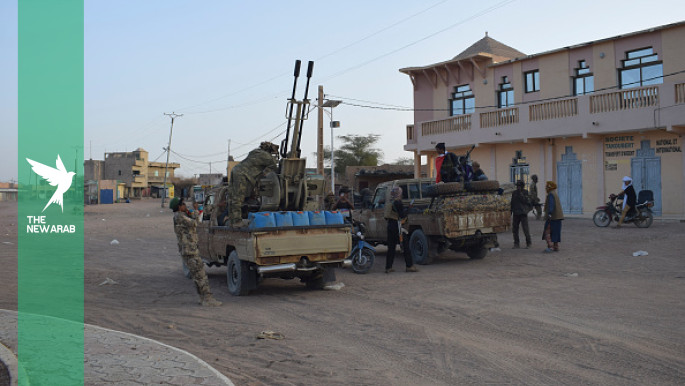
Mali is witnessing a strong expansion of extremist organisations in the Sahel region, where influence is divided between Al-Qaeda and ISIS. [Getty]
The latest attack in Mali, carried out by the Azawad Liberation Front in coordination with “Jama’at Nusrat Al-Islam wal-Muslimeen” affiliated with Al-Qaeda (JNIM), calls for a reassessment of the nature of the groups active in the country. Mali is witnessing a strong expansion of extremist organisations in the Sahel region, where influence is divided between Al-Qaeda and ISIS.
The Malian arena has long been crowded with armed political organisations of multiple references and demands. Some are linked to tribal and ethnic representation.
Others are based on regional and ethnic Tuareg factors, tied to the demands of the northern region that has rebelled against central authority in Bamako since 1963.
In recent decades, additional groups with a hardline jihadist dimension have emerged. They are characterised by geographic mobility, as they incorporate members from different countries.
Eight organisations have continued to play a role in shaping developments in Mali and its instability to this day.
Azawad movements in Mali
Before 2024, northern Mali included four Azawadi political and armed movements representing the northern region near Algeria. The population is majority Tuareg, alongside Arab and Fulani communities.
These movements were the National Movement for the Liberation of Azawad, the Imghad and Allies Self-Defence Group, the High Council for the Unity of Azawad, and the Arab Movement of Azawad.
These movements engaged in periods of confrontation with the central government in Mali until the signing of the Algiers Peace Agreement in 2015. All participated in the political and integration process.
However, the military coup in Bamako in May 2021 and the direction taken by the transitional authority marked a turning point.
In September 2023, the authorities cancelled the Algiers Peace Agreement. They also sought to impose central control over northern cities and relied on the Russian “Wagner” group.
This pushed the four Azawad movements to take a decisive step on 30 November 2024. They announced their dissolution and the creation of a unified political-military entity called “Azawad Liberation Front”.
The new entity operates under a single political and military leadership and banner.
This took place during a conference held between 26 and 30 November 2024 in the Tin Zaouatine area near the Algerian-Malian border.
Prominent Azawadi leaders attended, including Bilal Ag Cherif, Mohamed Ould Ramadan, Abbas Ag Intalla and Mahfouz Ag Adnan.
Participants also included cadres educated in Algeria, Mauritania, France and Britain.
The front declared itself “the sole legitimate representative of the Azawad people”.
The unification of the movements into a single front and the merger of all armed brigades under the banner of the “Unified Azawad Army” enabled a series of confrontations with Malian army forces and “Wagner”.
This was particularly evident in the April 2025 battle.
The front then began preparing for the large-scale attack it launched last Saturday, 25 April. This allowed it to regain control of northern cities and return to the pre-2023 situation.
The front maintains close relations with Algeria, which treats it as a key party in any political process in Mali.
These movements adopt a progressive reference within a conservative framework, taking into account the nature of local society in the Azawad regions.
Before 2024, these movements demanded local governance mechanisms within the Malian state. After unification, they shifted their central demand to full secession and the establishment of the state of Azawad. They also designed their own flag.
Transnational groups
On the other side of the Malian landscape stands another armed organisation. It excludes geographic and regional dimensions but operates transnationally in line with hardline groups.
It seeks to establish what it describes as a “state of sharia”.
This is “Jama’at Ansar Al-Islam wAl-Muslimeen”, formed in March 2017 from an alliance of four extremist organisations.
These include the “Al-Mourabitoun” battalion, based in the Gao region and considered among the most violent groups. Its leaders include Al-Hassan Al-Ansari and Abdul Rahman Al-Mauritani.
It was responsible for the attack on the Tiguentourine gas facility in Illizi in southern Algeria in January 2013. It also carried out the kidnapping of seven Algerian diplomats from the Gao consulate in northern Mali in 2012.
Another component is the Sahara Emirate brigade affiliated with “Al-Qaeda in the Islamic Maghreb”. It is active along the borders of Niger, Mali and Algeria. Yahya Abu Al-Hammam and the group judge Abdul Rahman Al-Sanhaji led it.
The alliance also includes the “Macina brigades”, an ethnic base for the Fulani community in northern Mali, led by Malian Mohamed Koufa.
These organisations pledged allegiance to the former Al-Qaeda leader Ayman Al-Zawahiri and the leader of “Al-Qaeda in the Islamic Maghreb”, Abu Musab Abdel Wadoud, who was killed by French forces in June 2020.
Iyad Ag Ghali was endorsed as head of the organisation. He is a rebel political figure who led the Tuareg uprising in Kidal, northern Mali, between 1990 and 1995. After a peace agreement, he worked as a Malian diplomat in Jeddah, Saudi Arabia, between 2005 and 2008.
He later returned to northern Mali and established the hardline “Ansar Al-Din” group, which advocates the implementation of sharia.
He then allied with other groups close to “Al-Qaeda”. In March 2020, he announced his willingness to engage in dialogue and negotiations with the Malian government. However, he returned to confrontation after the May 2021 coup.
In the latest attack, the Azawad Front acknowledged field coordination with “Jama’at Nusrat Al-Islam wal-Muslimeen”.
Azawad Front leader Mahfouz Ag Adnan told The New Arab that “this coordination is not only linked to sharing the same objective, which is to overthrow the regime in Bamako, but also because most members of ‘Nusrat Al-Islam’ come from northern Mali and from the same Azawadi, Arab and other tribes, and their regions have been subjected to the same practices by the Malian army”.
In addition to these two blocs of organisations that have merged into central alliances, a political alliance has emerged. This is the “Forces for the Republic of Mali” coalition.
It includes opposition figures abroad, among them Imam Mahmoud Dicko, based in Algeria. He is considered the most influential figure in the Malian arena and led street protests before the May 2021 coup.
The coalition was announced in December 2025 and holds notable political and popular weight. It calls for the overthrow of the military-led transitional authority, which had announced the suspension of all political parties.
It also calls for the opening of a civilian republican transitional phase. It seeks the restoration of state legitimacy and the rebuilding of the army within a republican framework.
It further calls for a comprehensive national dialogue to restore constitutional order and rebuild the state on the basis of national unity.
This map shows that all these organisations converge on one point: the overthrow of the current regime. However, they differ significantly in their ultimate objectives.
The “Forces for the Republic” coalition presents itself as an alternative to the transitional authority within the unity of the Malian territory.
By contrast, the Azawad movements adopt a secessionist demand.
Meanwhile, “Ansar Al-Muslimeen” seeks to establish an Islamic state, applying sharia across Mali.
Its constituent groups previously attempted to build this model after taking control of northern cities such as Gao and Kidal in March 2012.
Some observers say all these organisations remain open to political containment if favourable conditions emerge.
They point to the possibility of a Malian-Malian dialogue that would restore peace arrangements and stability in northern Mali, in particular, with regional and international support.
Article translated from Arabic by Afrah Almatwari. To read the original, click here.