
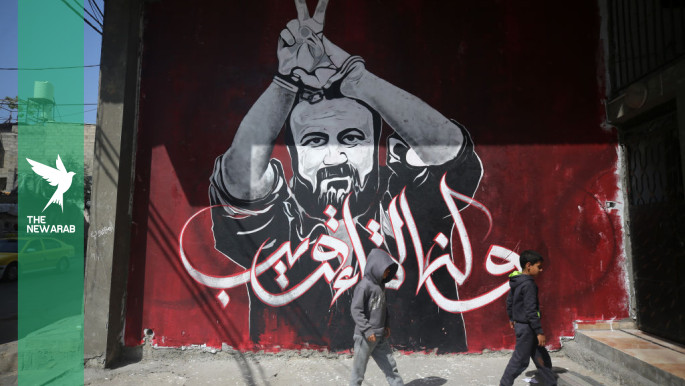
Marwan Barghouti is a Palestinian political leader that has been imprisoned for the last 20 years [Getty]
Did you know that Marwan Barghouti supports Brazil with all his heart at every World Cup? Did you know, too, that he is a devoted Real Madrid fan?
Let me tell you something about the human side of Marwan: the child in him who never stopped loving football.
In 2018, inside Hadarim Prison, Israeli authorities placed Marwan in solitary confinement specifically to prevent him from watching the World Cup and cheering for his beloved Brazil. Imagine, then, what his reaction would be if Palestine were to take part in the World Cup today.
But now Marwan does not know when this year’s World Cup begins. He does not know whether his favourite team, after Palestine, of course, is playing. He does not know where the tournament is being held, or even who is taking part in this global event that means so much to so many nations.
Marwan is a devoted football fan. Watching the World Cup seemed to return him to his innocent, mischievous childhood. His laughter would echo through the corners of the prison every time his team won or scored.
The Israeli occupation’s assault on Palestinian and Arab prisoners continues even in these small, intimate details. It continues in the way this Zionist colonial apartheid system insists on tearing Marwan away from the joy of following his favourite team, Brazil, in the World Cup.
Yes, the occupation reveals itself in the smallest and most invisible details. It lies in Israel’s obsession with controlling every aspect of a Palestinian’s life, including the simple possibility of living quietly, normally, and with a little joy.
All Marwan Barghouti wants, even in prison, is to preserve his humanity and vitality through football, even as he remains a leader of the Palestinian people.
I was with him in the Israeli apartheid prisons. I witnessed his joy, his childlike happiness, whenever his favourite team won.
I heard his voice fill the prison walls. I heard it burst through the cell windows every time his team scored. At times, I felt that Marwan’s laughter inside the Israeli occupation prisons was itself a victory, not only for him, and not only for us as prisoners, but for humanity as a whole.
What is he facing now under the brutality of Zionist fascism? He must be exhausted, hungry, worn down and drained by the violence of Zionist policies, policies of inventive and deadly repression. And yet, in the middle of this battle, he still searches for those childlike joys: the chance to cheer for his beloved team in the World Cup.
I was there. I know him well. I know that spontaneous energy in him, the one that could change everything in the middle of the prison’s suffocating rhythm. Prisons have no mercy and no humanity, but Marwan’s joy broke through them.
I know his excitement. I know how he used to greet me, especially because we supported the same team.
Now the World Cup comes again, and Marwan and his fellow prisoners remain inside the cells of Israel’s occupation and apartheid prisons. Amid all the urgent priorities of Palestinian prisoners’ lives and resilience, Marwan and his companions are still searching for basic human moments of enjoyment: to watch the World Cup without a fascist jailer whose only purpose seems to be stealing Palestinians’ joy, even their joy in football, even their joy in cheering for their favourite teams in international matches.
Marwan today does not know when the games will begin. He does not know whether his favourite team is playing, after Palestine, of course. He does not know who is competing this year, or where the tournament is taking place. This is a worldwide event, and yet he is cut off from it.
Marwan is there now, amid genocide and systematic destruction directed against him and all prisoners in Israeli apartheid prisons. He is there hungry, exhausted and suffering, yet still carrying within him love, excitement and the childlike hope that his favourite team might win this year’s cup.
Marwan is not only the Palestinian national leader who resists and endures for his people. He is human. That is how I have known him since our first days in apartheid prisons, and his loud laughter is what I remember most clearly from the time we spent together.
His laughter reverberates through prison walls whenever his team wins a game. What, then, would it sound like if the game were for an entire nation longing for freedom and humanity?
Bassem Khandaqji is a Palestinian novelist, poet, and journalist. Arrested in 2004 at the age of twenty-one for his political activities, he continued to write from prison, producing a body of work that has earned wide recognition across the Arab world. He was released from prison in 2025, one year after A Mask the Color of the Sky won the prestigious International Prize for Arabic Fiction.
This article was originally published by Ultra Palestine under the title “مروان البرغوثي وكأس العالم” and has been translated by Majd Hamad
Have questions or comments? Email us at: editorial-english@newarab.com
Opinions expressed in this article remain those of the author and do not necessarily represent those of The New Arab, its editorial board or its staff.