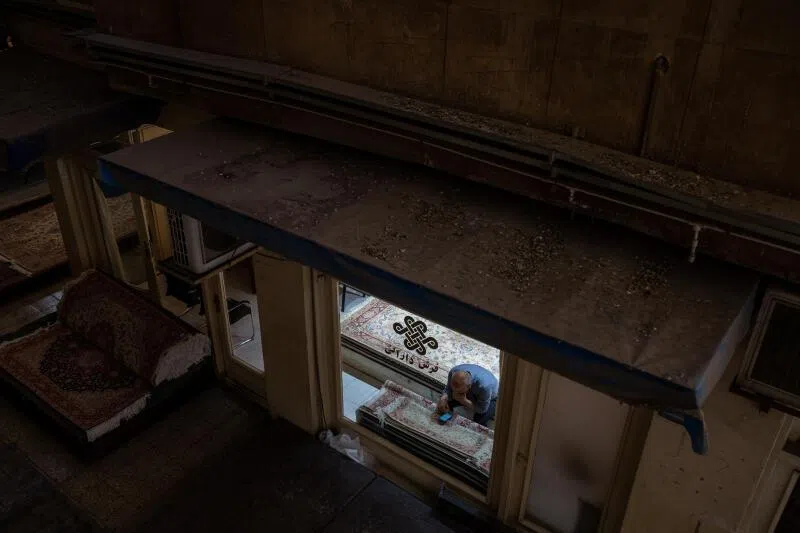
In mid-March, Babak, 49, an Iranian product designer at a tech company in Tehran, Iran, was called into his boss’s office and told that his position was being eliminated.
Iran’s government had shut down the internet two weeks earlier, at the outset of the US-Israeli war on the country, throwing the country’s tech industry into chaos and making Mr Babak’s job impossible.
“Throughout my career, I have worked hard, continuously learned, and tried to grow,” said Mr Babak, who sent voice messages to The New York Times, and asked to be identified only by his first name to avoid government reprisal. “Yet at this stage of my life, I find myself in an uncertain and ambiguous position,” he said.
Mr Babak’s experience has become increasingly common throughout Iran as companies have instituted round after round of layoffs in recent weeks, according to interviews with businesses and employees and Iranian news reports.
For the Trump administration, Iran’s severe economic struggles are part of a strategy to pressure the country into submission. “I hope it fails,” President Donald Trump told reporters earlier in May, of Iran’s economy. “You know why? Because I want to win.”
Iranian officials insist that pressure will not work and that the country will not surrender.
Many of those companies are buckling under wartime pressures. During the war, the United States and Israel hit Iranian industrial sites that produce key raw materials, as well as key infrastructure. And a US-imposed blockade on Iran’s ports, in place since a ceasefire in April, has cut off much of its oil exports and disrupted imports of other goods.
An Iranian government official, Gholamhossein Mohammadi, estimated that the war has caused the loss of 1 million jobs, “and the direct and indirect unemployment of 2 million people,” in comments reported by the news outlet Tasnim.
On April 25, an Iranian job search platform reported a record 318,000 resumes submitted in a single day, a figure that was 50 per cent higher than the previous record, according to the news site Asr Iran.
Even before the war, Iran’s economy had been struggling from years of sanctions, entrenched corruption and mismanagement, while a spiralling currency has eroded Iranians’ purchasing power.
“A strange and overwhelming vortex of economic problems has emerged, and it continues to grow more complex,” Mr Amir Hossein Khaleghi, an economist in Isfahan, said in an interview. Before the war, Iran was “already in a very poor economic situation, facing a set of mega-crises,” he said.
The private sector’s latest struggles portend a deepening crisis for Iran’s government. Its proposed budget for the year, put forward before the war, already represented a sharp reduction in public spending when factored for inflation, and depended more on taxation than in the past. Now, tax revenues from the private sector are likely to drop significantly.
Economic discontent has ignited repeated protests in Iran over the past decade, including nationwide demonstrations that began in December as the currency collapsed. Although those protests were suppressed through a deadly crackdown that killed thousands, the anger fuelling them has remained unresolved.
In a statement to mark a national day in Iran that honours workers and teachers, the supreme leader, Ayatollah Mojtaba Khamenei, urged companies to avoid layoffs “to the extent possible.” Many of those companies are facing deep crises that are a direct result of actions by Mr Khamenei’s government.
For instance, Iran’s digital sector, once a symbol of the country’s potential, has been brought to its knees by a severe, government-imposed internet shutdown.
The head of an Iranian tech industry lobbying group estimated the internet shutdown is costing Iran up to US$80 million (S$101 million) a day in direct and indirect losses.
Digikala, known as the Amazon of Iran and the country’s leading tech company, has cut 200 employees, about 3 per cent of its workforce, with recent instability among the causes, said the company’s CEO, Masoud Tabatabaei.
And in April, the founder of Kamva, an Iranian e-commerce company, announced the firm would be closing entirely.
A Digikala store, sometimes called the Amazon of Iran, said it has cut 200 employees, about 3 per cent of its workforce.
PHOTO: ARASH KHAMOOSHI/NYTIMES
In the industrial sector, the immediate cause of many of the layoffs is a shortage of raw materials. Major petrochemical and steel plants were targeted during the US-Israeli strikes on the country, cutting off supplies to related industries. And imports have also been disrupted by the US blockade of Iran’s ports.
A textile factory in western Iran has laid off 700 of its 800 workers, according to the Iranian Labor News Agency, a semi-official outlet, which also reported another factory in the country’s north shedding 500.
Even manufacturers that have not announced formal layoffs are effectively frozen, staying open in name only but producing little output, labour leaders say.
“In practice, some of these units do not have real production and only work semi-actively or intermittently to maintain their existence,” said Mr Bahram Zonoubi Tabar, head of a local labour council in Iran’s Fars province, in an interview with the news agency.
Mr Mehdi Bostanchi, head of the country’s Coordination Council of Industries, a body that liaises between companies and the government, said Iran’s industrial sector was going through a contraction that would affect as many as 3.5 million workers.
“In this situation, unlike classic periods of recession, the decline in employment is less visible in official statistics and instead manifests through non-renewal of contracts, reduced working hours, and forced leave,” Mr Bostanchi said in a written response to questions from the New York Times.
At times, the government’s efforts to address the economic crisis have added to the pressure on businesses. In March, the government announced a 60 per cent increase in Iran’s minimum wage, which was meant to keep wages in line with the country’s galloping inflation rate. Instead, it “created a shock to the economy,” said Mr Nima Namdari, CEO of Karnameh, an online car sales company.
“As a result, the wave of layoffs intensified,” Mr Namdari said.
Mr Babak, the product designer, has been laid off twice in the span of a year. His first layoff occurred just 10 days before Israel struck Iran in June 2025, and it took him months to find a new role, which was for less pay. It was difficult to make ends meet, he said, but he and his wife managed. Then came the US-Israeli war, the internet shutdown and his recent layoff.
He and his wife have sold their cars and jewellery to stay afloat in recent weeks. With nothing left to sell, he said, they are now relying on help from their families.
Mr Babak said he still hasn’t been able to find another job. “It pains me to see how this situation has affected my wife’s spirit,” he added. “There are moments when we both struggle, but we are doing our best to hold on to hope.” NYTIMES
Yeganeh Torbati contributed reporting.