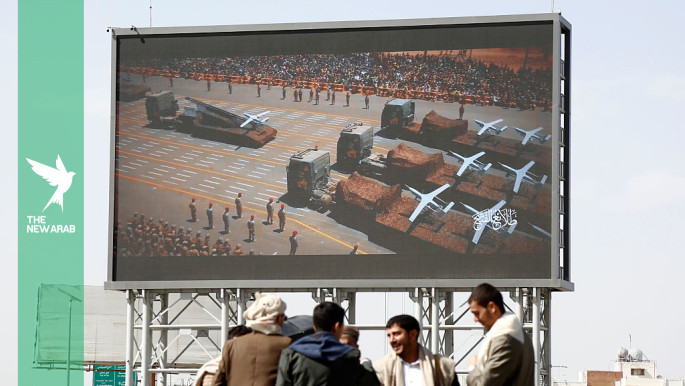
An estimated $218 billion was spent in military equipment in the Middle East in 2025 [Getty]
Middle East and North Africa military expenditure reached $218 billion in 2025, marking a near-standstill with just 0.1% growth from the previous year – a dramatic slowdown after the region’s unprecedented 15% spending surge in 2024, according to new data from the Stockholm International Peace Research Institute (SIPRI).
World military expenditure rose by 2.9% in real terms to reach $2,887 billion in 2025, the 11th consecutive year of growth. Despite the marginal increase in 2025, MENA military spending increased by 36% over the decade 2016-25 in the context of recurring regional conflicts and crises.
Israel
Israel’s military expenditure decreased by 4.9% in 2025 to reach $48.3 billion, according to SIPRI.
“The relatively modest year-on-year decrease in Israel’s spending reflected the reduction in the intensity of the war in Gaza, following the ceasefire with Hamas in January 2025,” the report stated.
Zubaida Karim, research assistant at SIPRI’s Military Expenditure and Arms Production Programme, told The New Arab this was indicative of a new baseline in Israel rather than a return to pre-conflict norms, comparing it to “putting a shadow over the overall military spending”, given Israel’s huge increase over the decades.
However, with the 12-day war with Iran in June 2025 and ongoing military operations in Lebanon and Syria, Israel’s expenditure in 2025 was still 120% higher than in 2016 and 97% higher than in 2022, the year before the war in Gaza started.
Israel continued to receive $3.8 billion in US military assistance in 2025 under a separate mechanism funded through the US Department of State’s budget covering the period 2019-28. Karim noted how Israel is the only country receiving annual military aid of this scale in the region, which she argues “makes a huge difference” in creating an imbalance in capabilities in the Middle East.
This comes despite the Pentagon requesting emergency supplemental funding exceeding $200 billion after Washington initiated the war with Iran on 28 February.
Gulf States
The region’s largest spender in 2025 was Saudi Arabia, with estimated expenditure of $83.2 billion – 1.4% higher than in 2024 and 12% higher than in 2016.
SIPRI also ranked the Gulf state as the eighth largest spender globally.
Karim said lack of available data for many Gulf countries means “there’s a lack of transparency and reporting military budgets from the Gulf States especially, and Saudi Arabia”.
Looking ahead, she predicted: “Considering the current situation with the wars and the overall consistent tension in the Middle East, we’re probably going to see a higher increase in their budgets”.
Iran
Iran’s military expenditure decreased for the second consecutive year, to $7.4 billion in 2025, which was 5.6% lower than in 2024 and 0.9% lower than in 2016.
The year-on-year drop in expenditure in real terms can mostly be attributed to the effect of Iran’s annual inflation rate of 42%, as military spending rose in nominal terms.
Funding for key domestic arms producers increased sharply in Iran’s military budget for 2025.
Allocations to the Iran Aircraft Manufacturing Industrial Company (HESA), which produces military aircraft and drones, increased by 50%, while allocations to the Aerospace Industries Organization (AIO), which produces ballistic missiles, grew by 44%.
However, SIPRI noted these budgeted allocations “probably represent only a relatively small proportion of Iran’s procurement spending in 2025 as parts of Iran’s drone and missile programmes are funded through off-budget mechanisms – often using oil revenues”.
Karim explained that following the initial clash with Israel in 2024, Iran allocated a huge amount of resources to drones and missiles, while previously off-budget spending was mostly going to general law enforcement.
She estimated off-budget spending constituted about 40% of total military expenditure.
Despite saying it usually takes a year to fully understand military expenditure levels, Karim said that in light of the US-Israel war in Iran that began in February 2026, Tehran’s budget will likely increase significantly.
North Africa, Turkey
Military spending by North African countries totalled $35.0 billion in 2025, which was 9.3% more than in 2024 and 67% more than in 2016.
Algeria’s military spending rose by 11% to reach $25.4 billion in 2025, making it by far the biggest spender in both North Africa and Africa as a whole. At 25%, Algeria’s military expenditure as a share of government spending was the second largest globally after Ukraine.
With military spending of $6.3 billion in 2025, Morocco was the second largest spender in Africa, with spending rising 6.6% in 2025.
Spending by both Morocco and Algeria is largely driven by long-standing tensions between the two – especially over the contested territory of Western Sahara – which continued to escalate in 2025.
Turkey’s military expenditure reached $30.0 billion in 2025, an increase of 7.2% from 2024 and 94% from 2016.
The overall increase was driven by Turkey’s continuing military operations in Iraq, Somalia and Syria, but most of all by investments in its domestic arms industry, with allocations to the special fund supporting the Turkish arms industry rising by 25% year-on-year and accounting for 22% of Turkey’s total military expenditure in 2025.
Looking ahead, Karim predicted that “if the wars continue in the Middle East, we’re likely going to see a huge increase – maybe not exactly to the same level as 2024, but not far away either”.
She added that a clearer indication should emerge as budgets are released for most countries in the coming months.