Two of the world’s biggest beer companies — Anheuser-Busch InBev SA and Heineken NV — are probably going to feel it, too.
Morgan Stanley analysts led by Sarah Simon said there’s a risk that third-quarter sales in Latin America will fall short of expectations after A Seleção and El Tri were knocked out of the tournament on Sunday — and in the process quashed hopes for the kind of beer-swilling boom one could have expected if they had pushed on toward the July 19 final.
“We believe the concentration of the beer volume uplift comes from ‘deep run’ games,” the analysts wrote in a note to clients.
Morgan Stanley said AB InBev, the maker of Corona and Skol, is the “most exposed,” given its sales in Mexico and Brazil, while Heineken also has “meaningful” exposure.
The shares of both slumped on Monday, with AB InBev closing down over 4% in Brussels and Heineken slipping 1.4% in Amsterdam.
Meanwhile, Constellation Brands Inc. — which distributes Corona and Modelo in the US — finished the session down 4.9% at its lowest level since November 20. Boston Beer Co. and Molson Coors Beverage Co. also closed lower. And Ambev SA, a Brazilian subsidiary of AB InBev, closed 2.5% lower in São Paulo.
Brazil was bounced from the tournament by Norway following a brace from Erling Haaland. It marks the first time Brazil has failed to reach the quarter-finals of the World Cup since 1990, where they were bested by a Diego Maradona-captained Argentina. Meanwhile, Mexico was defeated by England in a five-goal thriller at Estadio Azteca in Mexico City.
Also Read: Ukrainian drones hit Russia’s largest refinery, in one of deepest strikes yet
For Simon and the other Morgan Stanley analysts, Brazil’s early exit is likely to have a bigger impact than Mexico’s, given its bigger beer market and higher expectations going into the World Cup.
“We see this negative impact mainly as an absence of incremental growth which would have occurred had either team progressed further in the competition,” they wrote.
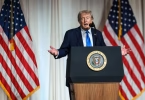
The focus now shifts to the US national team, which faces Belgium later on Monday. About 20% of AB InBev’s revenue comes from the US, which has performed well in the tournament so far and received a lifeline when striker Folarin Balogun was cleared to play after President Donald Trump lobbied to have a penalty against him overturned.
But it’s unclear how much that will offset any lost beer sales in Latin America.
“Given the country’s shorter football history, the deep-run beer benefit in the US is less well tested and could provide upside surprise if the team continues to progress, particularly given the host-nation backdrop and the scale of the US beer market,” the Morgan Stanley analysts wrote.