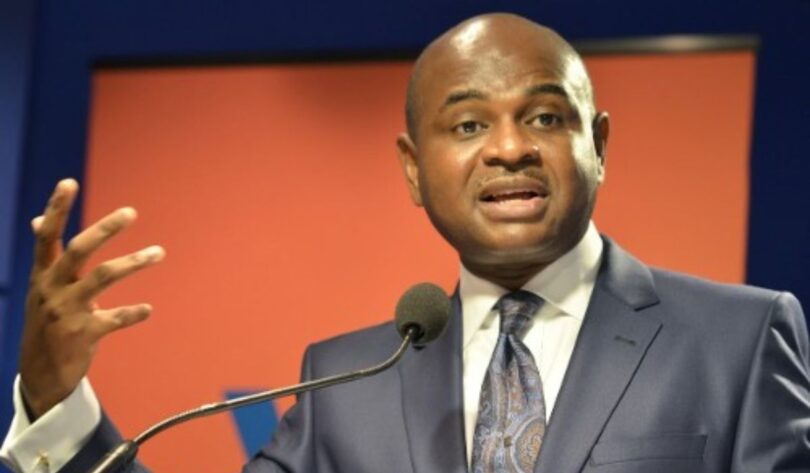
Professor Kingsley Moghalu, President of the African School of Governance, has opined that the reason the country has failed to tame insecurity over the last decade is the lack of a political and civic identity, news.ng reports.
Moghalu, who appeared on Arise Television on Monday night, noted that there is a non-existence of political, civic, ethnic, and historical identities, ingredients needed to form a nation, arguing that Nigeria is merely a geographical name and not a nation.
According to him, the country’s inability to fight terrorism is due to a lack of common purpose and unity.
He said, “Yes, indeed, that’s what I’m saying. And more particularly, the failure to meet the challenge, because even in the best of societies, even in the most united societies, there is still crime. And sometimes terrorism will try to probe into countries that are doing very well and are united nations in themselves.
“But the failure we have had in Nigeria, which we cannot run away from; the fact that terrorism is really sweeping through the country; and we have not been able to overcome it so far in the last 10 to 15 years. That failure is driven, from my perspective, by the failure for us to be a nation. And how this works is as follows.
“When you don’t have nationhood, that is to say, a common political and civic identity, or in an ethnic sense, so it’s the combination of political and civic and ethnic and historical identity that creates nations; that doesn’t exist in Nigeria. So we are a country, geographically, not a nation. Now, what this does is that because we don’t have a common purpose, we are not united internally to be able to fend off external threats from terrorists.”
Moghalu noted that another challenge the country is facing in curbing the menace is the collusion security operatives are allegedly having with terrorists, serving as informants to armed bandits.
The former presidential aspirant added that the lack of internal cohesion and the inability of Nigerians to recognize terrorism as a common enemy could be the reason the country has not been able to surmount insecurity.
“Now, you see this in a number of ways. One, a lot of allegations of collusion within the security forces between those elements and the terrorists. You also see it in distorted, corrupt incentives, where you see what you might call a military-industrial complex that is profiting from the war against terrorism.
“Lots of money spent, but very few results are delivered. So these two things show you that there is no internal cohesion inside Nigeria to be able to face an enemy, because we do not generally regard that enemy as our common enemy. Some people will be in the South and see the killings in the North and say, well, that’s their problem.
“Some people in the West will look at it and say that’s their problem. Some people in the North will look at the killings in maybe Niger Delta, when we had terrorist incidents in the Niger Delta. Or in the Southeast, when we were having problems with IPOB and ESN, and say, well, that’s their problem. So we don’t have this commonality of vision, and it weakens us as a country,” he explained.
Watch the clip: