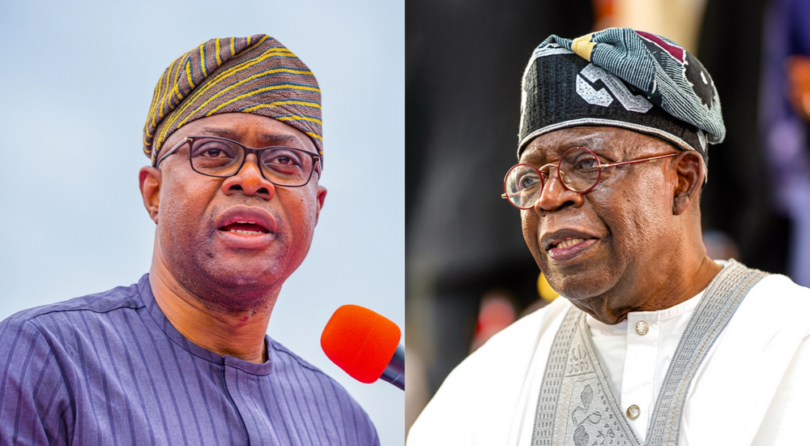
The 2027 presidential election will not be won with billions of naira, political godfathers or favourable opinion polls, the presidential candidate of the Allied Peoples Movement (APM), Seyi Makinde, has declared.
Makinde said the ultimate determinant of the election would be the Nigerian people, insisting that the electorate would not surrender their political choices to wealthy politicians and powerful political structures.
Making a direct reference to President Bola Tinubu, Makinde declared, “This 2027 election will not be determined by politics, by pollsters, or by the number of multimillionaires in your party.”
“This election is not going to be determined by the number of millionaires you have in your corner, or how many billions you have to spend. This election will be determined by the people of Nigeria.”
Tinubu is seeking re-election on the platform of the ruling All Progressives Congress (APC).
The APM candidate spoke on Monday in Lafia, Nasarawa State, during his engagement with the party’s candidates in the North-Central Zone, where he presented his proposed “Reset Agenda” as an alternative to the current direction of the country.
Makinde, who is also the Oyo State governor, said the intensity of his campaign schedule demonstrated the stamina required to govern Nigeria effectively.
He disclosed that he travelled from Ibadan to Abuja before embarking on a three-and-a-half-hour road journey to Lafia, where he held meetings with APM candidates until 2 a.m.
According to him, the demanding schedule was only part of campaigning, arguing that governing Nigeria would require even greater energy.
“So, you need a lot of energy to be able to serve and govern our people effectively, and Makinde has the energy to Reset Nigeria,” he said.
The governor also launched a fresh attack on the Federal Government’s handling of insecurity, questioning the planning and budgetary provisions behind the expansion of Army divisions.
He challenged the government to identify the 2026 budget provision for the expansion, particularly against the backdrop of worsening insecurity in parts of the North-Central.
“I was looking at the budget for 2026. I was looking for the item in that budget relating to the expansion of those Army divisions. I did not see it,” he said.
“If they have it in the budget that they prepared for 2026, let them bring it out.”
The APM candidate argued that expanding military formations without clear budgetary planning was inadequate for tackling insecurity.
“You cannot just wake up and say, without any plan, I am setting up or expanding Army divisions to tackle insecurity. There has to be a lot of planning that will go into this,” he said.
Makinde equally took aim at the Federal Government’s economic policies, arguing that increased allocations to state governments had not translated into an end to hunger and hardship.
He used Oyo State’s finances to illustrate his argument, saying the state’s dependence on federal allocation stood at more than 80 per cent when he assumed office in 2019 but fell to about 65 per cent by 2022.
He said the figure had subsequently climbed back to nearly 80 per cent, which he attributed to the economic policies of the present administration.
“By 2023, when they came on board with their voodoo economy, the resultant effect is that today Oyo State is back to almost 80 per cent dependence on federal allocation,” Makinde said.
He promised that an APM government would embark on a four-year national reset focused on security, education, economic management and the country’s socio-political environment.
“We can reset this country, reset and give Nigeria a new security architecture, reset and give Nigeria a new path for education, reset our economy utilising data, science and logic, and reset our socio-political environment in four years,” he said.
Makinde said the proposed reset could be achieved within four years, arguing that Nigeria had previously undergone major political transformation within a relatively short period.
He promised that, if elected president, he would, on May 29, 2027, establish a transitional government of national unity designed to usher in what he described as “new players and a new agenda” for sustainable national development.
“So, as your President from May 29, 2027, we will run a transitional government of national unity that will culminate in new players and a new agenda for Nigeria’s sustainable development,” he said.