
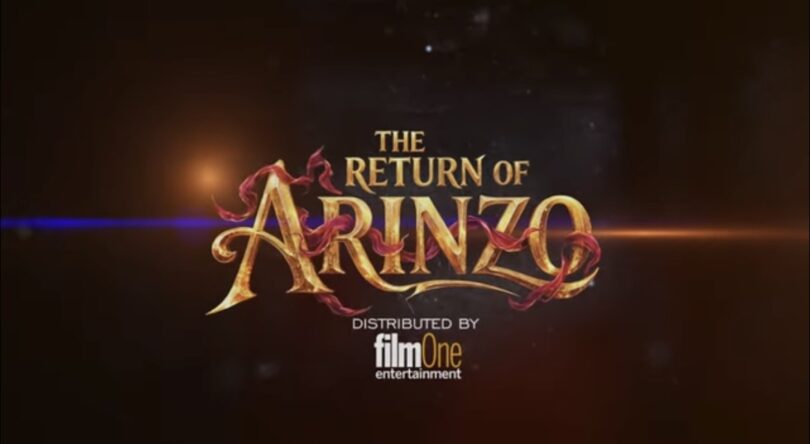
Despite its ambitious scope and star-studded cast, the film struggles with a disjointed narrative.
Cast: Mercy Aigbe, Iyabo Ojo, Funke Akindele, Williams Benson, Bimbo Akintola, Adjetey Anang, Enioluwa Adeoluwa, Scarlet Gomez, Juma Jux.
Platform: Cinemas
Release date: 3 April, 2026.
Running time: 2 hours 15 mins
Have you ever tried to bury a part of your past, hoping it would never find its way back? Or perhaps it is the hardest battle against others or against the versions of ourselves we thought we had left behind? Iyabo Ojo’s directorial debut, ‘The Return of Arinzo,’ leans on these questions, using the movie as a metaphor for the consequences we think we’ve escaped.
Over a decade after the original ‘Arinzo’, released in 2013, introduced audiences to a story of betrayal and fractured sisterhood, the sequel returns with an expanded narrative, becoming a wider, pan-African crime drama. Running with a star-studded cast featuring stars from Nigeria, Ghana and Tanzania, including Mercy Aigbe, Funke Akindele and Bimbo Akintola, the film attempts to harness politics, family drama, crime, and spirituality into one high-stakes story.
The two-hour drama hinges on a central question: can redemption exist in the face of unresolved pain?
At its core, the film follows Aisha Williams (Mercy Aigbe), a powerful woman whose past as a member of a violent criminal gang resurfaces just as her husband, Marcus (Benson Williams), is on the verge of a major political breakthrough to secure the party’s presidential ticket. Her marriage and First Lady bid, however, are disapproved by Marcus’ sister, Bolanle (Funke Akindele).
Years earlier, Aisha was involved with a gang led by Arinzo (Iyabo Ojo). A betrayal within the group led to bloodshed, and Arinzo was believed to have been killed. Unbeknownst to Aisha, she survived and has been waiting for the right moment to return. In the present day, Aisha’s son, Olamide Mandla (Enioluwa Adeoluwa), proposes to Simisola Fijabi (Scarlet Gomez), a young woman from a different background. Their engagement appears joyful at first, but tension rises when Aisha discovers that Simi is Arinzo’s daughter. This revelation reconnects past and present, setting off a chain of events that threatens to destroy Aisha’s carefully built life.
As Marcus’ political campaign gains momentum, damaging secrets about Aisha’s past begin to leak to the public, triggering scandal and internal conflict within her family and team. At the same time, Simi is kidnapped in what initially appears to be a political attack but later proves tied to a deeper revenge plot. Investigations uncover betrayal within Aisha’s inner circle, including a mole working against her. Meanwhile, Arinzo resurfaces stronger, orchestrating events from the shadows while confronting both her past and her daughter, Simi. The story builds toward a clash between revenge and redemption, highlighted by Pastor Bridget (Bimbo Akintola), who represents the path of forgiveness.
As a major directorial effort, Iyabo Ojo deserves credit for its ambition. The film spans multiple countries, combining politics, crime, family drama and spirituality through a large pan-African cast. On paper, it is bold and expansive.
However, in execution, it struggles under the weight of its own ambition. The biggest issue is tonal inconsistency. The film shifts between political drama, action thriller and spiritual redemption without fully blending them, making it feel like several stories running in parallel rather than one cohesive narrative. Subplots involving the political campaign, kidnapping, engagement, church arc, Aisha’s PR mole and past gang history often compete for attention, affecting pacing and emotional balance.
Character development also suffers. Aisha’s resistance to her son’s marriage feels abrupt, while Arinzo’s turn towards repentance comes across as rushed and insufficiently explored, weakening its emotional impact. Some plot devices further strain credibility. The graveyard letter (“I am coming for you”) feels predictable, while the PR aide’s reveal as both mole and killer comes off more as a shock twist than a carefully built revelation.
Still, the film delivers moments of strength. Its central conflict remains engaging, and the ending, in which Arinzo’s supposed redemption is undercut by her return to prison, leaves a lingering message that some pasts are never truly buried. Ultimately, The Return of Arinzo is an ambitious film that offers drama and spectacle, but is weighed down by an overcrowded narrative and uneven execution.
Final Verdict
Story idea: Strong
Execution: Mixed
Entertainment value: High (especially for Nollywood audiences)
Cinematography: Good
Rating: 6.5/10