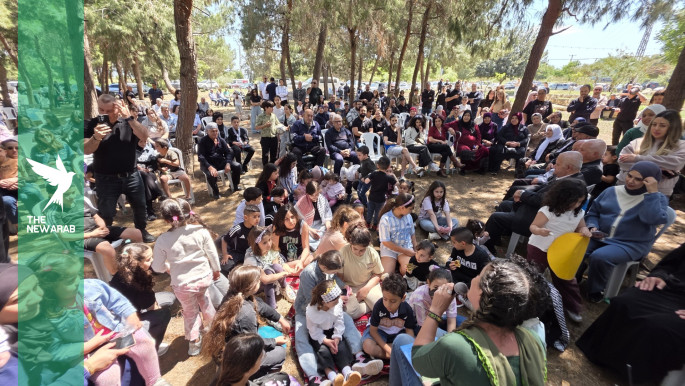
Palestinians revive depopulated villages in 1948 areas during Israel Independence Day, 22 April 2026. [Naif Zaidani/The New Arab]
Palestinian villages depopulated since 1948 inside Israel held a series of events on Wednesday, 22 April, marking attachment to the right of return, the land, and the transmission of collective memory between generations to commemorate the Palestinian Nakba.
Israeli-imposed restrictions, justified by a state of emergency, prevented the annual central march organised by the Association for the Defence of the Rights of the Displaced. It is the second consecutive year the march has been halted. The association instead called for the march to be held virtually, alongside local tours and activities across villages.
In al-Damun, visited by The New Arab, scenes and emotions were overwhelming.
Elderly residents expressed longing as they recounted memories, while children displayed emerging awareness, and older residents looked on as younger ones drew the Palestinian flag. Others spread toys on the ground, while people of different ages gathered near the water spring, which remains a witness to a once-living village, or walked among the ruins of homes. Some participants shared traditional foods that carried the scent of the past, while others attended artistic performances, including drawings and music that reflected a national mood.
A sense of narrative
Mohammad Asaad Murshid, born in al-Damun, has long accompanied returning families and visitors on tours through the ruins. This year, he moved more slowly but remained determined to provide testimony and uphold both hope and action.
He told The New Arab that his memory still holds vivid recollections from when he was eight years old in 1948, alongside accounts passed down from his father and relatives.
“When we left in 1948, I was eight years old. There was a large threshing floor here with wheat, and the memories begin here,” he said. “I asked my father about a plane flying overhead, and he told me not to be afraid; it was the truce plane.”
“It was afternoon, and suddenly bombs fell near my uncle’s house. His daughter, Basma Khalil Abu Ali, was killed, and her mother and sisters were injured. We were displaced and scattered. We went to Sakhnin, Al-Rama and Sajur and lived in several areas before settling in Kabul,” he added.
“The purpose of the commemorative activities is to introduce younger generations to the landmarks of al-Damun. It is our village, our property, and we left it against our will. We had no weapons to resist, and we were working in our wheat fields and on our threshing floors when the attack happened. We have the right to return to this blessed land, and we are confident we will return,” Murshid said.
“We came to our village to check on it. I was born outside it in 1949. My family was distributed between Tamra and Kabu, two towns in the Galilee near the depopulated village in the Acre area. There is nothing like al-Damun. They told us it had everything, and we hope to return to it,” Wafeeqa Murad said.
In the spring, Ahmed Mohammad Rayan told The New Arab that he regularly visits the “village of fathers, grandfathers and great-grandfathers to affirm that the right of return is non-negotiable and does not fade with time”.
“We continue the struggle and the fight for this village to return to its people. Al-Damun was a central, very important and developed village for its time, with a flour mill and an olive press,” he said. “This spring’s water has dried from crying over the separation from its people, and it still waits for us. The stones speak and say: Return, our people; return, the people of Al-Damun who drank from my water. We will return, God willing.”
Two core messages
“There are two core messages,” Dr Khaled Anabtawi, head of the strategic and political department at the National Democratic Assembly, told The New Arab while attending the event.
“First, the right of return does not expire. It is a legitimate and fundamental right and a core pillar of the Palestinian national project, our identity, and our political imagination. The issue of return and displacement brings us back to the starting point: the matter is not only a conflict over land, borders or religions but also a conflict over a people, of whom more than 70 per cent were displaced and expelled in 1948 from their land under a settler-colonial project. This is the starting point and the root of the conflict,” he said.
The second issue, according to Anabtawi, concerns internally displaced Palestinians.
“As is known, around 20 to 25 per cent of Palestinians inside Israel are internally displaced, meaning they are refugees who were expelled from their villages but did not leave the territory of 1948, instead moving to other areas. They are citizens of the State of Israel, yet the Israeli establishment insists on preventing their return to their villages and denying them their right to return,” he said.
“This demonstrates the issue is not demographic. They are citizens of the state, and their return would not change the demographic balance. Rather, it would mean recognition by the Israeli establishment of their rights to this land and of the historical injustice. We must insist on memory and awareness and on confronting the Zionist narrative at all times, because this is the foundation of our political identity in this country,” he added.
During a speech in al-Damun, Father Simon Khoury, whose family was displaced from the village, said, “The sound of church bells will continue to meet the sound of the call to prayer until the Day of Judgement. We are here despite the Palestinian cause becoming subject to exploitation by those with weak consciences. We are a people who have been afflicted and robbed, but we remain. Our presence here today is proof of our return.”
“According to international law, we have the right to return to our land. We are not migrants but displaced people. We are a mighty people, we are strong, and we tell the whole world that we will return. And we have returned today,” Father Khoury added.
Restrictions, threats and the Palestinian flag
Lawyer Nidal Othman, a member of the al-Damun committee, told The New Arab that the national return march organised by the Committee for the Defence of the Rights of the Displaced was originally planned to go from Tamra to al-Damun.
“However, due to the security situation and concerns about possible rocket debris along the routes that could harm people, in addition to police restrictions, the association preferred to organise local visits and marches,” he said. “In our programme, we affirm that return is a right we will not give up.”
Researcher Khaled Awad, a member of the Association for the Defence of the Rights of the Displaced, also spoke to The New Arab about the constraints surrounding preparations for the central march and the decision to move it online.
“There have been exceptional circumstances over the past two years that pushed us to shift from a traditional march to an online one, including the war and the policies of Minister Itamar Ben Gvir, as well as racial discrimination,” he said. “We do not want to put people in danger. Our national responsibility requires us to protect our people’s safety. It is not possible to organise the march as in previous years under Ben Gvir’s policies, restrictions on participant numbers, and the ban on raising the Palestinian flag.”
He said the march is fundamentally based on the flag.
“Removing it and warning against raising it undermines the march. Confrontation was clear last year, when Ben Gvir threatened to storm the march if the Palestinian flag was raised. We assessed that massacres could occur, and therefore we did not organise the traditional march,” he said.
Despite this, Awad stressed the association continues to develop new tools.
“We have created a new project and a new strategy through visits to depopulated villages in the absence of the central march. This will continue even if we later resume the traditional march,” he said.
He added that programmes are now in place with coordination, teams and guidance.
“Through our platform and the digital march, we aim to deliver the message to everyone inside and outside the country, alongside seminars and various activities. Today we mark the 29th anniversary of the Return March and the 78th anniversary of the Nakba, and activities will continue until May 15, the official date of the Nakba,” he said.
Article translated from Arabic by Afrah Almatwari. To read the original, click here.