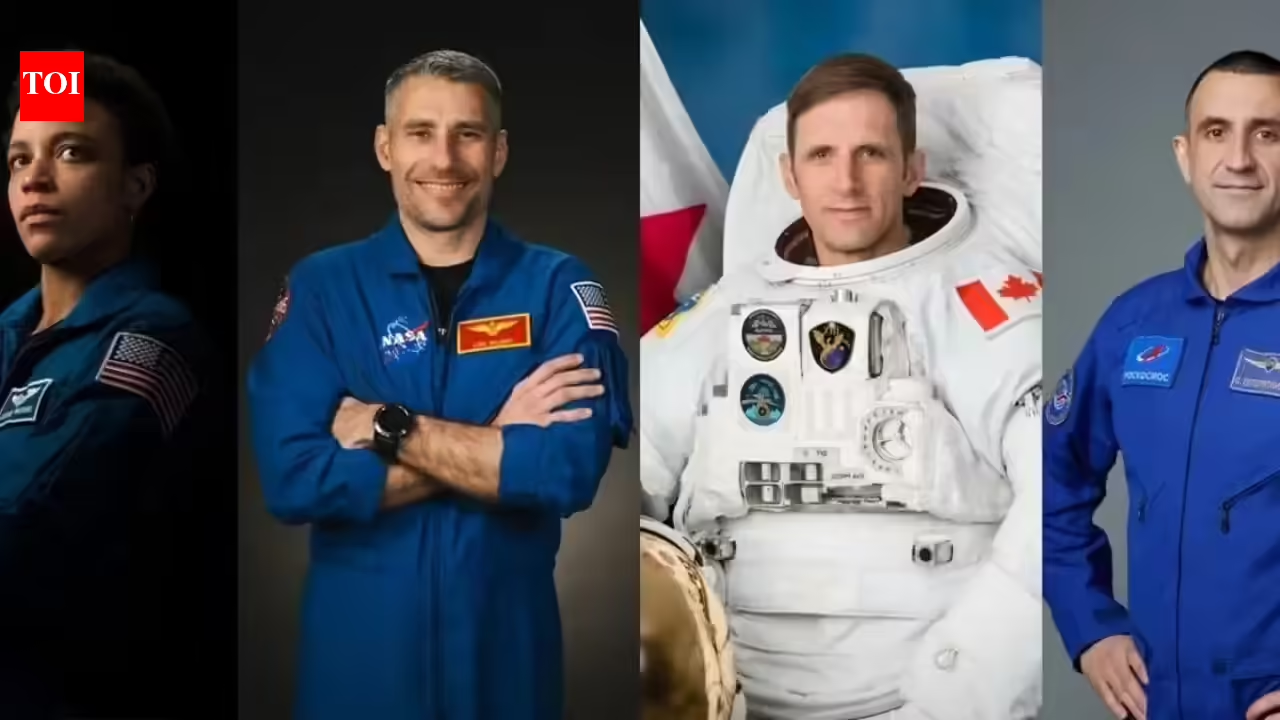
NASA has announced the crew assignments for its SpaceX Crew-13 mission, which is scheduled to launch no earlier than mid-September to the International Space Station. The mission brings together astronauts and cosmonauts from NASA, the Canadian Space Agency, and Roscosmos for a long-duration scientific expedition in low Earth orbit. The four-member team will join Expedition 75 once they arrive at the orbiting laboratory. NASA has also adjusted the launch schedule, moving it earlier than previously planned to increase the frequency of crew rotations under its Commercial Crew Program. The mission continues a long series of SpaceX-supported flights to the space station, focusing on scientific research, technology testing, and preparations for future human exploration of the Moon and Mars. Each crew member brings specialised training and operational experience from aviation, engineering, and space science backgrounds.
NASA’s SpaceX Crew-13 astronauts assigned: Key roles for ISS mission
NASA astronauts Jessica Watkins and Luke Delaney have been assigned key flight roles. Watkins will serve as spacecraft commander, while Delaney will act as pilot. They are joined by Canadian Space Agency astronaut Joshua Kutryk and Roscosmos cosmonaut Sergey Teteryatnikov, who will serve as mission specialists. The crew represents three space agencies working together on the International Space Station programme.Once aboard the station, the team will integrate into Expedition 75 operations. Their responsibilities include conducting experiments in microgravity, supporting maintenance tasks, and contributing to ongoing station systems work. The mission continues NASA’s collaboration with international partners through the Commercial Crew Program, which relies on SpaceX’s Dragon spacecraft for transport to orbit.
NASA astronauts Watkins and Delaney assigned for Crew-13 mission roles
Jessica Watkins is making her second trip to the International Space Station. She previously flew on SpaceX Crew-4 in 2022 and spent 170 days in space during Expeditions 67 and 68. Watkins holds a background in geology, with academic work focused on planetary surfaces, including studies of Mars. She also contributed to NASA’s Curiosity rover science team at the Jet Propulsion Laboratory. Her assignment as commander places her in charge of mission execution and crew coordination during flight operations.Luke Delaney is making his first spaceflight. He has a background in mechanical and aerospace engineering, along with experience as a naval aviator and test pilot. Delaney has worked on developmental aircraft systems and airborne research missions at NASA’s Langley Research Center. His role as pilot includes supporting spacecraft operations during launch, docking, and undocking phases.
International crew members on Crew-13
Joshua Kutryk of the Canadian Space Agency is also flying to space for the first time. His career includes service as a fighter pilot in the Royal Canadian Air Force, along with experience as a test pilot. Kutryk has an academic background in mechanical engineering and space studies, with additional qualifications in flight test engineering and defence studies. His role as a mission specialist involves supporting scientific experiments and station operations.Roscosmos cosmonaut Sergey Teteryatnikov completes the Crew-13 team. He trained as a naval engineer before joining the Russian cosmonaut corps in 2021. His work background includes naval engineering roles involving ship systems and specialised mechanical operations. This mission marks his first flight to the International Space Station, where he will contribute to technical tasks and research activities.
ISS continues 25-year legacy as Crew-13 supports deep space goals
Crew-13 will carry out numerous experiments that are focused on the study of human physiology, physical sciences, and technological performance in microgravity. This type of activity allows scientists to learn more about the impact of long-distance flights on the human organism, and results can be used in planning missions to other places.In addition, the ISS has continuously hosted astronauts since 1998. The station is a means for cooperation between countries and a center for different kinds of scientific experiments. The upcoming mission will continue the chain of operations and help NASA achieve other goals within the Artemis project.