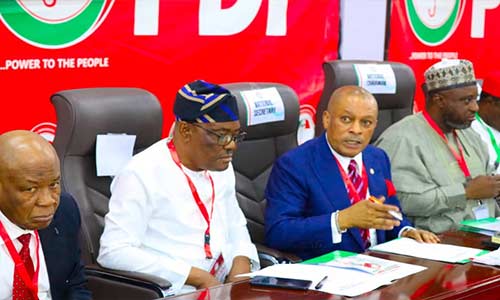
The unresolved leadership crisis rocking the Peoples Democratic Party (PDP) reverberated again on Saturday as the Abdulrahman Mohammed-led National Working Committee (NWC), backed by FCT Minister Nyesom Wike, called on the Nigerian Bar Association (NBA) and the Legal Practitioners Disciplinary Committee (LPDC) to investigate and sanction lawyers allegedly giving false interpretations of the Court of Appeal’s recent judgment on the party’s leadership dispute, specifically accusing the Turaki faction’s National Publicity Secretary, Comrade Ini Ememobong, a lawyer, of offering interpretations that were “not in alignment” with the appellate court’s decision.
The NWC also raised alarm over the alleged circulation of doctored excerpts of the court ruling on social media, stating that portions being highlighted and presented as part of the judgment did not emanate from the court as being portrayed, and called on security agencies and relevant regulatory authorities to investigate the source of the documents and bring anyone found culpable to book.
The development underscores the continuing depth of the PDP’s internal crisis, as both factions have offered diametrically opposed interpretations of the same Court of Appeal judgment, each claiming the ruling vindicated its position to the exclusion of the other, while no workable discussions on reconciliation or compromise have been opened between the two camps.
The Court of Appeal in Abuja, in a judgment delivered on Wednesday by a three-member panel led by Justice Uchechukwu Onyemenam, with Justices Mohammed Mustapha and Okon Abang concurring, dismissed an appeal filed by the Kabiru Turaki-led faction of the PDP.
The Turaki faction had sought a declaration from the appellate court recognising it as the authentic leadership of the party and affirming that the PDP’s national convention held in Ibadan on November 15-16, 2025, was conducted in line with the party’s constitution.
However, the Court of Appeal held that the question of the Ibadan convention had already been determined by the Supreme Court in Appeal No. SC/CV/164/2026 (PDP v. Alhaji Sule Lamido & 4 Others), which nullified the convention and its outcome. The appellate court held that the matter had become “academic,” meaning there was no longer any live controversy requiring judicial determination, as the Supreme Court had already settled the core issues.
The Court of Appeal also faulted the January 30 judgment of Justice Uche Nma Agomoh of the Federal High Court, Ibadan, for granting reliefs that no party before the court had sought, specifically the recognition of the caretaker committee led by Abdulrahman Mohammed and Samuel Anyanwu. The appellate court described the offending portions of Justice Agomoh’s judgment as “a nullity and liable to be set aside ex debito justitiae.”
Since the ruling became public, both factions have offered fundamentally different readings of what the Court of Appeal decided.
The Turaki faction, through its spokesman Ini Ememobong, claimed that the ruling affirmed the suspension of the Abdulrahman Mohammed-led NWC and nullified the Federal High Court Ibadan judgment that had declared the 2025 national convention invalid.
The Abdulrahman Mohammed-led faction rejected this interpretation entirely, accusing the rival camp of deliberately distorting the court’s decision to mislead party faithful and the public.
The NWC’s National Publicity Secretary, Jungudo Haruna Mohammed, issued a statement on Saturday specifically naming Ememobong and accusing him of offering interpretations of the judgment in a June 3, 2026, public comment that did not align with what the Court of Appeal actually decided.
Mohammed described the alleged distortion as “an attack on both the integrity of the judiciary and the administration of justice in Nigeria,” and called on the NBA and LPDC to take disciplinary action.
“The Legal Practitioners Disciplinary Committee and the Nigerian Bar Association are urged to rise to the occasion by investigating the conduct of legal practitioners who deliberately misrepresent court judgments and use their professional standing to promote falsehoods capable of bringing the legal profession into disrepute,” Mohammed stated.
He insisted that the Certified True Copy of the judgment “speaks for itself and leaves no room for the false narratives currently being circulated across the media and social media platforms.”
The Abdulrahman Mohammed-led NWC set out its own interpretation of what the Court of Appeal decided, contesting the Turaki faction’s claims point by point.
First, the NWC insisted that the appellate court did not invalidate the legality or constitutionality of the party’s caretaker committee from which the current NWC emerged. Instead, the NWC argued, the court dismissed the appeal on the grounds that it was academic and sought to relitigate issues already determined by superior courts.
Second, the NWC argued that the judgment of the Federal High Court in Ibadan delivered on January 30, 2026, by Justice Agomoh “remained valid, binding and enforceable.” This claim is itself contested, given that the Court of Appeal described the offending portions of Justice Agomoh’s judgment as a nullity. The NWC’s position appears to rest on the argument that the Court of Appeal found the appeal academic rather than ruling on the merits of Justice Agomoh’s judgment, meaning the trial court judgment was not formally set aside on its merits.
Third, the NWC rejected claims that the appellate court made any pronouncements concerning Khamaldeen Ajibade, SAN, the party’s Legal Adviser, or Senator Samuel Anyanwu, the National Secretary.
Beyond the interpretation dispute, the NWC raised alarm over what it described as doctored excerpts of the court ruling circulating on social media. The faction alleged that highlighted portions being presented as part of the judgment did not actually emanate from the court.
“Portions highlighted and presented as part of the judgment did not emanate from the court as being portrayed,” the NWC stated, calling on security agencies and relevant regulatory authorities to investigate the source of the documents and take appropriate legal action against anyone found responsible.
The allegation of doctored court documents, if substantiated, would constitute a serious criminal offence and a grave affront to the administration of justice. Fabricating or altering judicial documents to support a political narrative strikes at the heart of public confidence in the legal system.
The NWC’s call for NBA and LPDC intervention places both bodies in a position where they may need to determine whether the interpretations offered by the Turaki faction’s lawyers constitute legitimate legal advocacy, however aggressive, or cross the line into deliberate misrepresentation that violates the Rules of Professional Conduct for Legal Practitioners.
Rule 1 of the Rules of Professional Conduct provides that a lawyer shall uphold and observe the rule of law, promote and foster the cause of justice, and maintain a high standard of professional conduct. Rule 15(3)(d) prohibits a lawyer from knowingly making a false statement of law or fact. If a lawyer is found to have deliberately misrepresented a court judgment in public statements, the LPDC has the authority to investigate and impose sanctions ranging from a reprimand to suspension or striking off the roll.
However, the line between aggressive interpretation of a judgment and deliberate misrepresentation is not always clear, particularly in a politically charged dispute where both sides have incentives to present judicial decisions in the most favourable possible light. The NBA and LPDC would need to examine the specific claims made by Ememobong and compare them with the actual text of the judgment to determine whether the interpretation was a good-faith legal argument or a knowing distortion.
Perhaps the most troubling aspect of the continuing PDP crisis is the finding that both the NWC and the Turaki-led Interim National Working Committee (INWC) have still failed to open any workable discussions on reconciliation or compromise to end the lingering disagreement.
The PDP’s leadership crisis has persisted for months, with multiple court actions, conflicting judicial orders, rival conventions, and competing claims to party authority creating a state of near-permanent institutional paralysis within what was historically Nigeria’s largest opposition party.
The Supreme Court’s nullification of the Ibadan convention was expected to provide a definitive resolution, but instead of accepting the apex court’s ruling as the basis for a fresh start, both factions have continued to contest the implications of the decision and its effect on their respective claims to legitimacy.
The result is a party that is approaching the 2027 election cycle with two rival leaderships, two sets of candidates in some states, multiple pending court cases, and no evident pathway to reunification. For a party that once governed Nigeria at the federal level and controlled a majority of states, the current state of affairs represents an existential crisis that the Court of Appeal’s judgment has done nothing to resolve.
The NWC’s statement also addressed a broader concern about the role of lawyers and media in representing judicial decisions.
“Lawyers bore a special responsibility to uphold the integrity of the judicial process,” the NWC warned, adding that “deliberate misrepresentation of court decisions could erode public confidence in the judiciary and heighten political tensions.”
More details here…