…Kano Records 1,422 Arrests, Secured Only 147 Convictions
…580,000kg Of Codeine Seized At Seaports Yields No Conviction
…North-West Tops Arrests, Ranks Last In Drug Seizures
…NDLEA Attributes Arrest-Conviction Disparities To Court Backlogs
The NDLEA’s own annual report tells three stories at once. Who got arrested, what got seized, and actually went to prison.
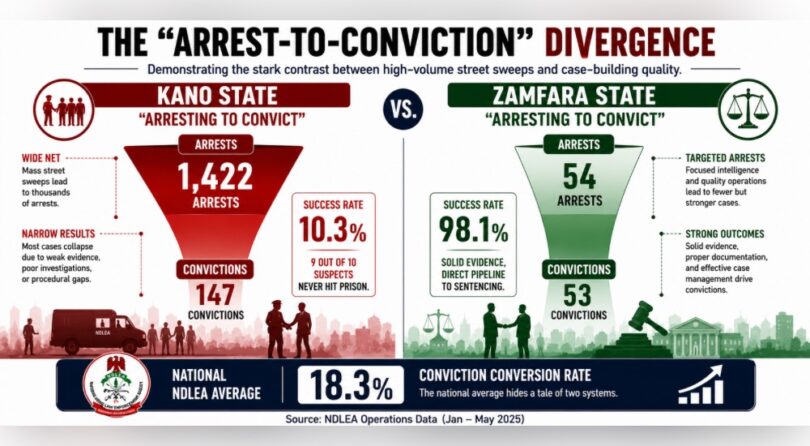
Somewhere in Kano, there is a man who was arrested by the NDLEA in 2025. We do not know his name. We do not know if he was carrying cannabis in a polythene bag or tramadol pills in his babanriga pocket. What we know, from the NDLEA’s own annual report, is that he was one of 1,422 people the Kano command arrested last year. We also know that only 147 of those 1,422 arrests became convictions.
If you do the math, it will translate to one conviction for every ten arrests. Nine out of ten people Kano’s NDLEA arrested in 2025 did not end up in prison. Some are in court, others had their cases struck out, the rest maybe in a grey zone the report does not explain. But they were not convicted.
But Zamfara command, the next-door neighbour to Kano in the same North-West zonehad fifty-three convictions out of fifty-four arrests in the same 2025. That is a 98.1 percent success rate. Every single person Zamfara arrested, almost without exception, was somebody the evidence could actually put in a dock and keep there.
Same zone, same region, same drug war, but two completely different realities.
That gap, between Kano’s 10 percent and Zamfara’s 98 percent, is the story that the NDLEA’s 2025 Annual Report tells when you read all three of its report data together. Not just the arrests, nor just the seizures, but all three. Because they do not tell the same storyand the distance between them is where Nigeria’s drug war is actually being won and lost.
Arrests share vs seizures share vs convictions share by geopolitical zone. Source: NDLEA 2025 Annual Report. Analysis: The Whistler.
Every year, when the NDLEA releases its numbers, the headline is arrests. And the 2025 numbers are genuinely impressive on that count. Nineteen thousand, nine hundred and forty-four people arrested across 36 states and the FCT. The North-West zone led the country with 4,515 arrests. Kano alone contributed 1,422, the highest single state total in the country. Katsina added 1,011. Kaduna, 1,071.
When you read only the arrest data and you would conclude the North-West is the frontline of Nigeria’s drug war, until you take a look at the drug seizure records, you will notice the trend
The North-West zone, with its 4,515 arrests, seized a combined 24,714.57 kilograms of drugs in 2025. That is 0.51 percent of all drugs seized nationally. The North-Central zone, which made 3,840 arrests, fewer than the North-West, seized 2,313,399 kilograms. The South-South, with 3,224 arrests, seized 1,422,560 kilograms. The zone making the most arrests was producing less than one percent of the drugs being pulled off the streets.
Then read the conviction records:
Kano: 1,422 arrests, 147 convictions, 10.3 percent. Katsina: 1,011 arrests, 92 convictions, 9.1 percent. Plateau: 1,245 arrests, 75 convictions, 6.0 percent. The three biggest arrest states in the North-West and North-Central combined are converting fewer than one in ten arrests into a sentence.
Now look at Zamfara again. Fifty-four arrests. Fifty-three convictions. Niger State: 122 arrests, 121 convictions, a rate of 99.2 percent. Anambra: 461 arrests, 176 convictions, 38.2 percent. Abia: 379 arrests, 152 convictions, 40.1 percent.
The states making the fewest arrests are winning the most in court. The states making the most arrests are losing nine times out of ten. That is not a coincidence. That is a patternand it has a name. It is the difference between arresting to count and arresting to convict.
There is a number buried in the NDLEA 2025 seizure records that will stop you if you are reading carefully. You will reach Kwara State, run your eye across the columns, and then read it again to make sure.
Kwara State Command. Cannabis seized: 2,089,980.06 kilograms. Two million, eighty-nine thousand, nine hundred and eighty kilograms. In one state. In one year.
The entire North-West zone, seven states, 4,515 arrests, seized 24,714 kilograms total. Kwara alone, with 842 arrests, seized 84 times more than the whole North-West put together.
The explanation maybe possibly cannabis farm destructions. The forests in Kwara have for years hosted some of the most productive cannabis cultivation in Nigeria. The NDLEA’s Kwara command may have spent 2025 going after the farms themselves, not the street dealers or the marijuana smokers.
Kwara is not alone in this haul. Cross River: 401 arrests, 441,824 kilograms seized, almost entirely from cannabis farms destroyed in its forests. Taraba: 406 arrests, 270,906 kilograms. Ondo: 336 arrests, 228,863 kilograms. Edo: 462 arrests, 202,822 kilograms.
These are not seizures from street dealers. These are agricultural operations. Farms. Hectares. Decades of cultivation gone in a single NDLEA sweep. And the states running these operations are doing it with relatively small arrest counts, because you do not need to arrest a thousand people to destroy a cannabis plantation. You need a team, a truck, and a lighter.
The farm destruction model raises a critical accountability question for the Agency. Does destroying a farm translate into fewer drugs on the street, or does cultivation simply shift location? Can the NDLEA show its operational assessment report which indicates that farm destructions in Kwara, Cross River, Ondo, and Taraba have reduced street availability in consuming states?
From the NDLEA’s report, it is apparent that the drug war in the South-West and parts of the South-South is a supply disruption operation. The drug war in the North-West is a street arrest operation. Both are counting their results in the same national total. They are not the same thing.
Arrest share vs seizure share by geopolitical zone. Source: NDLEA 2025 Annual Report.
Before we go any further, the Port Harcourt Seaport Command needs its own paragraph.
In 2025, the NDLEA’s Port Harcourt Seaport Command seized 410,553.61 kilograms of drugs, 400,718 kg of that were codeine. Four hundred tonnes of codeine, sitting in a container at a Nigerian port, intercepted by the agency’s seaport team. The number of people arrested in connection with it: one.
The number of people charged in court: zero. The number of convictions: zero. The number of pending cases: zero.
Apapa Seaport Lagos: four arrests, 151,694 kilograms of codeine seized, zero prosecutions filed. Tincan Seaport Lagos: 14 arrests, 27,567 kilograms of codeine seized, zero convictions.
Three seaport commands. Nineteen arrests. A combined 580,000 kilograms of codeine intercepted. Not a single case before a judge.
The codeine in those containers did not manufacture itself. It arrived in ships from India or China, declared as something else, loaded by somebody who arranged the shipment, cleared by a network that knew the cargo. One arrest and no prosecution raises questions about whether the investigation progressed beyond interception.
Where was that codeine going? The opioid data from consuming states gives you a partial answer. Imo State seized 69,295 kilograms of tramadol with 376 arrests. Enugu seized 77,116 kilograms of codeine with 586 arrests. Abuja’s NAIA Command seized 6,182 kilograms of tramadol and arrested nobody. The drug moves from the port to the distribution hub to the consumer. The NDLEA is catching it at both ends. The middle remains largely untouched by anything in this 2025 report.
If you only read the arrest record of Agency’s report, the South-East looks like the quietest zone in the country. Two thousand, two hundred and seventy-six arrests. Lowest of any zone. The obvious conclusion is that the South-East has less drug activity than everywhere else.