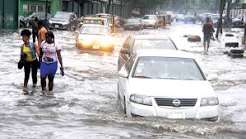
(Cross River flood. Photo by Peoples Gazette)
The National Emergency Management Agency has advised locals to refrain from disposing of waste in drains and streams in order to avert future catastrophes, attributing the frequent flooding in Cross River State to bad environmental practices.
During an evaluation of the areas impacted by Thursday’s flood in Calabar Municipality and Calabar South Local Government Areas, the organization issued the warning on Friday.
Many neighborhoods were drowned, inhabitants were stranded, and two people are said to have died as a result of the several-hour-long downpour on July 9.
Others were hurt and admitted to the hospital.
Mrs. Aisueni Mmandu, Head of Operations at NEMA’s Uyo Operations Office, led the assessment team and encouraged locals to take more responsibility for environmental protection.
You need to understand that you are your surroundings.
You must implement acceptable environmental practices for the impacted communities in order to lessen recurrent flooding and minimize preventable property and human damage,” she stated.
Mmandu pointed out that careless trash disposal, especially of plastics and other non-biodegradable items, has persisted in obstructing drainage channels and exacerbating flooding in communities that are already at risk.
She cautioned that blocked drains greatly increase the risk of floods during periods of heavy rainfall and asked locals to use approved garbage disposal locations.
“One of the main causes of blocked channels and worsening flood incidents across affected communities is the indiscriminate dumping of waste into drains and waterways,” she continued.
According to the NEMA official, if locals adopted safer environmental practices, the recent flooding might have been mostly avoided.
If we follow safer environmental practices, floods can be prevented. In order to increase public education throughout communities, NEMA will offer flood preparedness jingles and awareness materials that can be translated into regional languages, she stated.
She said that through community sensitization programs and cooperation with pertinent stakeholders, the organization would step up flood awareness activities throughout all 18 local government areas of the state.
“NEMA will undoubtedly step up efforts to raise awareness of flooding throughout the state’s eighteen Local Government Areas. Above all, we have to avoid throwing trash into drainage systems,” Mmandu said.
In order to enhance information sharing and guarantee quicker coordination during emergencies, she also suggested establishing a multi-agency WhatsApp platform encompassing pertinent ministries, departments, and agencies.
Mmandu also urged the National Orientation Agency and the Cross River State Ministry of Environment to expand flood awareness initiatives through community gatherings and local government councils.
Affected communities were reassured by Mr. Efa Nyong, Director-General of the Cross River State Emergency Management Agency, that assistance would be given once damage assessments were finished.
Nyong stated that the Cross River State Government and the Federal Government, via NEMA, were dedicated to helping the disaster victims.
Speaking as well, Mr. James Ekabua, Director of Flood and Erosion Control at the Cross River Ministry of Environment, stated that despite engineering efforts, many of the impacted settlements were situated on natural flood plains, leaving them extremely vulnerable to floods.
He noted that the government’s next course of action would be guided by expert assessments and said that human activity, obstructed drainage canals, and rapid urban growth have further raised flood risks.
Mrs. Josephine Okon of Big Qua Community, one of the impacted people, claimed that flooding has been a problem in the area for over five years, repeatedly destroying houses and other property.
She claims that many residents were unaware of the most recent flood, which happened on Thursday at around 2:30 a.m.
“It was awful, especially because it happened at night, when we came out and saw that some buildings and fences had collapsed,” she added.