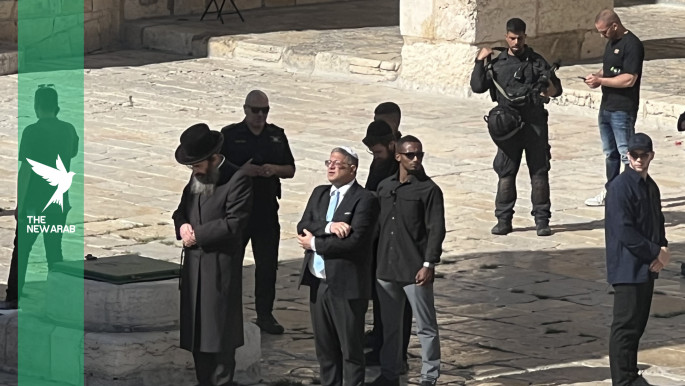
The Israeli prime minister has reportedly waived restrictions that would have required his approval for key decisions involving the Al-Aqsa Mosque, leaving authority with Itamar Ben-Gvir. [Getty]
Israeli Prime Minister Benjamin Netanyahu has reportedly rejected efforts to restrict far-right National Security Minister Itamar Ben-Gvir’s controversial involvement in matters concerning the Al-Aqsa Mosque complex, despite legal objections, according to a report by Israeli news publication Haaretz on Sunday.
Netanyahu will no longer require decisions related to Al-Aqsa to be approved by him or the government, the report added, citing Cabinet Secretary Yossi Fuchs, who conveyed the position to Attorney General Gali Baharav-Miara.
Ben-Gvir has been internationally condemned for frequently storming Al-Aqsa under the protection of Israeli forces. Jordan, which administers the holy site, has long denounced Ben-Gvir’s moves as “unacceptable,” while Palestinians have warned against Israelis trying to change the status quo of the mosque, which only allows Muslim worship there.
Netanyahu’s decision comes following negotiations between representatives of Ben-Gvir and Baharav-Miara’s office.
During the talks, the attorney general’s team reportedly sought to introduce provisions requiring approval from either Netanyahu or the government as a whole for exceptionally sensitive issues, rather than leaving such decisions solely to Ben-Gvir’s discretion.
The discussions were reportedly centred on a document drafted by Baharav-Miara last year, which stated she would not oppose Ben-Gvir’s return to the government after he resigned from it over a ceasefire in Gaza.
The developments also come after judges in Israel’s High Court in April considered petitions seeking to compel Netanyahu to dismiss Ben-Gvir from his post.
The petitions alleged that the far-right minister had interfered in police operations and undermined democratic norms.
The negotiations focused on Ben-Gvir’s involvement in police matters classified as “exceptionally sensitive”, a category that also encompasses issues relating to the Al-Aqsa Mosque compound, Haaretz reported.
“The result is that on sensitive issues such as the Temple Mount [al-Aqsa Mosque], the prime minister is effectively delegating responsibility to Ben-Gvir without the involvement of the broader political leadership,” a source familiar with the matter told Haaretz.
The newspaper, citing several sources, reported that Netanyahu had effectively left such matters to Ben-Gvir’s discretion in coordination with the Jerusalem District Police commander.
As a result, Israeli police have refrained from enforcing restrictions on the display of Israeli flags at al-Aqsa, something which has further inflamed tensions and angered Palestinians.
Ben-Gvir has been accused of pushing for Jewish prayer at Al-Aqsa, which is prohibited under longstanding arrangements.
Jewish extremists storming Al-Aqsa
While Israeli extremists have for years conducted incursions and religious rituals at al-Aqsa in violation of the longstanding arrangements, there has been an uptick in Jewish prayer taking place openly at the site in recent years.
Ben-Gvir often leads the incursions, while Israeli police often restrict Muslim worshippers from entering.
Palestinians have long expressed concerns that the growing number of incursions and instances of Jewish prayer at the site form part of a broader effort to pave the way for a future division of the compound between Muslims and Jews, similar to the partition of the Ibrahimi Mosque in Hebron during the 1990s.
Jews refer to the site as the Temple Mount, a term many Muslims regard as highly provocative, and where Jewish tradition holds that two ancient temples once stood.
In April, Ben-Gvir stormed the Al-Aqsa Mosque compound under the protection of armed Israeli forces on the third day of Eid al-Fitr.
The incursion drew widespread condemnation, with Hamas describing the move as a “dangerous escalation”.
The group also said efforts by “the terrorist government led by the war criminal Netanyahu [aims] to Judaise the blessed Al-Aqsa Mosque and impose a fait accompli on the holy city”.
According to Palestinian media reports, Ben-Gvir has entered the compound at least seven times since taking office, with four of those visits occurring during Israel’s genocidal war on Gaza.
Since the outbreak of the war on Gaza in 2023, human rights organisations have documented a significant increase in attacks, incursions and military raids across the occupied West Bank.
As a powerful symbol of Palestinian national and religious identity, developments at the Al-Aqsa Mosque compound frequently inflame tensions throughout the region, given its status as one of Islam’s most revered sites.