
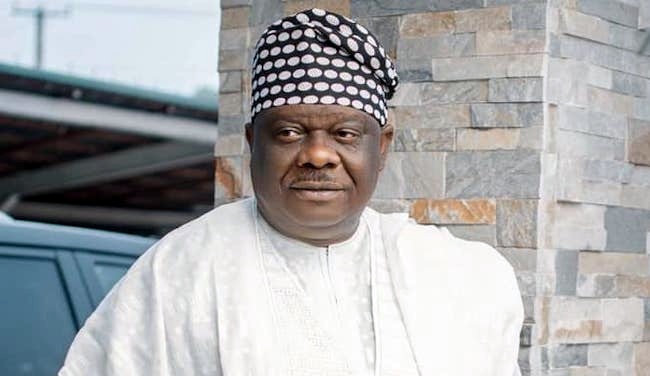
The plaintiffs cited a previous Supreme Court judgement that imposed a lifetime disqualification on Mr Aondoakaa from holding public office.
Four indigenes of Benue State have asked the Federal High Court in Abuja to restrain former Attorney-General of the Federation (AGF), Michael Aondoakaa, from contesting the 2027 governorship election in the state.
They cited a previous Supreme Court judgement which barred Mr Aondoakaa from holding any public office.
Mr Aondoakaa is vying for the 2027 governorship election in Benue on the platform of the Peoples Democratic Party (PDP).
The applicants who described themselves as registered voters in Benue State, are David Ejembi, Aondoaver Teryila, Joseph Okpanachi and Benedict Orkume. The suit is marked FHC/ABJ/CS/2152/2026.
The plaintiffs sued the Independent National Electoral Commission (INEC), the PDP, and Mr Aondoakaa.
They urged the court to declare that INEC is under constitutional obligation to comply with the judgment of the Supreme Court in the case of Michael Kaase Aondoakaa v. Obot (2022) 5 NWLR (Pt. 1824) 523, by stopping PDP from sponsoring Aondoakaa to contest in the 2027 governorship election in Benue.
They argued that this aligns with the provisions of sections 235 and 287(1), read together with the meaning of “public office of a state” in Section 318(1) of the Nigerian constitution.
They prayed the court for an order of declaration that, by a combined construction of the above provisions of the law, INEC is under constitutional obligation to comply with the apex court judgment.
They also prayed for an order of declaration that, by a combined construction of the above provisions of the law, PDP is under constitutional obligation to comply with the judgment of the Supreme Court, by terminating the sponsoring of Aondoakaa’s candidature for the poll.
The plaintiffs, therefore, sought an order of perpetual injunction restraining the commission from allowing PDP to sponsor Aondoakaa to contest for the 2027 Benue governorship election.
They equally prayed the court for an order of perpetual injunction restraining Aondoakaa from contesting in the election.
During Monday’s hearing, Mr Itula informed Judge Abdulmalik that he was unable to serve the court processes on Mr Aondoakaa.
Against this development, the lawyer said an ex-parte motion for substituted service had been filed.
He said the motion sought an order to serve Mr Aondoakaa, the defendant, through the PDP’s office.
After moving the motion, the judge granted the application.
She ruled that a copy of the service shall be forwarded to the court as evidence of service.
The judge also ordered that hearing notices be served on all the defendants. She then adjourned the case until 29 September for further mention.
On 10 December 2021, the Supreme Court affirmed Mr Aondoakaa’s lifetime disqualification from public office, for using his office as the AGF to frustrate the implementation of a court judgement.
Concurring with the decisions of both the lower Federal High Court and Court of Appeal in the unanimous decision, a five-member panel of the Supreme Court led by Mary Peter-Odili (now retired) dismissed the appeal against the lower court’s judgement.
Kudirat Kekere-Ekun, the future Chief Justice of Nigeria, who delivered the lead judgement, held that “The appellant (Aondoakaa), as the Chief Law Officer of the Federation and a Senior Advocate of Nigeria was reckless and acted in a manner most unbecoming of the occupant of such an exalted office.”
The case stemmed from the primary election of the PDP ahead of the 2007 election for the Uyo Federal Constituency of Akwa Ibom State.
Emmanuel Obot, who commenced the suit at the Federal High Court, had emerged as the winner of the primary election.
He said his name was presented to INEC, but only to be later substituted unlawfully with another name.
On 12 December 2007, the Court of Appeal, Calabar division, ordered the President of the Court of Appeal to empanel a new tribunal to hear and determine Mr Obot’s petition in Uyo.
But Mr Aondoakaa, in his capacity as the AGF, wrote the President of the Court of Appeal not to give effect to the decision of the Court of Appeal.
The then President of the Court of Appeal, Ayo Salami (now retired), however, ignored Mr Aondoakaa’s letter, and went ahead to set up a new panel of judges for the tribunal.
On 18 April 2008, the new election tribunal panel gave its judgement ordering that Mr Obot be sworn into the House of Representatives to represent Uyo Federal Constituency.
Affirming the tribunal’s judgement on 2 December 2009, the Court of Appeal ordered INEC to issue a certificate of return to Mr Obot.
By virtue of Section 246(2) of the Nigerian constitution, the decision of the Court of Appeal on legislative elections is final.