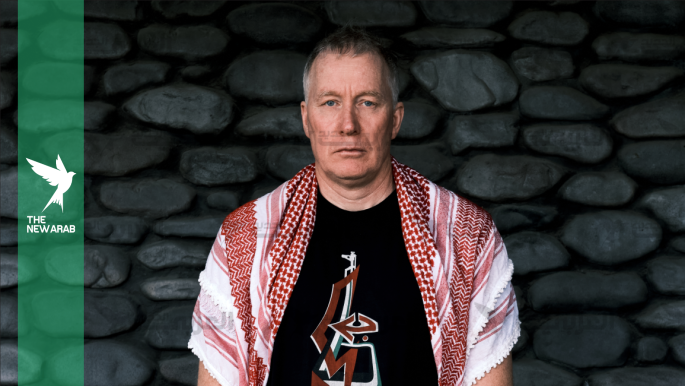
New Zealand’s “Free Palestine” Party leader Paul Hopkinson. [The New Arab]
In an unprecedented move on New Zealand’s political scene, the Free Palestine Party Aotearoa has been launched with the Palestinian cause at the heart of its political platform, describing it as the foremost moral, political and economic issue in the world today.
The party’s launch comes in an election year, amid growing debate over New Zealand’s position on Israel’s genocidal war on Gaza and its relations with Israel.
In an interview with The New Arab, party leader Paul Hopkinson discussed the reasons behind its formation, its political goals, its position on Palestine and New Zealand foreign policy, and how he sees the party’s role in the country’s political life.
Why did you choose to establish a party focused on Palestine in New Zealand, rather than limiting yourselves to participation in events and protest movements? And why now?
We chose to establish a party built around the Palestinian cause because we believe it is the most important moral, political and economic issue facing New Zealand and the world today.
It is the most important moral issue because it represents the greatest genocide and holocaust of this century, taking place in full view of the entire world.
It is also the most important political issue for our country because any state that fails to oppose this genocide and defend international law not only becomes complicit in these crimes against humanity but also loses its credibility and standing on the international stage.
In addition, from an economic perspective, it is the most important issue facing New Zealand and the world because the Israeli regime’s practices and acts of aggression, alongside the United States, against Palestine and Lebanon, as well as its war on Iran, are pushing the world not only towards recession, but towards depression if they continue.
We all take part in protests and events in support of Palestine, and most of us have been involved in supporting the Palestinian cause for decades. The holocaust of the Palestinian people has been ongoing for more than 78 years.
All the parties currently represented in the New Zealand parliament have held power at different stages, but they have failed to support international law or take action against Israel when atrocities were committed against the Palestinian people.
The mainstream media, because of its biased coverage, has also become complicit in the ongoing holocaust of the Palestinian people.
We believe that having an officially registered political party will put this issue directly before the people of New Zealand.
As for the timing, it is linked to the fact that Palestine and the Palestinian people have not faced this level of threat since the Nakba in 1948, regardless of the fact that 2026 is an election year in the country.
The party’s name, “Free Palestine from the River to the Sea”, is controversial and has already drawn criticism. Why did you choose this name in particular?
The party’s name for registration purposes is Free Palestine, while our main slogan is “Free Palestine from the River to the Sea”.
We hope to change the party’s name to this slogan once the registration process is complete.
We chose this slogan and want to adopt it as the party’s name for two reasons. First, because it is the only solution capable of achieving peace in the Middle East and justice for all Palestinians. Second, because it preserves freedom of expression on Palestine, a freedom that no longer exists in the United Kingdom, Germany and elsewhere.
Are you concerned that the party’s name could become a point of confrontation and alienate the public and other political forces, rather than helping the party become a force for Palestinian advocacy?
As for the criticism this may provoke, it is impossible to support Palestine without being criticised by Zionists and their supporters.
The slogan “Free Palestine from the River to the Sea” is not confrontational. Rather, it is a just and clear solution to the genocide and oppression practised by the Israeli apartheid state.
The one-state solution was the answer to apartheid in South Africa, and we, as supporters of Palestine, cannot allow Zionists and their supporters to determine what may be said or done.
What is the party’s legal status? Has it been officially registered, met the requirements and received approval?
The party is still in the registration phase, and this process takes time.
We believe we have submitted a strong and comprehensive registration application. However, the party faces many administrative obstacles and will be subject to opposition and strict scrutiny.
Despite this, strong public support has enabled us to gain, in record time, a number of paid-up members far exceeding the legal minimum requirement of 550.
How would you explain your political programme, and who are you seeking to address in New Zealand?
Our political programme, as outlined in our principles, is based above all on respect for international law, human rights and UN resolutions, and on demanding an independent foreign policy that does not make New Zealand complicit in crimes against humanity.
The right of return and a democratic one-state solution were positions held by the Palestine Liberation Organisation before the disastrous Oslo Accords.
This position remains that of the Popular Front for the Liberation of Palestine, as well as many other groups that represent Palestinians.
I would also note here that Hamas also believes in a one-state solution. Ultimately, it must be the Palestinian people who decide the nature of their state.
We intend to direct our political programme to all New Zealanders.
We also plan to use our position as a registered political party to hold all other parties to account on the issue of Palestine.
Our six core principles, in brief, are: the right of return; the primacy of international law and UN resolutions; respect for the Universal Declaration of Human Rights in relation to Zionist violations; the one-state solution; unconditional support for all forms of Palestinian resistance; and an independent New Zealand foreign policy, including withdrawal from military and security alliances with the United States.
You have previously described the New Zealand government’s position on Palestine as “cowardly”. Why, and what steps do you believe it has failed to take?
I think I have already made my views on the failures of the New Zealand government clear.
As I said, the holocaust of the Palestinians has been ongoing for 78 years.
Throughout this entire period, the New Zealand government has been part of military and security alliances, including the Five Eyes alliance, with the United States, which is Israel’s main supporter. The alliance includes the United States, the United Kingdom, Canada, Australia and New Zealand.
Since the beginning of the latest genocide against the Palestinian people, New Zealand soldiers have taken part in military exercises with the Israeli army and US forces.
On the other hand, successive New Zealand governments have failed to take any steps to hold Israel accountable for its violations of international law or to support UN resolutions related to Palestine.
None of the politicians or parties in our country has shown the courage to take practical steps against the Israeli apartheid state or hold it accountable in any international institution.
As the national spokesperson for the Popular Front for the Liberation of Palestine campaign in New Zealand, how do you respond to those who view your association with this cause as controversial?
As I mentioned, I am the national spokesperson for the Palestine Solidarity Campaign with the Popular Front for the Liberation of Palestine in New Zealand.
As is clear from the party’s principles, we offer unconditional support for all forms of Palestinian resistance, including armed resistance.
I do not see this as controversial because international law grants Palestinians, as a people under occupation, the right to all forms of resistance, including armed resistance.
The Popular Front for the Liberation of Palestine is also not listed as a terrorist organisation in New Zealand.
I believe that other resistance organisations, such as Hamas and other Palestinian factions, should not have been placed on any terrorism list either, if New Zealand had an independent foreign policy.
What message would you like to send to members of New Zealand’s Jewish community who may have concerns or reservations about your party’s positions?
As is clear from our six core principles, nothing in them should concern anyone who believes in human rights and justice, regardless of their ethnicity or religion.
There are many Jews within our movement in New Zealand and around the world who support Palestine.
The attempt by Zionists and their supporters to link all Jews to the most lethal and depraved apartheid regime in the modern world is shameful.
Palestinian society has historically been made up of Muslims, Christians and Jews.
This is a translated version of an Arabic article. To read the original, click here.