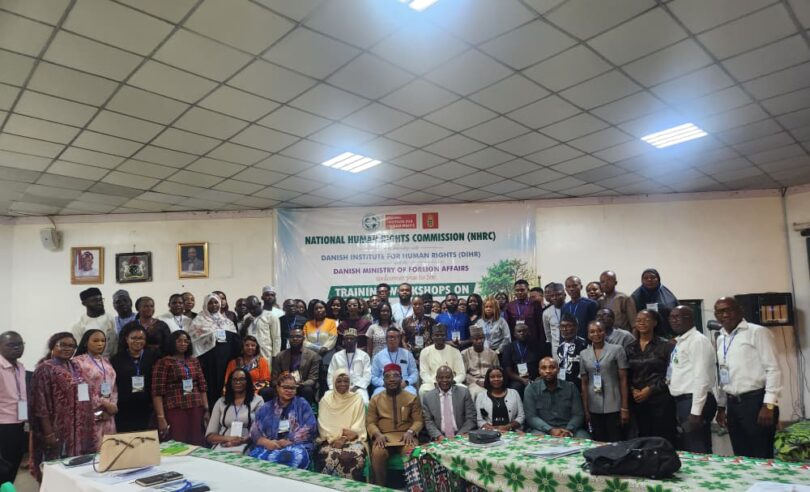
The NHRC called for the engagement of human rights experts to “see the far-reaching implications, not only the physical, but the human rights implications.”
The National Human Rights Commission (NHRC) on Tuesday called for the inclusion of human rights in the national climate change policy.
“The National Policy on climate change should have human rights mainstreamed into it, because if that is not done, there is going to be a gap. The government will be working hard, but the full impact on the lives of the people will not be taken into consideration,” Mr Ojukwu said, as he recommended that “the national policy of climate change must be reviewed to have human rights mainstreamed into it so that the policy will protect the life and rights of the people.”
Mr Ojukwu, a Senior Advocate of Nigeria (SAN), noted that the Nigerian government has focused more on reducing emissions and early warning signs without looking at the human implications of climate change.
The senior lawyer called for the engagement of human rights experts to “see the far-reaching implications, not only the physical, but the human rights implications.” He also suggested that the NHRC should be carried along.
“To have a holistic approach to climate change means that human rights should be mainstreamed into government response plans and research on climate change,” he said.
Nigeria is facing shifts in climate patterns with significant impacts. Climate change has been marked by unusual rainfall, heat waves and severe flooding that has displaced communities and destroyed farmlands.
In 2025, the National Emergency Management Agency (NEMA) disclosed that floods impacted 25 states across Nigeria, killing 228 people and displacing many.
The government has responded to extreme weather events by giving warnings. In July, the Nigeria Hydrological Services Agency issued a seven-day flood advisory, warning of a medium flood risk in 17 states within the month.
Speaking at the workshop, the Chief Advisor at the DIHR, Maria Poppins, noted that climate change has undermined development gains and rights fulfilment.
Ms Poppins said the climate projections are bleak, wthe human rights defenders. The workshop is slated for Tuesday to Friday at the NHRC’s head office in Abuja.
She noted that communities that contribute the least to emissions should at least have a say in how climate policies are formulated.
During the staff training session, Obioha Ben-Okoro, the chief legal officer of the NHRC and climate change focal person, noted that climate change can not be treated only as an environmental issue.
Mr Ben-Okoro explained that climate change could create multiple human consequences. For instance, he noted that flooding in the aftermath of climate change destroys homes, crops, contaminates water, disrupts schools, displaces families and increases the risk of diseases.
These impacts affect the rights to life, dignity, access to food and water and socio-economic rights. “There will also be increased competition for scarce resources, one of the causes of the farmer-herder crisis,” Mr Ben-Okoro emphasised.
He also said that the hazards caused by climate change affect people disproportionately, including disability, socio-economic status, geographic location and gender.
“Climate change does not affect everyone equally; the same hazard can produce very different consequences,” Mr Ben-Okoro said.
He urged the participants at the workshop to employ a human rights-based approach before, during, and after climate change hazards.
Mr Ben-Okoro explained that this can be achieved through participation in decision-making processes, accountability and access to justice, transparency and access to information, and ensuring non-discrimination and equality.
As part of its effort to address climate change in Nigeria, the NHRC inaugurated a National Working Committee in partnership with the Federal Ministry of Environment and the National Council on Climate Change.