
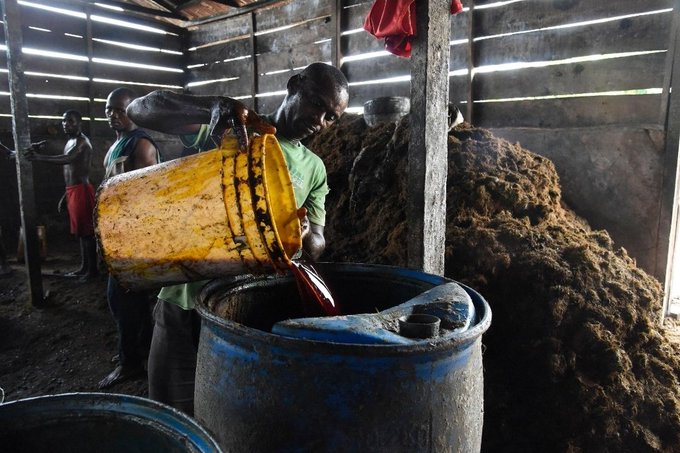
(Nigeria Palm Oil. Photo by Naija News)
Nigeria spends roughly $550 million a year to close its palm oil supply imbalance, according to the Lagos Chamber of Commerce and Industry, which has expressed concern that supply shortages and Indonesia’s new export restrictions are raising local palm oil prices and import expenses.
Leye Kupoluyi, President of the Lagos Chamber of Commerce and Industry, stated at the LCCI 2026 Third Quarter Economic Outlook Press Conference on Wednesday that Nigeria’s economy would be affected by the most recent policy changes made by Indonesia, the world’s biggest exporter of palm oil.
The LCCI president noted that Nigeria consumes between 2.5 million and 3 million tonnes of palm oil annually but produces only about 1.4 million tonnes, leaving a significant supply gap that has heightened the country’s dependence on imports.
According to Kupoluyi, Indonesia, the world’s largest palm oil exporter, has begun implementing strict new export controls and centralisation policies for strategic commodities, a development expected to affect palm oil imports into Nigeria.
He reiterated that Nigeria’s annual consumption of 2.5 to 3 million tonnes far outstrips its domestic production of about 1.4 million tonnes.
He explained that supply shortages and increased levies from Indonesia have directly driven up local palm oil costs and import bills, noting that Nigeria spends roughly $550 million annually to bridge the supply deficit, with recent government data showing N23 billion spent on imports from neighbouring West African nations in a single quarter.
Kupoluyi warned that supply constraints and rising international prices were pushing up production costs for manufacturers, particularly in the food and cosmetics sectors, with implications for inflation.
He said supply bottlenecks and higher global palm oil prices are contributing to inflation in Nigerian packaged goods, heavily affecting the food and cosmetics industries.
He added that while these constraints squeeze manufacturers, the higher prices should serve as a major incentive for local planters and agribusinesses to scale up operations, stressing that government needs to study these developments and swiftly offer incentives to operators in the sector to help them achieve optimal production levels.
The LCCI president urged the Federal Government to use the current market conditions to stimulate domestic palm oil production through targeted incentives for farmers and agribusinesses, arguing that increased local output would reduce import dependence and strengthen the economy.
He also reiterated the chamber’s commitment to engaging government and other stakeholders on policies that would improve the business environment, noting that the Lagos Chamber would continue to engage relevant government agencies, the media, and other interest groups, as and when necessary, on actionable recommendations for a thriving business community.