
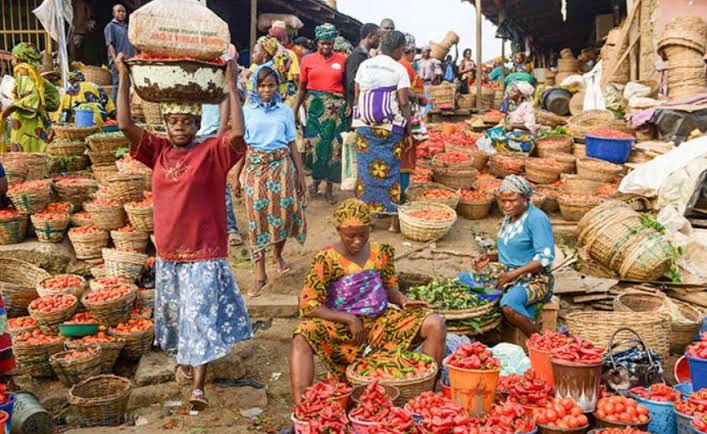
(Food Items. Photo Credit: Nairametrics)
The National Bureau of Statistics, NBS, disclosed yesterday that Nigeria’s headline inflation rate eased slightly month-on-month, dropping by 0.02 percentage points to 15.91 percent in June 2026, down from 15.93 percent in May.
This marks a reversal after three consecutive months of rising inflation since March 2026.
Despite the overall moderation, however, the food index climbed by 0.56 percentage points to 17.52 percent in June, up from 16.96 percent in May, driven largely by price movements in items such as crayfish, fresh pepper, fresh tomatoes, dried green peas, loose yam flour, water yam, beef, banana, cassava flour, cowpea, garri, Irish potatoes and yam tubers.
According to the NBS’s latest Consumer Price Index, CPI, report, the slight dip in headline inflation was mainly driven by a 0.9 percent decline in the core inflation basket, which fell to 15.92 percent in June from 16.82 percent in May.
The Bureau noted that the June 2026 figure represents a decrease compared to both May 2026’s 15.93 percent and the 25.29 percent recorded in June of the previous year.
It added that on a month-on-month basis, headline inflation stood at 1.66 percent in June, which was 0.09 percentage points lower than the 1.75 percent recorded in May, indicating that prices rose at a slower pace in June compared to the month before.
Regarding food prices specifically, the NBS reported that food inflation stood at 17.52 percent year-on-year in June 2026, compared to 25.41 percent in June 2025.
On a month-on-month basis, however, food inflation actually rose to 3.75 percent in June, up by 0.77 percentage points from May’s 2.98 percent.
Breaking this down regionally, the Bureau noted that year-on-year food inflation was highest in Kogi at 53.02 percent, followed by Niger at 43.83 percent and Benue at 40.83 percent, while Katsina, Rivers and Imo recorded the slowest annual increases, at 19.15 percent, 23.81 percent and 24.60 percent respectively.
On a month-on-month basis, food inflation was steepest in Katsina at 16.82 percent, followed by Kebbi at 9.79 percent and Niger at 8.96 percent, while Borno, Benue and Bayelsa recorded declines of 3.54 percent, 2.36 percent and 1.34 percent respectively over the same period.