
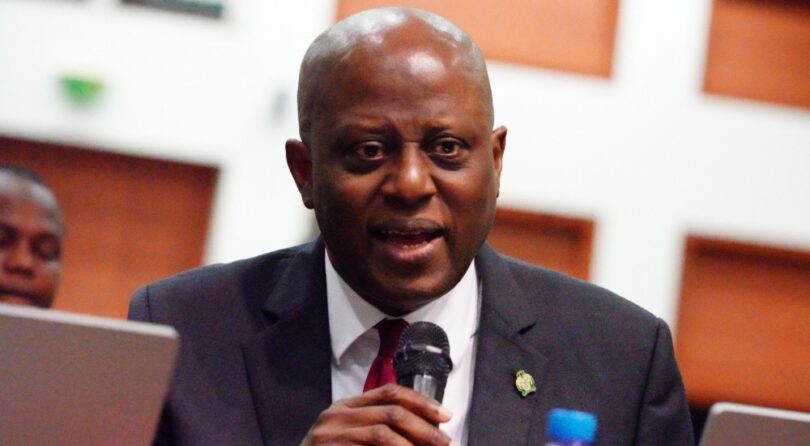
…Says FX Distortions Cost Nigeria More Than Fuel Subsidy
Nigeria lost the equivalent of three percent of its Gross Domestic Product (GDP) as a result of distortions created by multiple foreign exchange (FX) rates, Governor of the Central Bank of Nigeria (CBN), Olayemi Cardoso, has said.
Cardoso disclosed this while reflecting on the reforms undertaken by the apex bank since the current management assumed office three years ago, arguing that the multiple exchange rate regime had imposed significant losses on the economy.
Using Nigeria’s 2023 nominal GDP of about N314tn, three percent translates to approximately:
N9.42tn.
According to him, the losses associated with the differential exchange rate windows were greater than those recorded from the controversial fuel subsidy regime.
He said while the losses from fuel subsidy were estimated at about 2.2 percent of GDP, the losses arising from multiple FX rates were higher, at approximately three percent of GDP.
Cardoso therefore put the combined loss from the two distortions at about 5.2 percent of GDP.
“The losses that were taking place from the differential in exchange rates were way too wide, and you can term that as a subsidy,” he said.
“That subsidy was, well, in short, the losses — let’s call it the losses that we were experiencing from that subsidy was much more than the losses that we were experiencing from the fuel subsidy, and that was something that wasn’t well known to many.”
He added, “The losses from the fuel subsidy were in the region of 2.2 percent, I remember, of GDP. Now that’s a staggering amount of money.
“But guess what? The losses that we were making as a result of these multiple exchange rate windows was more. It was three percent of GDP.
“So between those, you had 5.2 percent of GDP lost. Not sustainable by any stretch of imagination.”
The CBN governor said the situation was worsened by the existence of several exchange rate windows, which he described as a dysfunctional system that created different rates for different categories of users.
He said access to the cheaper rates was not available to everyone, creating opportunities for some individuals and businesses to benefit from the disparity while others were forced to transact at higher rates.
“We had a very dysfunctional foreign exchange market, whereby there were multiplicity of rates,” Cardoso said.
“Depending on who you knew and the access you had would determine the rate you would get.”
According to him, claims about the naira exchange rate at the time failed to capture the actual experience of most market participants because only a limited number of people could access the more favourable rates.
“When sometimes the statement is made that, ‘Oh, this was the rate at that time, and that it is no longer that rate,’ I laugh,” he said.
“Because when you go and do a survey of who was able to get those rates at that lower rate, you’ll find that just a handful were able to do so.”
Cardoso said the CBN’s foreign exchange reforms were aimed at eliminating the distortions and creating a more transparent market in which transactions would be conducted on the basis of market conditions.
He said the reforms had resulted in the unification of exchange rates and the adoption of a willing-buyer, willing-seller approach.
“What has happened is that we have succeeded in closing that gap, unifying the exchange rates,” he said.
He explained that the reform was important not only because of the financial losses associated with the previous arrangement but also because of concerns over fairness and transparency.
“It was important to do this for a number of reasons. Not least, of course, was the fact that it is not fair that some people should profit at the expense of others,” Cardoso said.
He argued that eliminating the multiple-rate system had removed what he described as a major distortion that had affected the Nigerian economy for years.
“We are happy, very pleased that we’ve been able to literally eliminate that distortion, and that our system of willing buyer, willing seller, which allowed transparency and allowed the market to find its own level is where we are today,” he said.
According to him, the FX reforms also contributed to improved stability in the foreign exchange market, allowing businesses to plan and project with greater certainty.
Cardoso said the CBN had moved the economy from a period of severe volatility towards greater macroeconomic stability, noting that the improvement in the external position had also helped reduce pressure on the FX market.
“Stability from a situation of great volatility to one where the market is stable. You can plan. You can project,” he said.
He added that FX pressures had receded significantly, with improved stability also having positive implications for other segments of the economy, including the capital market.
“When we look at the capital markets, where is it coming from? It’s coming from the stability in the foreign exchange markets,” Cardoso said.
The governor also linked the reforms to the rebuilding of the country’s external reserves, which he said had risen to more than $55bn, the highest level in more than 18 years.
He attributed the improvement to consistency and discipline in policy implementation, as well as increased diaspora remittances.
“We have been able to rebuild our reserves,” he said. “We’re in excess of $55bn, the highest number in over 18 years.”
Cardoso further said the CBN’s broader reforms had helped bring inflation down from the levels recorded when the current management assumed office.