This year’s edition focuses on poetry, a genre widely seen as demanding precision, depth, and clarity of expression.
The Nigeria Prize for Literature has received 223 entries for its 2026 edition and has now moved into the adjudication stage.
Sponsored by Nigeria LNG Limited, the award, regarded as one of Africa’s most prestigious literary honours, rotates annually across four genres of literature: prose fiction, poetry, drama, and children’s literature.
This year’s edition focuses on poetry, a genre widely seen as demanding precision, depth, and clarity of expression.
Organisers said the 223 submissions show sustained engagement from writers, even though the figure is slightly below peak years.
The volume remains competitive when compared with recent cycles, particularly in prose fiction, emphasising the prize’s continued relevance.
Speaking at the event, the General Manager for External Relations and Sustainable Development at NLNG, Sophia Horsfall, represented by Abdul Umar, described the handover as the beginning of a rigorous process.
“This marks the start of a process that demands attention, patience, and sound judgement, and will ultimately determine the work that defines this year’s Prize,” she said.
She noted that poetry requires a high level of discipline, where “a single line can define an entire work.”
Stakeholders referenced the 2022 poetry cycle, when Nigerian poet Romeo Oriogun won the prize for his collection ‘Nomad’, a work that continues to resonate within contemporary African literature.
According to Ms Horsfall, such past achievements have set a high benchmark for subsequent editions.
“At NLNG, we have consistently provided a platform that supports excellence and inspires a sustainable future,” she said. “Beyond recognising talent, the Prize has contributed to the growth of reading culture, encouraged discipline in writing, and strengthened Nigeria’s literary landscape.”
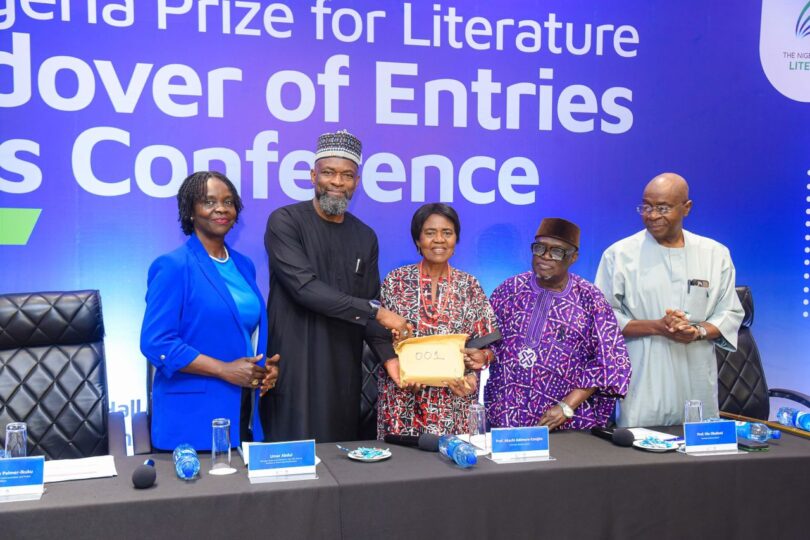
The entries were received by the Advisory Board, chaired by Akachi Adimora-Ezeigbo, who then handed them over to the panel of judges.
Ms Adimora-Ezeigbo said the prize’s credibility rests on its rigorous adjudication process.
“Every entry will be read thoroughly and assessed against standards that have been carefully built and sustained over time,” she said, assuring writers of a fair and merit-based process.
Adjudication
According to the organisers, the adjudication process will span several months, culminating in a longlist of 11 entries, a shortlist of three, and ultimately the selection of a winner later this year.
Organisers say that, beyond the monetary reward, the prize aims to identify works that will shape literary discourse and influence future writing. “The winning work becomes more than a prize recipient; it becomes a benchmark,” Ms Adimora-Ezeigbo noted.
Anne-Marie Palmer-Ikuku, manager of Corporate Communication and Public Affairs at NLNG, said the initiative remains central to the company’s commitment to education and cultural development.
“There are very few platforms in Nigeria that have consistently shaped a field the way this Prize has shaped literature,” she said.
As the adjudication begins, attention now turns to the panel of judges whose decision will determine the winning poetic work for 2026.