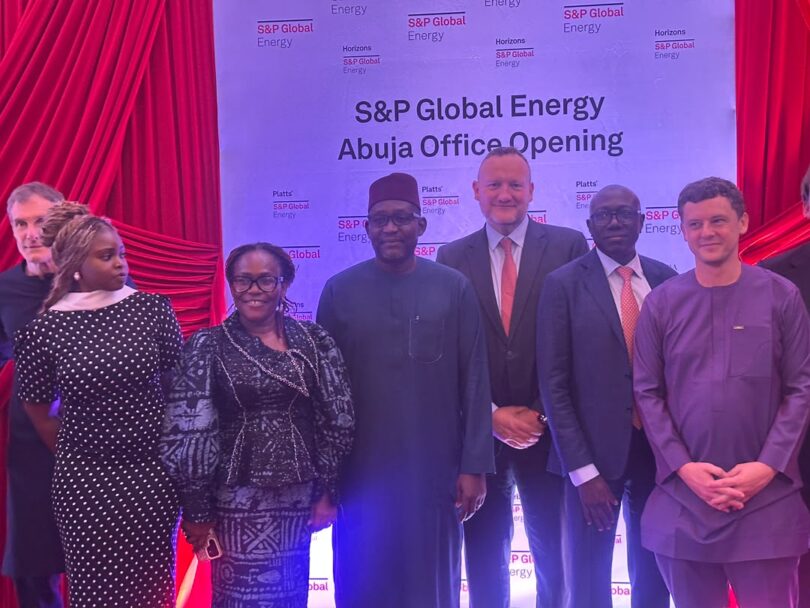
S&P Global Energy says Nigeria and the wider West African region have the potential to emerge as a major pricing hub for petroleum products, driven by increased local supply from the Dangote refinery and growing regional trading activity.
The Executive Director, Strategy and Benchmarks at S&P Global Energy, Joel Hanley, has said Nigeria and the wider West African region have the potential to become a major pricing hub for petroleum products as the region’s refining and trading landscape undergoes significant changes.
He said the emergence of the Dangote refinery had significantly altered the dynamics of the West African petroleum market.
According to him, West Africa is already an energy hub, but increasing volumes of refined products supplied from Nigeria provide an opportunity for the region to develop benchmarks that better reflect local market conditions.
“I’m a big believer that West Africa has the opportunity to be a pricing hub. It’s already an energy hub. Dangote has changed everything,” Mr Hanley said.
He said the growing flow of petroleum products from Nigeria, particularly from the Dangote refinery in Lekki, was changing the region’s traditional dependence on European pricing benchmarks.
“For many years, we’ve seen the pricing linked. People have been pricing their cargoes coming into West Africa from European assessments, European benchmarks,” he said.
While acknowledging the importance of European benchmarks, Mr Hanley said they primarily reflect European market conditions and may not fully capture developments in West Africa.
Mr Hanley said developing and strengthening price assessments for markets in Lekki, Lagos and Lomé could provide a pricing mechanism that better reflects the dynamics of the West African market.
“In order to have a price assessment or a benchmark that is more reflective of the local market, for me, I think it probably makes sense to make sure that we’re assessing markets in Lekki and Lomé and Lagos,” he said.
He said this could encourage market participants to rely less on European benchmarks and focus more on developments within West Africa, particularly Nigeria.
Mr Hanley said S&P Global assesses gasoline, gasoil and jet fuel markets in West Africa, as well as several crude oil grades from Nigeria and other African producers.
He said the company’s role was to ensure that market participants understood how its price assessments were developed, particularly because the figures are used in commercial contracts and investment decisions.
The Senior Reporter, West Africa Refined Products at S&P Global Energy, Matthew Tracy Cook, said the Dangote refinery had significantly changed the structure of the West African petroleum products market.
Mr Cook said Nigeria was transitioning from being largely a price taker to playing a greater role in price formation within the regional market.
“West Africa has been highly dependent on international benchmarks and international supply for its fuel needs — gasoline, diesel and jet fuel. But with the development of the Dangote refinery, that has all changed,” he said.
He said the refinery was contributing significant volumes of products to the regional market, creating new supply flows and changing the traditional pattern of petroleum products being shipped from Europe into West Africa.
According to him, S&P Global’s regional price assessments are intended to provide greater transparency on the changing market dynamics.
He said the company’s assessments could also help market participants understand product flows and arbitrage opportunities between Nigeria and other West African markets.
On discussions around a possible return of petrol subsidy in Nigeria, Mr Tracy said participants at an S&P Global event in Lagos had expressed opposition to such a move.
He stressed that the observation reflected views expressed by market participants and was not his personal position.
“We ran an event in Lagos for the last two days, and during that there was a panel discussion, and there was quite a deep-seated feeling against the return to subsidy,” he said.
According to him, a return to subsidy could complicate the development of a free market and affect marketers and traders seeking to establish West Africa as a major trading and pricing hub.
“I don’t know that a return to subsidy will be overwhelmingly popular among certain parts of the trading community who are trying to build this area as a major hub for trade and price assessment,” he said.
He said market-based pricing would allow regional benchmarks to reflect actual supply and demand conditions.
“Without commenting on whether or not that’s a good thing, what that does allow is for regional benchmark pricing that’s set truly by supply and demand,” he said.
In his remarks at the event, Nigeria’s Minister of State for Petroleum Resources (Oil), Heineken Lokpobiri, described S&P Global as strategic to Nigeria’s energy sector.
“S&P Global is very strategic to our energy sector. We have an existing relationship, and we are committed to ensuring that Nigeria does not take that relationship for granted,” Mr Lokpobiri said.
He welcomed the company’s decision to establish an office in Abuja, saying Nigeria would continue to play its role in the global energy landscape.
“This is very important work, and I want to say that Nigeria will not be left behind. In every ramification, we will make sure that we play our role in the global energy landscape,” he said.