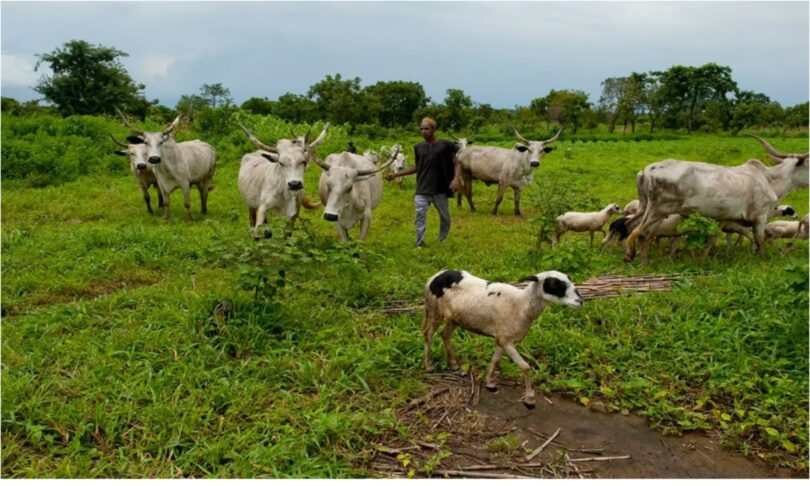
The Federal Government of Nigeria has identified 470 gazetted and legally recognised grazing reserves across the country for the rehabilitation and settlement of pastoralists as part of measures to phase out open cattle roaming in cities such as Abuja and Lagos.
The Minister of Livestock Development, Idi Maiha, disclosed this during an interview on Arise News while discussing the implementation of the National Dairy Policy Framework and broader reforms in the livestock sector.
Maiha explained that relocating herders into designated reserves would improve disease monitoring, animal healthcare and livestock breeding systems.
Responding to questions on whether cattle roaming on city streets would soon end, the minister said open grazing had become unsustainable, noting that long-distance cattle movement negatively affects productivity and contributes to Nigeria’s inability to meet local dairy demands.
“We are sensitising pastoralists to adopt a sedentary lifestyle. Once they settle in designated reserves, all the interventions required to improve productivity become easier to implement,” he said.
The minister also revealed that the government planned to introduce electronic jaw-tagging for cattle to improve monitoring and security.
“We are also introducing jaw-tagging of animals so that once a cow steps outside its designated boundary, an alarm is triggered, indicating it has either strayed or been stolen, and it can be returned immediately,” he added.
Speaking on dairy production, Maiha stated that average milk yield in Nigeria currently ranges between 1.2 and 2 litres per cow daily, compared to countries like Kenya where cows can produce up to 30 litres each day.
He attributed the low output to poor livestock genetics, inadequate feeding systems and weak disease management practices.
According to the minister, Nigeria possesses an estimated 270 million ruminants, including cattle, sheep, goats and camels, but has failed to modernise livestock genetics over the years.
He noted that while several African countries had improved their cattle breeds through deliberate breeding programmes, Nigeria continued to rely largely on traditional breeds with low productivity.
Maiha added that despite the presence of research institutes and veterinary institutions nationwide, large-scale genetic improvement had not been effectively implemented.
“While every other thing in our national space has changed, we have not been able to transform our livestock by introducing new genetics or selecting based on performance traits.
“Either of those approaches would have lifted yields from two litres to 15, 20, 30 or even 50 litres per cow per day,” he said.
The minister said the government’s livestock reform strategy would focus on improved feeding systems, disease control and enhanced genetics under the National Dairy Policy Framework, with the aim of boosting local milk production and reducing dependence on imports.