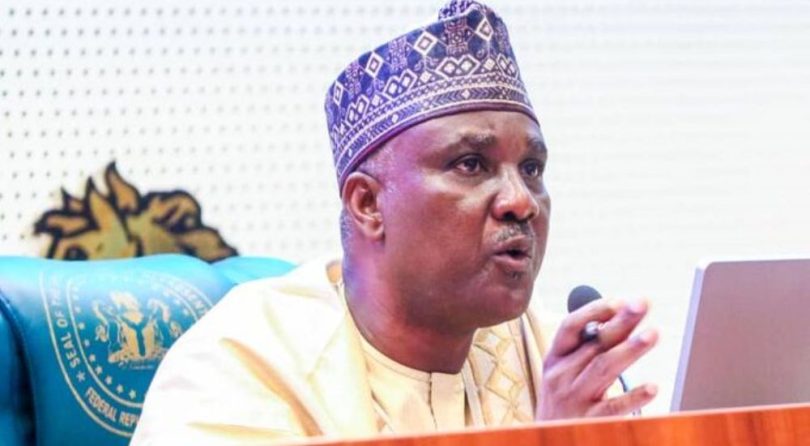
The Speaker of the House of Representatives, Hon. Abbas Tajudeen, has acknowledged the economic and security challenges confronting Nigerians, saying the difficulties faced by households and businesses deserve serious attention from government.
NEWSNGR reports Abbas spoke at the ongoing Global Alliance: World Public Relations Forum in Abuja on Monday, where he addressed issues bordering on responsible communication, democratic accountability, governance and institutional reforms.
Abbas, who was represented by the Majority Leader of the house, Professor Julius Ihonvbere, member representing Owan East/Owan West, said Nigerians had legitimate expectations concerning security, economic opportunities, public services and the quality of governance, stressing that government must ensure that the benefits of ongoing economic reforms translate into tangible improvements in the lives of citizens.
“The difficulties confronting households and businesses are real and deserve serious attention,” he said.
He explained that the reforms being implemented by the administration of President Bola Tinubu were aimed at addressing some of the structural weaknesses, restoring economic stability and laying the foundation for sustainable growth.
However, the Speaker acknowledged that the reforms were neither easy nor without immediate costs, adding that the government had a responsibility to ensure that Nigerians eventually benefit from the measures.
“The challenge before government is to ensure that their benefits translate into tangible improvements in the lives of ordinary Nigerians,” Abbas said.
On insecurity, he said the country’s security challenges required decisive and sustained action, noting that every innocent life lost represented a tragedy that demanded justice and accountability.
“Every innocent life lost is a tragedy that calls for justice and accountability,” he said.
He called for sustained efforts to confront those responsible for insecurity, strengthen security institutions and protect Nigerians irrespective of their religious, ethnic or geographical backgrounds.
“We must remain resolute in confronting those responsible, strengthening our security institutions, and protecting every Nigerian, irrespective of religion, ethnicity, or place of origin,” he added.
Abbas also cautioned against reducing Nigeria’s national image to its challenges, arguing that the country’s difficulties should not overshadow its economic and human progress or its development potential.
He said there was a distinction between reporting the country’s challenges and portraying those challenges as the totality of its national experience.
“There is a difference between reporting a country’s difficulties and reducing the country to those difficulties. There is also a difference between legitimate scrutiny and the construction of narratives that oversimplify complex realities,” he said.
The Speaker maintained that the country was not seeking exemption from public scrutiny but fairness in how its realities were presented.
“We do not seek immunity from scrutiny. We seek fairness in the exercise of scrutiny. This is not an argument for managing Nigeria’s image at the expense of truth,” he said.
He said communication professionals had a responsibility to provide fair, accurate and balanced accounts of national realities, noting that their work was important to public understanding and the effective functioning of democracy.
On Nigeria’s democratic journey, Abbas said the country had sustained constitutional governance since 1999 through successive elections, changes in political leadership and the continued operation of constitutional institutions.
He, however, acknowledged that the country’s democracy remained a work in progress, with challenges relating to institutional capacity, electoral confidence, public accountability and political intolerance.
According to him, the resilience of democracy lies in the constitutional space it provides for disagreement, representation, negotiation and peaceful political competition.
“Democracy cannot thrive on institutions alone. It also depends on the quality of public discourse,” he said.
He stressed that citizens needed reliable information to make informed choices, while political actors should engage through ideas, policies and evidence rather than insults, intimidation and deliberate falsehoods.
Abbas also called for a media environment where journalists could freely scrutinise those in authority while maintaining professional standards.
He said public institutions must equally recognise their obligations to transparency and accountability under democratic governance.
The Speaker further highlighted the importance of parliament in sustaining democracy, describing it as a meeting point between citizens’ aspirations and decisions shaping their collective future.
He said parliament provided a constitutional platform for representation, deliberation and accountability, adding that its legitimacy depended not only on the laws it passed but also on public confidence in its processes.
Abbas noted that the House of Representatives, comprising 360 members representing constituencies across the federation, had a special responsibility to ensure that the diverse interests and concerns of Nigerians were represented.
He identified national security, economic growth and development, education, healthcare, social inclusion, institutional strengthening and an open parliament as priorities of the legislature.
According to him, legislative performance should ultimately be assessed by its contribution to the welfare, security and opportunities available to Nigerians.
He also disclosed that the National Assembly had advanced constitutional reforms aimed at strengthening the country’s security architecture, including the proposed establishment of state police.