Nigeria’s ambition to build a $1 trillion economy will depend heavily on its ability to attract investment, support enterprise growth and sustain economic reforms, with Lagos State positioned at the centre of that journey, Vice President Kashim Shettima has said.
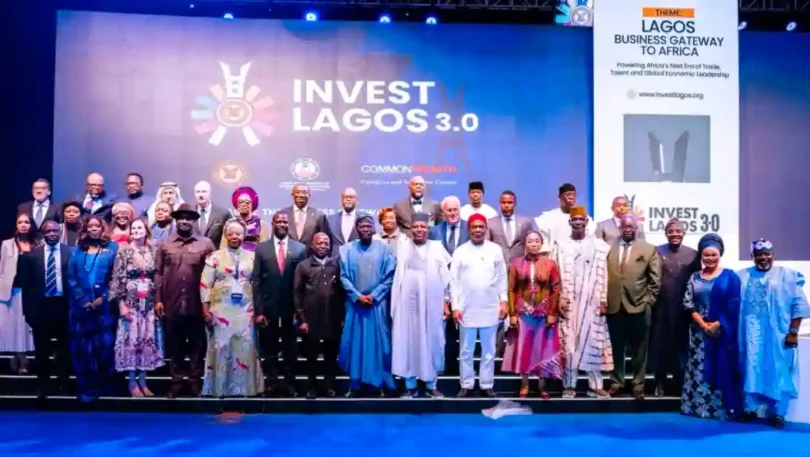
Speaking at the opening of the Invest Lagos 3.0 Summit held at Eko Hotel and Suites in Victoria Island, Lagos, the Vice President described Lagos as the strongest example of how subnational leadership can drive national economic transformation.
Addressing policymakers, investors, entrepreneurs, development partners and business leaders, Shettima said Nigeria’s economic future would be shaped by the creation of an environment where capital, innovation and productive businesses can thrive.
According to him, Lagos has consistently distinguished itself as Nigeria’s foremost economic gateway and one of Africa’s most important destinations for commerce and investment.
“Lagos is the livewire of our continent. Lagos is the furnace in which our ideas are tested against the discipline of execution. Lagos is the great doorway through which Nigeria continues to greet the future,” he said.
The Vice President noted that while Lagos is widely recognised as Nigeria’s commercial capital, its importance extends beyond commerce. He said the state has become a testing ground for governance, policy innovation and economic execution.
For decades, Lagos has remained Nigeria’s largest contributor to internally generated revenue, home to major financial institutions, technology companies, multinational corporations and critical infrastructure. The state also accounts for a significant share of the country’s economic activity, making it a key driver of national growth.
Shettima argued that Lagos’ progress demonstrates that economic transformation is possible when leadership, institutional continuity and private sector confidence work together.
He credited the state’s growth trajectory to years of consistent planning and governance reforms, particularly since Nigeria’s return to democratic rule.
The Vice President praised President Bola Ahmed Tinubu for laying the foundation of what he described as the Lagos development model, saying the governance framework established during Tinubu’s tenure as governor created a structure that subsequent administrations have continued to build upon.
“President Bola Ahmed Tinubu planted the tree whose shade has sheltered a succession of leaders committed to futurist ideas, institutional continuity and disciplined governance,” he said.
Shettima also commended Governor Babajide Sanwo-Olu for sustaining the momentum and strengthening Lagos’ position as a destination for investment and business expansion.
His remarks come as Nigeria pursues a broader economic agenda aimed at expanding the size of the economy through private sector-led growth, infrastructure development, industrialisation and increased investment inflows.
The Vice President said the goal of building a $1 trillion economy cannot be achieved through government spending alone, stressing that the private sector remains central to the country’s economic ambitions.
He pointed to Lagos as evidence that when governments create the right conditions, businesses and investors respond.
Referring to the summit’s theme, “Lagos: The Business Gateway to Africa,” Shettima said cities are increasingly becoming the engines of global economic growth, shaping production systems, supply chains, innovation networks and investment flows.
He noted that Lagos continues to attract investors because of its access to markets, infrastructure, talent and financial opportunities.
The state hosts some of Africa’s largest technology startups, financial institutions and industrial clusters. It is also home to one of the continent’s busiest seaports and remains a critical hub for trade and logistics.
For investors looking at Africa, Lagos often serves as a first point of entry due to its population size, business ecosystem and strategic location.
According to Shettima, Nigeria’s long-term economic success will depend on strengthening such ecosystems and ensuring that reforms create an environment where businesses can grow sustainably.
He reaffirmed the Tinubu administration’s commitment to economic reforms, saying recent policy decisions were designed to restore market confidence, improve fiscal sustainability and unlock large-scale private investment.
The administration has introduced several reforms over the past two years, including changes to fuel subsidy policy, foreign exchange management and fiscal administration.
While acknowledging that some of these measures have been difficult for citizens and businesses, the Vice President maintained that they were necessary to create a stronger economic foundation.
“We have taken difficult decisions because we understand that the economy of our dream cannot be built on illusions. It must be built on productivity, discipline, competitiveness, and the courage to create a climate in which enterprise can breathe,” he said.
The Vice President also highlighted Nigeria’s demographic advantage and strategic position within the African Continental Free Trade Area (AfCFTA).
With one of the world’s fastest-growing populations and access to a continental market of more than 1.4 billion people through AfCFTA, Nigeria has an opportunity to emerge as a leading centre for manufacturing, logistics, innovation and investment, he said.
However, he stressed that the Federal Government cannot deliver economic transformation in isolation.
Instead, collaboration between federal and state governments, investors, entrepreneurs and development institutions will be required to achieve long-term growth.
Governor Babajide Sanwo-Olu echoed similar sentiments during the summit, describing Lagos as an investment-ready destination that provides opportunities across multiple sectors of the economy.
According to him, the summit reinforces Lagos’ role as a gateway through which investors can access opportunities in agriculture, technology, commerce, infrastructure, energy and other growth sectors.
The governor also acknowledged the role played by President Tinubu in shaping modern Lagos, noting that the state’s current trajectory is built on years of reforms and long-term planning.
Sanwo-Olu outlined progress made by his administration in areas such as transportation, healthcare, human capital development, agriculture, technology and energy.
He said Lagos remains committed to creating an enabling environment for businesses and investors.
The economic significance of Lagos was also highlighted by other speakers at the summit.
Minister of Finance and Coordinating Minister of the Economy, Taiwo Oyedele, said recent reforms undertaken by the Federal Government are already helping to strengthen economic resilience across the country.
He noted that Lagos continues to stand out as a leading example of subnational development, particularly in trade and commerce.
According to Oyedele, efforts to address structural weaknesses in the economy are beginning to produce visible results across different sectors.
Lagos State Commissioner for Commerce, Cooperatives, Trade and Investment, Folashade Bada, said the summit sends a clear message that Lagos remains open for business, partnerships and investment.
She assured investors that the state would continue to provide a conducive environment for businesses to succeed.
The international community also expressed confidence in Lagos and Nigeria’s economic prospects.
Commonwealth Secretary-General Shirley Botchwey described Lagos as a city that has moved beyond potential to proof, citing its growing influence in technology, culture and enterprise development.
Chairman of the Commonwealth Enterprise and Investment Council, Lord Marland, said strong and pragmatic leadership is essential at a time of global economic uncertainty.
He noted that Nigeria’s leadership has demonstrated a willingness to pursue reforms and position the country for future growth.
Representatives from Afreximbank and the AfCFTA Secretariat also reaffirmed their confidence in Lagos’ ability to drive investment, trade and entrepreneurship across Africa.
Their comments reflected a broader consensus among participants that Lagos is uniquely positioned to benefit from Africa’s expanding trade opportunities and growing digital economy.
As Nigeria pursues its ambition of becoming a $1 trillion economy, the message from the Invest Lagos 3.0 Summit was clear: Lagos is expected to play a central role in that journey.
For policymakers, investors and entrepreneurs, the state represents not only Nigeria’s largest economic centre but also a model of how coordinated reforms, private sector participation and long-term planning can accelerate growth.
Whether Nigeria ultimately achieves its trillion-dollar ambition may depend on how successfully it can replicate across the country the conditions that have helped Lagos become the nation’s leading hub for business, investment and innovation.