
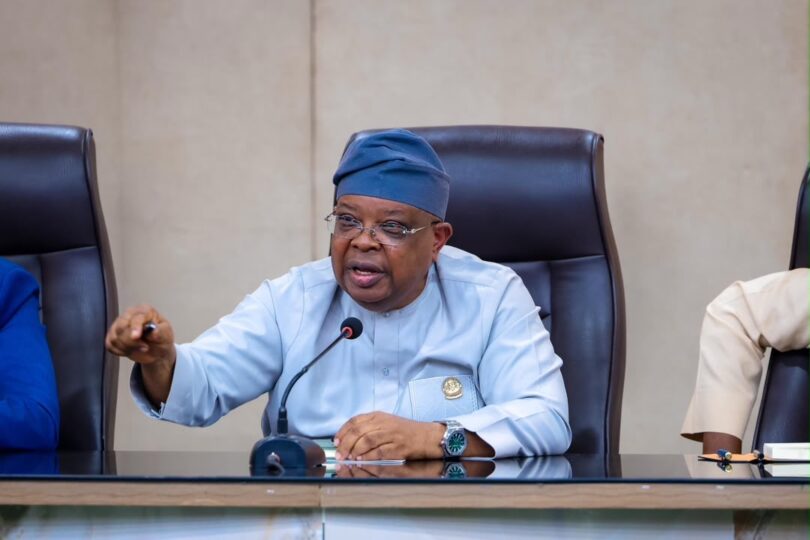
Nigeria’s Minister of Power, Joseph Tegbe, says the Federal Government is shifting its focus from immediate stabilisation of the electricity sector to deeper infrastructure reforms, investment mobilisation and expansion of the national grid
Nigeria’s Minister of Power, Joseph Tegbe, has announced a new phase of infrastructure development and investment mobilisation as the Federal Government moves from immediate power sector stabilisation towards building a more resilient and future-ready electricity system.
President Bola Tinubu, in June, swore in Mr Tegbe as Minister of Power alongside Sola Enikanolaiye, who was appointed Minister of State for Foreign Affairs.
Their appointments followed the resignations of the former Minister of Foreign Affairs, Yusuf Tuggar, and that of Power, Adebayo Adelabu.
During his Senate screening, Mr Tegbe warned that Nigeria’s electricity crisis would require tough and transparent reforms, stressing that there were no quick fixes.
He said the government’s approach to the sector must change.
“We will not do things the way we used to do before. I will not promise what I cannot deliver,” he said.
Mr Tegbe, who was previously appointed by Mr Tinubu in 2025 as Director-General of the Nigeria-China Strategic Partnership, described electricity as a foundation for national confidence, noting that decades of reforms had yet to produce the desired results.
He pledged to prioritise execution over rhetoric, identifying power distribution, metering, transparency and sub-national participation as key areas of intervention.
“We must close the metering gap and ensure Nigerians can track performance through a transparent public dashboard. The sector must be properly structured, and the people deserve to see real improvement,” he said.
He also said sub-national governments would be encouraged to generate electricity to reduce pressure on the national grid.
“We will come with clear milestones. If results are not visible in three months, they won’t be in six,” he added.
On Tuesday, Mr Tegbe said the Ministry’s initial focus during his first 100 days had been to stabilise the existing electricity system, restore stranded generation capacity and strengthen the commercial and governance foundations needed to attract sustainable investment.
According to him, the next phase of the government’s intervention will focus on four priorities: deeper grid stabilisation, development of the Transmission Super Grid, improved utilisation of existing assets and preparation for future electricity demand.
The minister said Nigeria’s recent power mission to China secured commitments from Chinese companies and financiers to accelerate priority electricity projects based on defined completion schedules.
He said the engagements were designed to move beyond financing discussions towards partnerships involving capital, technology transfer and project delivery.
Mr Tegbe said CMEC had reaffirmed its role in the 1.9GW Presidential Power Initiative (PPI), with the first transmission lines scheduled for delivery in the first quarter of 2027.
CNEEC, he added, had advanced financing arrangements for the $116 million Zungeru power evacuation project, with approval targeted before the end of the year.
TBEA also committed to a proposed $500 million industrial park for power-equipment manufacturing, alongside accelerated work on the PPI and a three-year delivery pathway for the East-West Super Grid.
HengFei Cables, according to the minister, committed to supplying cables for PPI Phase Two and proposed establishing a cable assembly plant and training centre in Nigeria.
Mr Tegbe said the initiatives would help link infrastructure development with local production and technical capacity.
The minister said the Ministry had commenced technical audits along the Lagos and Abuja transmission corridors to identify system weaknesses and guide investment towards interventions with measurable impact.
He identified the Lagos, Enugu-Port Harcourt and Abuja-Kaduna-Kano corridors as central to the government’s grid-stabilisation programme.
He said the Ministry would also begin developing the Transmission Super Grid while continuing corridor stabilisation through the PPI and other related programmes.
Nigeria’s electricity sector continues to face challenges across generation, transmission and distribution, limiting the availability and reliability of power for households and businesses.
Unreliable gas supply, low generation output, ageing infrastructure, transmission bottlenecks, sector indebtedness, vandalism, metering gaps, tariff shortfalls and governance challenges have continued to undermine electricity supply.
Amidst these plethora of challenges, The federal government recently raised approximately N728.9 billion through the Series 2 bond issuance under its N4 trillion Power Sector Multi-Instrument Issuance Programme, as part of efforts to resolve longstanding financial obligations in Nigeria’s electricity market.
The lingering power challenges have forced many households and businesses across Nigeria to rely heavily on petrol and diesel generators, as well as solar systems, to supplement electricity from the national grid.
Mr Tegbe said the Federal Government had signed a cooperation agreement with Huawei Technologies covering grid digitalisation, loss reduction, SCADA gap assessment and technical training.
He said improved digital visibility and system control were necessary to strengthen the management and performance of the national electricity network.