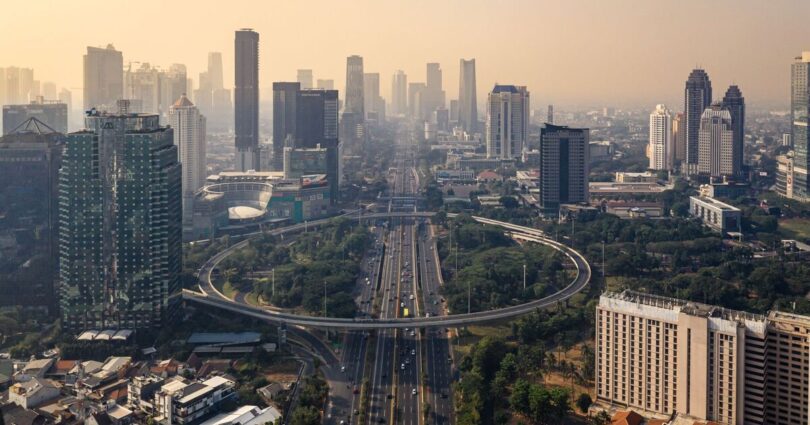
The city is home to around 42 million people (Image: Getty)
When people think of the world’s biggest cities, names like London, Tokyo and Istanbul usually come up first. All three are huge global hubs with millions of residents. But none of them currently hold the title of the world’s largest mega-city.
That title now belongs to a capital in Southeast Asia. According to 2025 UN estimates and data cited by the World Cities Culture Forum, Jakarta has now officially overtaken Tokyo as the world’s most populous metropolitan area.
READ MORE: UK mega-city that has already swallowed 5 market towns and continues to grow
READ MORE: Insane mega-city set to become the world’s largest with 100m people

Millions of people have moved to Jakarta from across Indonesia (Image: Getty)
While the city of Jakarta itself has a population of around 10.5 million, the “world’s largest” label refers to the wider Greater Jakarta region, known as Jabodetabek.
That urban area is now home to around 42 million people. By comparison, Tokyo’s metropolitan population has fallen to around 33 million, Istanbul stands at roughly 16 million and London at about 9.7 million.
Jakarta’s quick growth has been driven by a combination of factors. It is Indonesia’s political, economic and cultural centre, generating an estimated 17% to 20% of the country’s total GDP.
Millions of people have moved there from across Indonesia’s 17,000-plus islands in search of work in manufacturing, finance and services.
As a result, over time, Jakarta has physically merged with surrounding cities such as Bogor, Depok, Tangerang and Bekasi, creating one continuous urban area that stretches across western Java.
However, that scale has unsurprisingly brought serious challenges. Jakarta is widely described as one of the fastest-sinking cities in the world.

The city regularly ranks among the most congested in the world (Image: Getty)
Parts of North Jakarta are subsiding by up to 25 centimetres per year. This is largely due to excessive groundwater extraction, as piped water systems do not fully serve the huge population.
Traffic congestion is another major issue. The city regularly ranks among the most congested in the world, with long delays affecting daily life and costing the economy billions in lost productivity.
Infrastructure has also struggled to keep up. Only a limited proportion of the metropolitan area is connected to a formal sewage system, leading to pollution in many of its 13 rivers.
Looking ahead, some projections suggest Greater Jakarta’s population could reach between 45 and 50 million by 2050 if trends continue.
In response to overcrowding and environmental concerns, Indonesia is moving its official capital to a new purpose-built city called Nusantara in East Kalimantan on the island of Borneo.
While government offices will move, Jakarta is expected to remain the country’s main financial and business centre.

Jakarta is widely described as one of the fastest-sinking cities in the world (Image: Getty)
Despite all of these challenges, Jakarta is a popular tourist destination with plenty to do and see.
The National Monument, known as Monas, stands 132 metres tall in Merdeka Square and commemorates Indonesian independence. Visitors can climb to the observation deck for panoramic views.
The city is also home to Istiqlal Mosque, the largest mosque in Southeast Asia, which sits opposite the neo-Gothic Cathedral of Our Lady of the Assumption.
In Kota Tua, or Old Town, visitors will find cobbled streets and colonial Dutch buildings.
Jakarta is also famous for its massive shopping centres, including Grand Indonesia, and for its street food, from gado-gado to sate ayam.