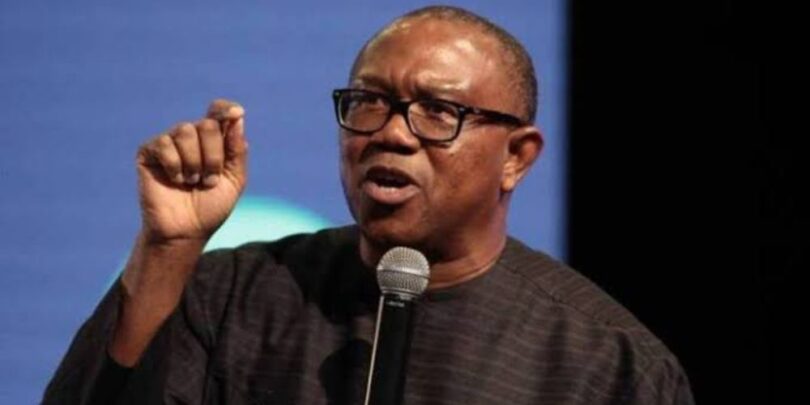
Mr Peter Obi has said his strategy to end insecurity, if elected president in 2027, will be intelligence and technology driven. Obi delivered his acceptance speech after securing the presidential ticket of the Nigeria Democratic Coalition (NDC) on Saturday in Abuja.
He said the moment marked a turning point for the country and urged his supporters to remain focused on rebuilding trust in governance.
Obi, who stressed that national unity remains central to his vision, warned against divisions along ethnic and religious lines.
In his address, Obi expressed concern that Nigeria’s global ranking in terrorism impact assessments had continued to decline in recent years.
“We must address insecurity with resolve and urgency, for no nation can thrive while its citizens live in trepidation. The primary responsibility of government is to ensure the safeguarding of lives and property,” he said.
“Our strategy will be intelligence-driven, technology-enhanced, proactive, and community-focused. We will fortify our security institutions, enhance operational coordination, support our courageous personnel, and tackle the underlying causes of insecurity—namely poverty, unemployment, and marginalisation.”
Obi said restoring safety would allow farmers to return to their fields, students learn without fear, and businesses regain confidence in the economy.
The former Anambra State governor, who has positioned himself as a reform-driven candidate, also pledged to prioritise healthcare, education, food security, and job creation if elected.
Below is the full text of his acceptance speech:
ACCEPTANCE SPEECH BY MR. PETER OBI FOLLOWING HIS NOMINATION AS THE PRESIDENTIAL CANDIDATE OF THE NIGERIAN DEMOCRATIC COALITION (NDC) – MAY 30, 2026
Protocols,
Esteemed citizens of Nigeria,
It is with deep humility that I accept the role of presidential candidate for our party.
I express my profound gratitude to the leaders of our party. His Excellency Seriake Dickson, the National Chairman, National Secretary and the National Working Committee, NWC members and members of our relentless supporters, and the Nigerian populace who have steadfastly kept the spirit of hope alive. I commend those who have made the journey from every region of our nation to convene here in Abuja.
I wish to assert unequivocally: a New Nigeria is Possible. This conviction has united us; it must serve as our compass on the challenging road ahead and sustain us through all trials we may face. This pivotal moment transcends the individual ambitions of Peter Obi; it concerns the essence of our nation and the future of our children. It is about rekindling hope for millions who have faced adversity yet remain committed to Nigeria.
Today, our nation finds itself at a crucial juncture, enveloped in uncertainty. Families are anxious about their safety; parents are concerned for their children’s futures; and talented youth increasingly question their prospects in their homeland.
Businesses are struggling, communities are suffering, and an alarming number of citizens have lost faith in the very concept of governance. Yet, I stand before you filled with optimism and strong faith in the resilience of our people, for I firmly believe that a New Nigeria is possible.
To realise this New Nigeria, we must first mend the foundational elements essential for the success of any nation.
Nigeria cannot advance while fragmented by ethnic, religious, regional, or narrow political divides. We may communicate in different languages and practise diverse faiths, but we share a singular destiny under one flag. Our diversity should not be a source of division; rather, it is among our greatest strengths.
We should build bridges where others erect barriers, replace mistrust with confidence, division with understanding, and resentment with a collective purpose. A united Nigeria is indispensable. As Will Durant wisely pointed out, “A great civilisation is not conquered from without until it has destroyed itself from within.” We must never self-destruct. We must heal, unify, and progress together.
In terms of security, the situation in Nigeria has considerably worsened. The global terrorism impact assessments ranked Nigeria as the 8th most affected nation in 2022, 6th in 2024, and 4th in 2026.
Yet, for many years, Nigeria garnered global recognition as a reliable contributor to peacekeeping, regional stabilisation, and conflict resolution. Our troops have not only displayed bravery but have also shown professionalism, discipline, resilience, and empathy in the most challenging operational contexts. Our officers and personnel have successfully commanded multiple international forces, safeguarded vulnerable civilian populations, monitored ceasefires, reinstated constitutional order, and contributed to rebuilding efforts.
Nigeria became one of the leading contributors of troops from Africa to UN peacekeeping missions and earned widespread admiration for operational effectiveness and leadership in various countries, including Rwanda, Sudan, Liberia, Sierra Leone, Mali, Western Sahara, Congo, Lebanon, Cambodia, Haiti, and Kuwait. At one point, a Nigeria, Lt. General Isaac Obiakor (retd) even led global peacekeeping initiatives.
We must address insecurity with resolve and urgency, for no nation can thrive while its citizens live in trepidation. The primary responsibility of government is to ensure the safeguarding of lives and property. Farmers must be able to return to their fields securely; students must be able to learn without fear; communities must be able to rest peacefully; and investors must regain their confidence in Nigeria.
Our strategy will be intelligence-driven, technology-enhanced, proactive, and community-focused. We will fortify our security institutions, enhance operational coordination, support our courageous personnel, and tackle the underlying causes of insecurity—namely poverty, unemployment, and marginalisation.
Regarding health, Nigeria is currently ranked 157th globally, placing it in the lower echelon of healthcare worldwide. Primary healthcare, the cornerstone of our medical system, remains severely not functional with only 10% to 20% of approximately 30,000 primary healthcare centres operational.
As a result, Nigeria suffers from one of the highest infant mortality rates in the world. Furthermore, health insurance coverage in Nigeria hovers around a mere 10%, in stark contrast to countries like Indonesia, which boast over 90% coverage. This situation is regrettable.
I pledge that within four years, our health insurance coverage will more than double to over 20%.
Within these four years, we will increase our healthcare budget to a minimum of 10% of our GDP, up from the current level of below 5%. We will invest heavily in and support our healthcare institutions to ensure the massive training of our healthcare workers, including nurses and other professionals. We shall also adequately staff our medical facilities.
In four years, there will be a fully functional and properly managed primary healthcare centre in all 8,809 wards across the nation. By the conclusion of our term, Nigeria will ensure that at least 50% of its 30,000 primary healthcare centres are fully functional, properly manned, and dedicated to serving the populace.
Education will remain at the forefront of our national revival, as no country can grow beyond its educational system. Nations that have transformed successfully have done so through sustained investment in human capital. Our children are not burdens; they represent our most valuable assets. We will invest heavily in schools, teachers, technology, and vocational training, ensuring that education equips our youth not only to seek employment but also to generate it. We must pivot Nigeria from a cycle of shared poverty to one of collective prosperity through knowledge, innovation, and productivity.
In 2023, when the present government took office, Nigeria ranked 109 out of 150 nations on the Global Hunger Index.
And by 2025, our ranking further plunged to 115th, placing us among the hungriest nations globally. Currently, the World Food Programme estimates that over 35 million Nigerians will face acute hunger and food insecurity this year. This is unconscionable, given our vast expanses of uncultivated land.
Rice remains the most consumed food in Nigeria. To illustrate our level of unproductivity, let us compare our capabilities with those of leading rice-producing nations. India is the largest producer of rice, yielding approximately 200 million tonnes of unmilled rice.
Bangladesh is the third largest producer, produces around 60 million tonnes of unskilled Rice, while Vietnam is the 5th, produces about 42 million tonnes.
Let us consider the land-to-population ratios:
India has a landmass of 3,287,263 square kilometres. Distributed across its population of 1.4 billion people, this equals roughly 2. 34 Square meter per person.
Bangladesh, with a landmass of around 148,460 square kilometres and a population of 170 million, has less than 1 square metres per person.
Vietnam’s landmass covers 331,000 square kilometres. Divided by a population of 102 million, it yields about 3.25 square metres per person.
Nigeria has a massive landmass of 923,768 square kilometres. Divided by our population of approximately 230 million, this results in about 4.00 square metres per person.
The foregoing clearly illustrates that we have absolutely no justification for being among the world’s hungriest nations.