
Senator representing Ogun Central, Shuaib Afolabi Salisu, has said Nigeria must urgently reform its legal and governance systems to align with the realities of the global digital economy, warning that while the world has embraced technology, “our laws are still analogue.”
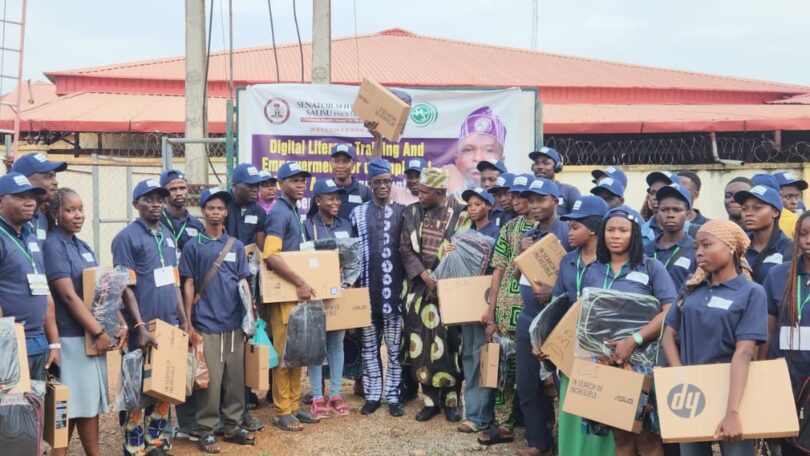
The lawmaker, who chairs the Senate Committee on ICT and Cybersecurity, spoke at the end of a two-week digital skills training programme held in Abeokuta for youths drawn from across the district.
The programme, organised in collaboration with the National Information Technology Development Agency and the Federal Ministry of Communications, Innovation and Digital Economy, trained about 350 participants in areas including cybersecurity, content creation, and digital skills.
Speaking at the closing ceremony held at the JAMB office in Oke-Mosan, Abeokuta, Salisu said the future belongs to countries and individuals that embrace technology.
“You know, the significance of this training is such that everybody is aware now that technology is the direction to go and the digital economy is growing. We therefore need to focus on two things — education and ICT skills,” he said.
The senator cited the rise of global digital platforms as evidence that technology has become the backbone of modern economies, opining that anyone without digital skills risks being left behind in today’s economy.
“What does this mean? It does mean that any citizen now that does not have ICT skills, such a person is impaired in what they can do,” Salisu added.
The senator said participants underwent one week of virtual training and another week of physical practical sessions to ensure they acquired hands-on knowledge before receiving laptops.
“At least, we have ensured that we are not giving out laptops for people to go and sell them easily. They have been properly trained,” he stated.
On the proposed National Digital Economy and E-Governance Bill currently before the National Assembly, Salisu described the legislation as a major legacy project aimed at modernising governance in Nigeria.
“This bill is in the third and final stage. This is one bill I want to leave as a legacy of my first term in the Senate. The society has gone digital. Our laws are still analogue. So, the first thing that this bill will do is to ensure that we provide a regulated environment to provide clarity about our electronic transactions.”
He explained that the bill would also compel government agencies to digitise their operations and services, adding that the proposed law would create a national digital exchange system to allow government institutions to share citizens’ data seamlessly.
The lawmaker expressed optimism that the legislation would be passed and signed into law before the National Assembly proceeds on recess later in the year.
Speaking on electronic voting and Nigeria’s digital progress, the senator argued that the country has already made significant advances in technology deployment.
He also pointed to the technological systems deployed by the Joint Admissions and Matriculation Board, saying officials from other African countries recently visited Nigeria to understudy its admission processes.
While acknowledging that more work still needs to be done, he said ongoing investments in broadband infrastructure under the federal government’s fibre optic expansion project would improve digital connectivity nationwide and support future electronic voting systems.