
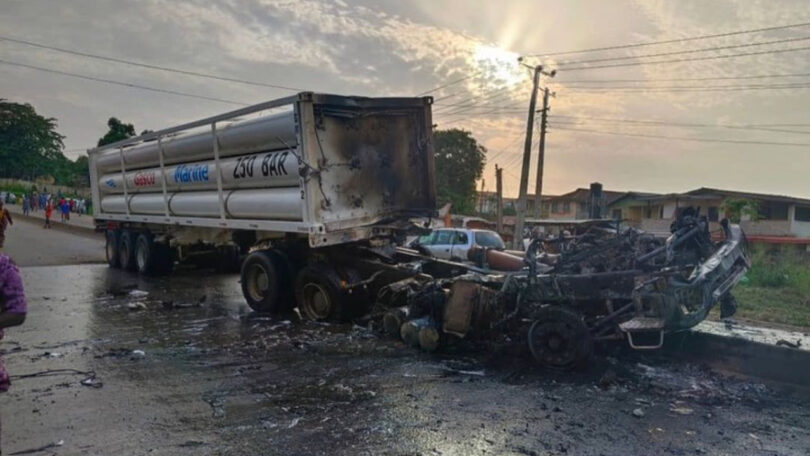
Hardly a week passes in Ogun State without a devastating road crash leaving behind deaths, crushed metal, shattered glass and burnt vehicles.
Structurally positioned as Nigeria’s primary gateway and economic artery, Ogun connects millions of commuters, goods, and industrial hubs to the rest of the country. Yet, these vital transit corridors have increasingly turned into deadly traps.
Full-year statistics from the Federal Road Safety Corps, FRSC, Ogun State Sector Command, paint a grim picture: in 2024, the state recorded 724 crashes, which claimed 311 lives and left 1,815 people injured. The carnage continued into the following year, with the first half of 2025 alone recording 494 crashes, 212 fatalities and 1,121 injuries.
Data from the first six months of 2026 shows a modest improvement, with 415 recorded accidents, 161 deaths and 1,007 injuries.
The sheer volume of casualties proves that Ogun’s transit corridors remain a major safety concern, driven by a culture of unchecked highway recklessness, excessive speed and dangerous overtaking that continuously leaves grieving families to pick up the pieces.
How Good Roads Became a Curse
While several road networks across the state remain in severe disrepair, official data reveals that paved and smooth corridors prove to be the most dangerous.
Free from potholes and traffic-choking obstacles, these good stretches tempt motorists into a false sense of security, encouraging excessive speeding, distracted driving and reckless overtaking maneuvers.
In an interview with DAILY POST, Superintendent Route Commander Afolabi Odunsi, the Public Relations and Education Officer for the FRSC Ogun Sector Command, confirmed this trend, revealing that drivers routinely lose caution on well-paved surfaces.
He identified the Ogunmakin axis, the Ijebu-Ode Expressway, the Abeokuta–Sagamu Expressway and the Ogbere axis as primary black spots for severe traffic violations and accidents.
According to him, these crashes stem from three core elements: the environmental, mechanical and human factors, arguing that the human factor accounts for over 90 percent of all incidents with driver behavior being the primary trigger.
“What we observe is that people tend to speed more when the road is good,” Odunsi said.
“When a road is bad, drivers exercise caution because nobody wants to damage their vehicle or risk getting stranded.
“But having good roads shouldn’t feel like a curse. Why should we be recording fatal crashes on well-paved corridors? It shows that the human factor can never be underestimated. We are the root cause.
“A vehicle cannot speed on its own; it only obeys the driver’s instructions through the accelerator or the brake,” Odunsi explained, pointing to excessive speed, phone distractions, drunk driving and heated arguments with passengers as major causes of deadly crashes.
Beyond alcohol, the FRSC spokesperson cautioned against consuming food or drinking water while in motion.
“While we advise against drinking alcohol before or during a trip, even taking water while actively driving poses a serious hazard,” Odunsi warned.
“If a driver must eat or drink water, they should pull over at a safe spot off the highway.
“We have seen tragic cases where a driver choked or lost control for just a second while reaching for water, resulting in a fatal crash. Just because many drivers do it doesn’t make it safe,” he added.
Heavy Trucks: From Mass Fatalities to the Anthony Joshua Tragedy
Highlighting the lethal danger posed by heavy commercial vehicles, the spokesperson pointed to a recent crash that claimed ten lives in a single moment.
The tragedy occurred when an articulated truck illegally reversed on a high-speed expressway instead of using a proper U-turn, leaving an oncoming, fast-moving vehicle to make a fatal maneuver.
“In that single act of impatience and carelessness, ten souls were lost,” Odunsi lamented, noting that while motorcycles and tricycles also cause accidents, crashes involving heavy trucks almost always result in mass casualties.
Also, persistent menace of stationary trucks along busy corridors remains one of the deadliest hazards on Ogun highways.
A devastating reminder of this crisis occurred in December 2025, along the Makun axis of the Lagos–Ibadan Expressway, when a Lexus SUV with registration number KRD 850 HN carrying former heavyweight boxing champion, Anthony Joshua crashed into a stationary truck.
The horrific collision claimed the lives of two of Joshua’s close team members and trainers, Sina Ghami and Latif Ayodele, underscoring how unchecked highway obstructions routinely turn vital transit routes into death traps.
According to official statements from the Federal Road Safety Corps, preliminary investigations indicated that the vehicle, suspected of exceeding the legally prescribed speed limit, lost control while attempting an overtaking manoeuvre and collided with a stationary truck parked by the roadside.
“The primary causes of the crash being excessive speed and wrongful overtaking constitute serious traffic violations and remain among the leading causes of fatal road crashes on Nigerian highways,” the FRSC stated.
1,203 Drivers Arrested, 1,016 Vehicles Impounded in Enforcement Drive
In response to rising casualties, the FRSC Ogun Sector Command ramped up enforcement across the state between January and July, resulting in the arrest of 1,203 drivers and the impoundment of 1,016 non-compliant vehicles.
Key to this crackdown was ‘Operation Guduma,’ a special exercise directed by the National Headquarters in May to target high-risk violations, including plate number abuse by high-profile individuals, fake diplomatic plates, overloading, dangerous mix-loading of passengers and cargo, and unlatched containers.
During this specific operation, at least 321 drivers were apprehended in Ogun State: 185 for overloading, 127 for plate number violations, four for unlatched containers, three for mix-loading and two for dangerous driving.
Meanwhile, from January to June, 1,016 vehicles were seized and held until corrective measures were put in place.
DAILY POST reports that among these, commercial vehicles operating without speed limiters were detained until functional devices were installed.
The command also intensified patrols along critical danger zones like the Itori axis, where 16 fatalities were recorded in a single month due to drivers recklessly leaving their lanes to avoid bad spots.
Recently, the FRSC RS2 Zonal Command, during a three-day Zonal Special Intervention Patrol code-named “AABO” (Safety), conducted simultaneously across Lagos and Ogun States between July 20 and July 22, 2026, apprehended a total of 2,224 traffic offenders for committing 2,944 infractions, with 1,423 of those violations classified as major “focus offences” requiring immediate enforcement action.
According to the command, the targeted directive forms a vital part of the Corps’ overall operational strategy to achieve a 10 percent reduction in road traffic deaths and injuries across the region in 2026.
In Ogun, 301 offenders were arrested for 392 offences on July 20, followed by 276 arrests for 386 offences on July 21, and 305 arrests for 379 offences on July 22.
Concurrently, the Lagos Sector Command, RS2.1 apprehended 413 offenders for 549 offences on July 20, 483 offenders for 646 offences on July 21, and 446 offenders for 592 offences on July 22.
The public education officer warned against nonchalant attitude among drivers, disclosing that by next month, national regulations will increase all traffic violation fines by 300% to serve as a stronger deterrent.
“If I must tell you now, fines for offences have been increased. Maybe by next month, it will come into effect- 300 percent increments for all offences.
“For instance, if before you were being given N2,000 for seatbelts, now you pay 6,000 Naira. If you drive dangerously, it’s a N50,000 Naira offence. So, now, if you try that, that means it’s N150,000 and this is not just about the money.
“You will be asked to go for psychiatric tests. After which, we will now know whether to take you to court or not,” Odunsi added.
Looking to the future, the command spokesperson advocated for a fully automated and data-driven enforcement system that links traffic violation records directly to drivers’ National Identification Numbers (NIN) and bank accounts.
Under the proposed framework, Odunsi explained that traffic offenders would automatically receive direct bank debit alerts for fines.
“Unpaid penalties will accumulate, and chronic defaulters who evade payment for up to six months will be flagged in an inter-agency security database as wanted offenders, subjecting them to immediate vehicle impoundment and court prosecution,” he added.
When contacted to explain what measures transport unions were taking to educate commercial drivers on speed limits and highway safety, several calls to the State Secretary of the Road Transport Employers Association of Nigeria (RTEAN) in Ogun State, Comrade Tiwalade Akingbade, went unanswered.