
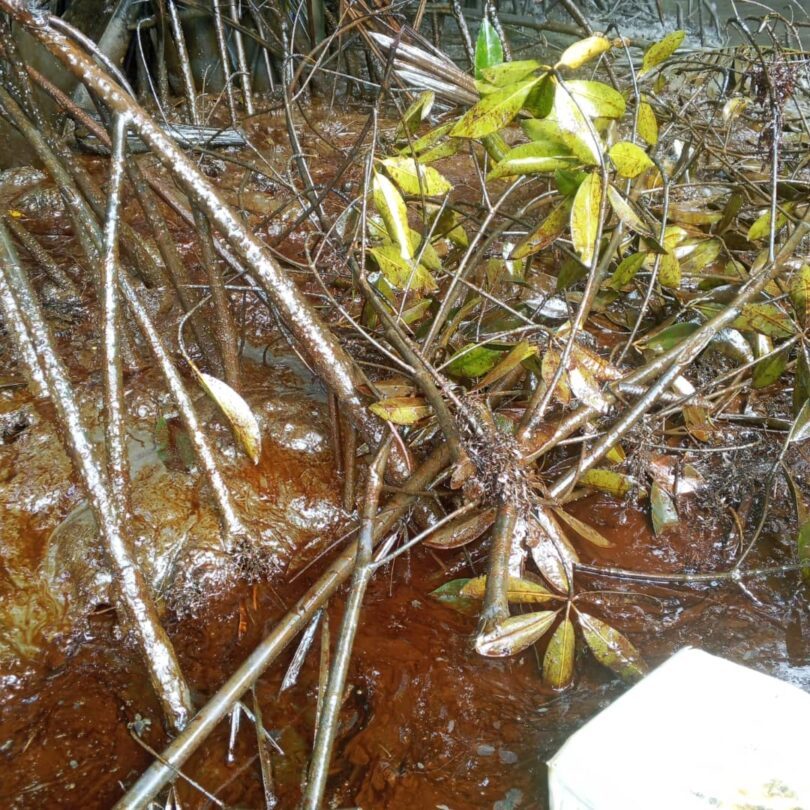
Residents of Ntafre, a remote Akwa Ibom oil community, say a crude oil spill has contaminated their creek, disrupted fishing and left them without safe water as NOSDRA moves to determine the source.
Residents of Ntafre, a hard-to-reach coastal community in Ibeno Local Government Area of Akwa Ibom State, have called for urgent cleanup and compensation after suspected crude oil pollution affected their creek and fishing activities.
During Wednesday’s JIV, participants observed suspected crude oil stains on vegetation, shrubs and mangrove stems around the creek.
PREMIUM TIMES observed dead aquatic organisms, including barnacles, around portions of the creek and perceived the smell of petroleum substances in the area.
NOSDRA, the Akwa Ibom State Ministry of Environment, and oil companies collected samples of suspected crude oil from stained vegetation, sediment, and water for laboratory analysis and oil fingerprinting to determine the owning oil company.
The investigative visit involved NOSDRA, the Akwa Ibom Ministry of Environment, Amni International, Seplat Energy, Tulcan Energy, Savannah Energy, civil society organisations and PREMIUM TIMES.
NOSDRA said other operators in the area, including TotalEnergies and Sterling Oil, had been informed about the investigation but did not participate.
Network Oando also attended but did not join the field inspection into the creek.
The village head of Ntafre, Akpan Bassey, said the community had continued to live with serious infrastructure deficits despite being surrounded by oil companies.
“We are surrounded by many oil companies. As the nearest community to the ocean where many oil companies operate, we bear the brunt of pollution first. Yet, we have no medical centre or hospital or pipe borne water,” Mr Bassey said.
He said residents had continued to depend on available water sources despite concerns about contamination.
“Even after the oil pollution, we continue to drink the polluted water because we have no alternative,” he said.
The youth president of Ntafre, Nelson Smith, said fishers first noticed the pollution in the early hours of 10 September while going fishing.
According to him, residents noticed a strong smell of petroleum in the creek and crude oil stains on their boats.
He said fishing yields had dropped since the incident, affecting the livelihoods of residents who depend mostly on fishing.
Mr Smith called for immediate cleanup of the affected environment and compensation for livelihood losses.
Ntafre is one of the 26 gazetted villages in Ibeno and is located close to the Atlantic Ocean.
The community’s isolation makes access difficult. The journey to Ntafre starts from Okoroutip Beach with about an hour-long boat ride through the creek, followed by a motorcycle ride from Akata 2 and another boat journey of about 20 minutes into the community. Marine police provided security for the JIV team during the journey.
Officials who participated in the JIV said the condition observed on Wednesday was different from what they saw during the initial inspection on 11 September, one day after the spill was reported.
Iniobong Ochcha of the Akwa Ibom State Ministry of Environment said he participated in the initial visit.
“That first day, oil was everywhere. It was scooped everywhere. Today, we only find stains. We saw stains on the vegetation and the soil,” Mr Ochcha said.
The Assistant Chief Scientific Officer of NOSDRA’s Uyo office, Gaxton Okobah said the agency and the state Ministry of Environment had observed visible crude oil on the water and surrounding environment during their 11 September visit.
He said the coordinates recorded during the initial inspection were used to locate the affected areas during Wednesday’s JIV.
“What we saw today was stained shrubs, stained vegetation and mangroves,” Mr Okobah said.
He said the samples collected during the investigation would be analysed in a laboratory in Port Harcourt.
“The result of the fingerprinting will not be delayed at all because the agency is interested,” he said.
Mr Okobah said determining the source of the pollution was crucial, particularly because similar incidents had reportedly occurred in the neighbouring Akata community in May but investigators were unable to establish evidence because of the time they arrived at the site.
“If we did not come on Friday, but probably came only today, we would have gone back with the same impression,” he said.
The NOSDRA assistant chief scientific officer said NOSDRA’s delay in conducting the JIV was because of the time required to get the operators to agree on a date for the investigation.
He, however, said the delay did not prevent government officials from responding to the initial spill report by the community.