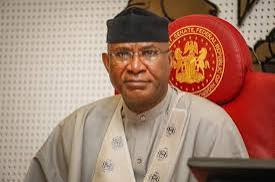
Former Deputy Senate President, Ovie Omo-Agege, has formally declared his intention to return to the Senate, announcing a bid for the Delta Central Senatorial District seat in the 2027 general elections on the platform of the All Progressives Congress, APC.
Omo-Agege, in a statement issued Wednesday in Asaba, said his decision followed “extensive consultations and reflection,” describing the move as a response to mounting calls from constituents and political stakeholders across Delta Central.
“Driven by patriotic duty, resourceful service, and a hopeful vision for our future… I hereby declare my intention to contest,” he said, framing the decision as both a personal conviction and a collective aspiration.
The declaration marks a significant political comeback attempt for the former lawmaker, whose recent electoral defeat continues to shape the narrative around his renewed ambition.
While he did not directly reference the loss, his tone underscored a determination to reassert relevance and reclaim political ground in Delta politics.
Omo-Agege said consultations spanned the eight local government areas of Delta Central—Ughelli North, Ughelli South, Udu, Okpe, Sapele, Uvwie, Ethiope East, and Ethiope West—where, according to him, there is a “clear consensus” on the need for experienced representation.
He cast the senatorial ambition in almost moral and spiritual terms, stating that after prayer and reflection, he views public service as a “divine duty.”
“It is a response to the humbling calls by our electorate… that I return to the Senate to serve our common good and give unflinching support to President Bola Tinubu’s Renewed Hope Agenda,” he added.
While positioning himself as a tested legislator, Omo-Agege highlighted his tenure between 2015 and 2023, including his role as Deputy Senate President, which he described as “golden years” of impactful representation.
He credited that period with attracting federal projects to Delta Central, including a federal polytechnic, a National Defence Space School, and an oil and gas industrial park.
He also cited the establishment of the Federal University of Medical and Health Sciences in Kwale, alongside various community-level interventions such as healthcare rehabilitation, ICT hubs, electrification, and transport infrastructure.
“These are the essentials of true representative partnership,” he said, drawing a contrast between what he termed “purposeful representation” and what he described as “cosmetic or insipid” leadership.
At the heart of his campaign message is a call for stronger political voice and influence for the Urhobo people, insisting that Delta Central’s Senate seat must remain “strategic, purposeful, and authoritative.”
“The Urhobo Nation’s Senate seat must not be silent,” he declared, pledging to deliver legislative leadership capable of driving bills from conception to presidential assent.
On policy priorities, Omo-Agege outlined a focus on economic empowerment, infrastructure, education, healthcare, and security.
He promised to facilitate job creation through increased funding for small businesses, artisans, and agro-processors, while also committing to improved collaboration with the executive arm on infrastructure development.
Throwing his weight behind Bola Tinubu, he described the administration’s economic reforms as “tough but necessary,” citing fuel subsidy removal, exchange rate adjustments, student loan initiatives, and wage support programmes as foundational steps toward long-term stability.
“Supporting President Tinubu in 2027 is non-negotiable,” he said, arguing that policy continuity would enable the completion of ongoing projects and attract further investment, particularly to oil-rich Delta Central.
He also used the opportunity to call for unity within the APC in Delta State, stressing the need for cohesion ahead of the next electoral cycle.
“We must approach 2027 as one family,” he said.