
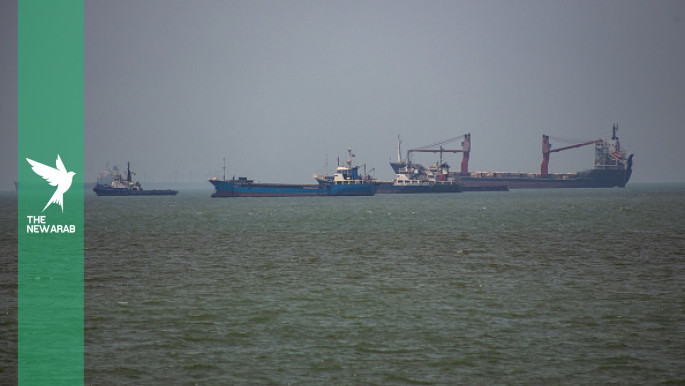
Commercial trackers have reported a stark fall of in traffic through Hormuz after Iran announced it would close the waterway [Getty]
The dispute over whether the Strait of Hormuz is open or closed has become the first major test of a new US-Iran mechanism intended to keep one of the world’s most important shipping lanes functioning.
At talks in Switzerland on Sunday, US and Iranian negotiators discussed safe passage through the strategic waterway, with Iranian Foreign Ministry spokesman Esmaeil Baghaei later saying that “a mechanism was set up”, without going into detail.
Yet within hours, competing claims about the status of the strait highlighted the challenge facing any new arrangement.
What happened?
Iran’s Islamic Revolutionary Guard Corps announced on Saturday that it had once again closed the Strait of Hormuz, citing continued Israeli attacks in Lebanon and accusing Washington of failing to uphold ceasefire commitments.
US Central Command (CENTCOM) quickly rejected the claim, insisting safe passage remained intact and stating that 55 merchant vessels had transited the waterway that day.
Hormuz handles roughly one-fifth of global oil and liquefied natural gas supplies, making any disruption a concern for global markets.
Why do the figures differ?
Commercial shipping data suggests a more complicated picture than either side’s claims.
According to maritime intelligence firm Kpler, only five vessels transited the strait on Sunday, down from 26 the previous day.
Other tracking services reported similar declines.
Windward said 12 vessels crossed the waterway on Sunday, compared with 35 a day earlier, while noting that a growing number of ships appeared to be operating with their Automatic Identification Systems (AIS) switched off.
The discrepancy may partly reflect the growing number of vessels operating without active AIS transponders, which are used to broadcast a ship’s identity and location.
Commercial tracking firms rely heavily on such signals to monitor maritime traffic, while military authorities may have access to additional means of tracking vessels.
As a result, ships moving through the strait with their AIS systems switched off could appear in military counts while remaining absent from some commercial datasets.
The differing figures may also reflect the incentives facing the various actors involved.
Tehran has an interest in demonstrating that its actions are having a tangible impact on shipping through the waterway, while US officials are keen to reassure markets and allies that commercial traffic remains largely unaffected.
As a result, both sides may emphasise different indicators when assessing the extent of the disruption.
However, the fact that US and Iranian negotiators discussed safe passage through the waterway and agreed to establish a new mechanism suggests that Washington recognises there is a problem requiring management, even if it stops short of accepting Tehran’s claim that the strait has been fully closed.
Open or closed?
The available evidence suggests the strait is neither fully open nor fully closed.
Vessels continue to transit the waterway, but commercial tracking firms have recorded a sharp decline in traffic, while Iran, commercial intelligence companies and US military authorities have all presented markedly different assessments of the disruption.
What is beyond dispute, however, is that Iran has demonstrated an ability to significantly affect shipping through the Strait of Hormuz. During the recent conflict, traffic through the waterway fell sharply as shipping companies reassessed the risks of operating in the area, even when vessels continued to transit the strait.
The conflicting figures suggest the debate is less about whether ships can physically pass through the waterway than about the extent to which commercial traffic has been disrupted and the degree of confidence shipping companies have in the route’s security.