
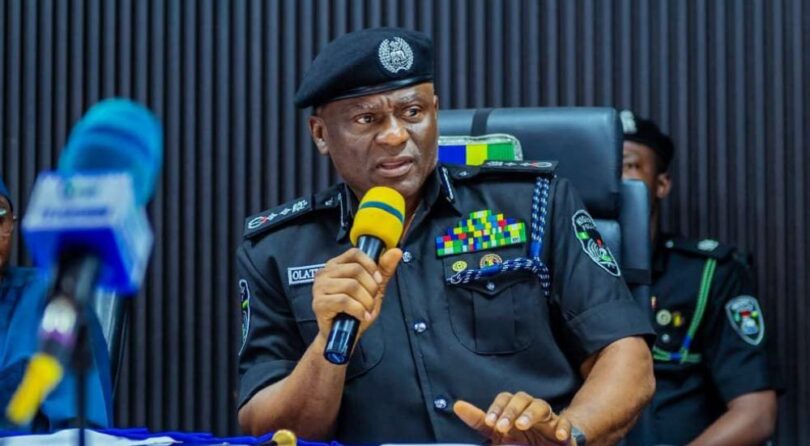
In early 2026, Olatunji Rilwan Disu became Nigeria’s 23rd substantive Inspector-General of Police through a swift, three-step constitutional process. Following the resignation of Kayode Egbetokun, President Bola Tinubu appointed Disu as Acting IGP on February 24. His leadership was unanimously confirmed by the Nigeria Police Council on March 2, and he was formally sworn in at the Presidential Villa on March 4. This transition marked the rise of a seasoned commander—formerly of the Lagos RRS and the IRT—tasked with institutionalizing accountability within the Force.
IGP Olatunji Rilwan Disu is a Lagos-born officer and elite strategist who rose through the ranks as Commander of the Lagos RRS (2015–2021), head of the Intelligence Response Team (IRT), and CP of the FCT. Most recently, he served as AIG in charge of Force CID Lagos, building a career defined by urban policing excellence and high-level criminal investigation.
The handling of the Effurun incident by IGP Olatunji Rilwan Disu has emerged as a definitive roadmap for institutional integrity within the Nigeria Police Force. By prioritizing swift accountability and a zero-tolerance stance on human rights violations, the IGP has replaced traditional bureaucratic silence with a model of immediate transparency. This approach was vividly demonstrated following the tragic extrajudicial killing of Mene Ogidi on April 26, 2026, where the IGP’s response served as a blueprint for genuine institutional reform.
A cornerstone of this new era is the shift toward immediate and decisive intervention. Unlike previous years characterized by administrative delays, the IGP ordered the transfer of the involved officers, including ASP Nuhu Usman, from the Delta State Command to the Force Headquarters in Abuja within just 48 hours. This strategic move neutralized local influences and signaled that the high command was taking direct responsibility for the investigation. By accelerating disciplinary proceedings through rapid Orderly Room Trials, the IGP ensured that justice was not delayed; by April 29, 2026, he had already approved the dismissal of the officers and recommended their criminal prosecution for murder.
This decisiveness functions as a powerful deterrent. In the past, disciplinary actions often lingered for months, fueling public suspicion of internal cover-ups. By acting within a 72-hour window, IGP Disu demonstrated that the Force would no longer provide a “slow-motion” shield for misconduct. Furthermore, his direct oversight of the process reinforced a uniform national standard of professionalism, sending a clear message that local unit loyalties would not be permitted to interfere with the course of justice.
Central to this reform is the reinforcement of the rules of engagement and clear public communication. By declaring that “no uniform is a license to kill,” the IGP provided a moral anchor for the institution, clarifying that such acts are personal misconduct rather than institutional policy. This vocal and transparent stance prioritizes the lives of citizens over the protection of rogue colleagues, which is essential for rebuilding the “social contract.” Ultimately, by ensuring justice moved at “the speed of thought” for the family of Mene Ogidi, IGP Disu is repairing the fractured relationship between the police and the public, proving that a stronger institution is one that is unafraid to purge its own ranks to uphold the law.
The absence of the typical protests and civil unrest that historically follow extrajudicial killings in Nigeria is perhaps the strongest testament to the impact of IGP Olatunji Disu’s leadership. His handling of the Effurun incident has “endeared” him to the public because it addressed the root cause of past riots: the feeling of helplessness and the anticipation of injustice.
The following factors explain why the IGP’s decisive strategy effectively defused a high-tension environment that could have easily spiralled into unrest. The pervasive feeling of helplessness and the anticipation of institutional impunity. By replacing silence with action, he successfully de-escalated a potentially volatile situation through a strategy of proactive accountability.
A critical factor in this de-escalation was the speed of the intervention, which pre-empted public anger. Historically, civil unrest in Nigeria often stems from “justice delayed,” where the perception of police stalling to protect their own fuels street-level frustration. By concluding the dismissal and recommending the prosecution of ASP Nuhu Usman within a mere three days—between April 26 and April 29, 2026—IGP Disu effectively removed the “incubation period” for unrest.
The public witnessed a system moving faster than the momentum of a protest, neutralizing the need for mass mobilization. This was bolstered by a commitment to radical transparency; unlike previous administrations that issued vague or defensive statements, Disu’s leadership openly acknowledged the wrongdoing and provided real-time updates on the transfer of suspects to Abuja. This openness acted as a pressure valve, reassuring the citizenry that the system was working for them.
Furthermore, the IGP successfully humanized the institution by adopting a “human-first” narrative. His explicit declaration that “no uniform is a license to kill” reframed the conflict from “The Police vs. The People” to “The Institution vs. Rogue Elements.” This distinction made it difficult for protesters to justify rioting against a force that was visibly and aggressively purging its own bad actors. This moral clarity was supported by the “social capital” Disu had earned during his tenure as the Lagos State Rapid Response Squad (RRS) Commander. His established reputation for civil policing and accessibility gave him a unique credibility, allowing Nigerians to believe in the sincerity of his actions.
The strategic decision to move the case from the local Delta State Command to the Force Headquarters in Abuja served to neutralize local tensions. By shifting the “battleground” away from the immediate site of the tragedy, the IGP discouraged local mobs from attacking stations in Effurun or Warri, as they recognized that both the decision-makers and the suspects were no longer within physical reach. Ultimately, IGP Disu has replaced a historical “culture of impunity” with a “culture of consequences.” In this instance, Nigerians did not feel the need to take to the streets because the IGP had already stepped into the role of the victim’s advocate, fulfilling the very demand for justice that the public usually has to fight for.
IGP Olatunji Disu’s handling of the Effurun incident served as a masterclass in de-escalation by replacing cold bureaucracy with a strategy of empathetic, multi-level communication. By reaching out directly to Mene Ogidi’s family, he transformed a legal crisis into a human narrative, acknowledging their grief and immediately lowering the emotional temperature of the community. His transparent engagement with the people of Delta State acted as a vital safety valve, removing the impetus for “jungle justice” through real-time updates, while his address to the entire nation converted a local tragedy into a powerful policy statement against the “culture of silence.” This proactive approach didn’t just manage a crisis—it de-weaponized the systemic anger that typically fuels national unrest, replacing public skepticism with a rare and much-needed sense of institutional trust.