
Bennett Oghifo
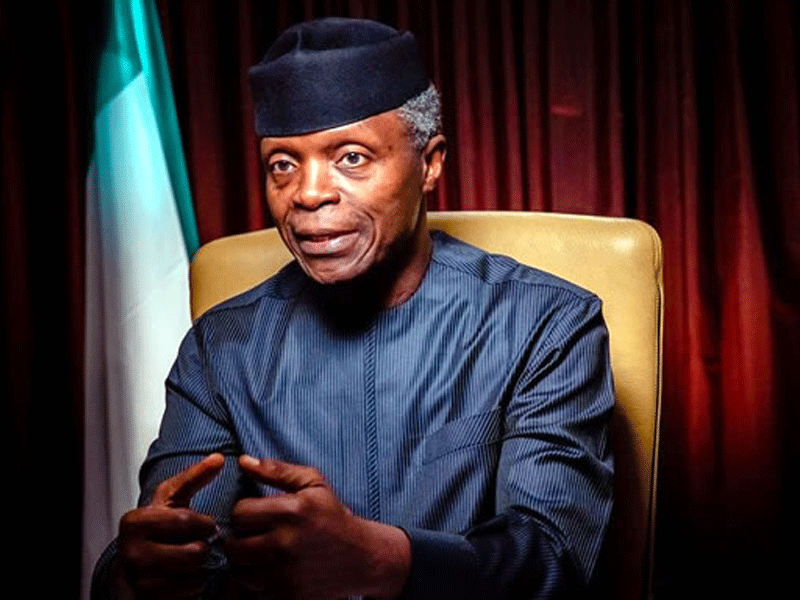
Former Vice President, Professor Yemi Osinbajo, has been appointed President of the Board of Trustees of the Nigerian Conservation Foundation (NCF), succeeding elder statesman, Chief Philip Asiodu, who stepped down after more than 25 years of leadership.
The appointment was announced at the Foundation’s 37th Annual General Meeting (AGM) held in Lagos, where the organisation also unveiled its renewed strategic direction for 2026-2030, with a renewed commitment to biodiversity conservation, climate action, ecosystem restoration and sustainable development.
Announcing the leadership transition, Chairman of the NCF National Executive Council, Hon. Justice (Mrs.) R.I.B. Adebiyi, described Asiodu’s stewardship as transformative, saying he leaves behind a stronger institution and a respected conservation movement.
According to her, Asiodu’s leadership was characterised by wisdom, foresight and an unwavering commitment to environmental sustainability.
She noted that under his watch, the Foundation strengthened its advocacy for forest restoration, biodiversity conservation and environmental policy while expanding its influence nationally and internationally.
Chief Asiodu, born in Asaba, Delta State, in 1934, served as Chief Economic Adviser to former President Olusegun Obasanjo and championed Nigeria’s 25 per cent forest cover target as well as the Great Green Wall Initiative. A recipient of the CON and CFR national honours, he also served as Chairman and Trustee of WWF International.
Justice Adebiyi said the Board was confident that Osinbajo’s extensive public service experience and climate leadership would position the Foundation for greater impact.
She noted that as Vice President between 2015 and 2023, Osinbajo spearheaded Nigeria’s Energy Transition Plan aimed at achieving net-zero carbon emissions by 2060 and consistently promoted the integration of biodiversity, forests and natural capital into national development planning.
She also recalled that as Chairman of the National Council on Climate Change and supervisor of the N-Power Programme, Osinbajo oversaw the deployment of over 500,000 young Nigerians into agriculture and environmental extension services.
According to her, his understanding that development and environmental conservation must progress together would strengthen partnerships with government, the private sector and local communities.
Accepting the appointment, Osinbajo described the opportunity as both a profound honour and enormous responsibility.
He paid glowing tribute to Chief Asiodu and the founding visionaries of the Foundation, including the late Chief S.L. Edu, Chief Akintola Williams and other pioneers, whom he credited with recognising the importance of biodiversity conservation decades before climate change became a global concern.
He said the foresight of the Foundation’s founders laid the foundation upon which Nigeria’s climate action efforts are built today.
Osinbajo observed that while climate change presents unprecedented challenges, humanity also possesses greater technological tools, including artificial intelligence, to address environmental problems more effectively.
He cited rising global temperatures, including recent heatwaves across Europe and the United Kingdom, as evidence that climate change has become a global emergency requiring urgent collective action.
He pledged to work with stakeholders to strengthen the Foundation’s leadership role in promoting environmental sustainability, describing NCF as Nigeria’s foremost non-governmental organisation dedicated to conservation.
Director-General of NCF, Dr. Joseph Onoja, said Nigeria must intensify efforts to protect endangered wildlife species and restore degraded ecosystems.
According to him, several iconic species, including giraffes, are already extinct in Nigeria, while forest elephants, Cross River gorillas, Nigeria-Cameroon chimpanzees, pangolins and other endangered species remain under severe threat.
He stressed that beyond wildlife conservation, the country must also restore degraded landscapes, expand protected areas and strengthen biodiversity conservation programmes.
Onoja added that environmental conservation also presents significant socio-economic opportunities through the creation of green jobs and improved livelihoods for communities.
On funding, he said the Foundation was exploring innovative financing mechanisms while encouraging greater private sector participation.
According to him, businesses have a direct stake in environmental sustainability because environmental degradation ultimately affects supply chains, profitability and long-term economic growth.
Earlier, Asiodu said Nigeria continues to face worsening climate change, biodiversity loss, deforestation and pollution, warning that over 90 per cent of the country’s original forest cover has already disappeared.
He urged governments at all levels to strengthen forest protection laws, increase funding for forestry institutions, support community forest management and integrate ecosystem restoration into national development planning.
He also called on the private sector to embrace zero-deforestation commitments, invest in landscape restoration and support sustainable production systems.
The Foundation also unveiled its 2026-2030 Strategic Direction anchored on four pillars – climate change, biodiversity conservation, pollution management and institutional strengthening – as it seeks to deepen its role in advancing sustainable societies where people and nature thrive together.
Caption: L-R: Head of Projects, Lagos State Development and Property Corporation (LSDPC), Engr. Wasiu Tajudeen; General Manager, Lagos State Traffic Management Authority (LASTMA), Mr. Olalekan Bakare-Oki; Executive Director, Business Development and Joint Ventures, LSDPC, Mr. Derin Phillips; and General Manager, Technical Services, LSDPC, Engr. Adeyemi Adesina, during the handover of a newly renovated LASTMA Zone 25 office complex and two operational vehicles by LSDPC in Lagos… recently