The Minister of Education, Dr. Tunji Alausa, has disclosed that more than one million out-of-school children have been returned to classrooms over the past two years through targeted interventions by the Federal Government aimed at expanding access to basic education.
Alausa made the disclosure on Wednesday while speaking at the 2026 Annual Education Summit of the Education Correspondents Association of Nigeria, ECAN, in Abuja.
The Summit, with the theme: “Three Years of the Tinubu Administration: Assessing Reforms, Progress, and Challenges in Nigeria’s Education Sector,” brought together policymakers, education stakeholders and journalists to review developments in the sector.
The minister said the milestone reflected the government’s determination to reduce the country’s out-of-school children population through deliberate policies and programmes focused on enrolment, retention and improved access to education.
“In the last 24 months, we have moved over one million children off the streets into schools. Over one million,” Alausa said.
Despite the progress, he acknowledged that millions of children remained outside the formal education system, stressing that accurate data was essential for designing effective interventions.
According to him, the Federal Ministry of Education is collaborating with the National Bureau of Statistics, NBS, to conduct a comprehensive household survey that will establish the actual number of out-of-school children across the country.
Alausa identified inadequate access to junior secondary education as one of the major factors contributing to the challenge, revealing that while Nigeria has about 90,000 primary schools, there are only about 16,000 junior secondary schools nationwide.
He explained that nearly 25 million pupils are currently enrolled in primary schools, but only about five million progress to junior secondary schools, leaving a significant transition gap.
“The ratio is one to eight. That tells you the major problem. The problem is access,” he said.
The minister also called on education correspondents to embrace data-driven journalism and make greater use of the Nigeria Education Data Infrastructure Management System, NEDIMS, to promote accountability in the education sector.
He urged journalists to use verified education data to scrutinise school infrastructure, teacher deployment, enrolment figures and other key indicators at the state and local government levels.
He said President Bola Tinubu’s emphasis on evidence-based governance, ensures that policymakers and journalists alike rely on data rather than assumptions.
“If you don’t use data, it is like you are flying blind. We want journalists to use the available data to challenge governors and local government chairmen. You can now see teacher-to-classroom ratios, student-to-teacher ratios and facilities available down to the school level,” he said.
The minister further highlighted reforms implemented under the Tinubu administration, including sustained industrial harmony in tertiary institutions, expansion of Technical and Vocational Education and Training (TVET), promotion of STEM education, digital transformation and improvements in university rankings.
Also speaking, the Minister of State for Education, Prof. Suwaiba Ahmad, said the sweeping reforms being implemented in Nigeria’s education sector are driven by a genuine passion for change rather than routine government activity.
Ahmad acknowledged that reforms are often difficult and may not produce immediate results, but insisted they are necessary to achieve lasting improvements in education.
“Change is never easy. But if you want different results, you have to change what you are doing,” she said, urging Nigerians to exercise patience as the reforms take root.
The minister noted that the Federal Ministry of Education is laying a solid foundation through the Nigerian Education Sector Renewal Initiative, NESRI, with emphasis on teacher development, curriculum reforms, digital transformation, STEM education, technical and vocational education, quality assurance and improved governance.
According to her, teacher professional development remains central to the ministry’s agenda, with digital platforms being deployed to ensure every teacher, regardless of location, has access to continuous training.
She also highlighted ongoing curriculum reforms designed to equip learners with digital literacy, entrepreneurship, climate education, financial literacy, civic responsibility and critical thinking skills needed for the 21st-century economy.
Ahmad commended education correspondents for promoting informed public discourse and urged journalists to continue supporting reforms through balanced, evidence-based reporting.
She said responsible journalism would help the public better understand the objectives of the reforms while encouraging greater accountability across the education sector.
The minister reaffirmed the Federal Government’s commitment to building an inclusive, resilient and globally competitive education system capable of driving national development.
On her part, the Executive Secretary of the Universal Basic Education Commission, UBEC, Dr. Aisha Garba, described education as the most powerful instrument for national development, stressing that every Nigerian child deserves access to quality basic education irrespective of background, location or socio-economic status.
Garba said no child should be left behind in the country’s drive to achieve inclusive and equitable education.
She reaffirmed UBEC’s commitment to supporting the Federal Government’s education reforms, adding that the commission would continue to partner with ECAN, the media and other stakeholders to build a basic education system that works for every Nigerian child.
The UBEC boss also commended the Minister of Education, Dr. Tunji Alausa, and the Minister of State for Education, Prof. Suwaiba Ahmad, for their leadership and support, noting that UBEC’s achievements over the past two years were made possible through their commitment to advancing reforms in the basic education subsector.
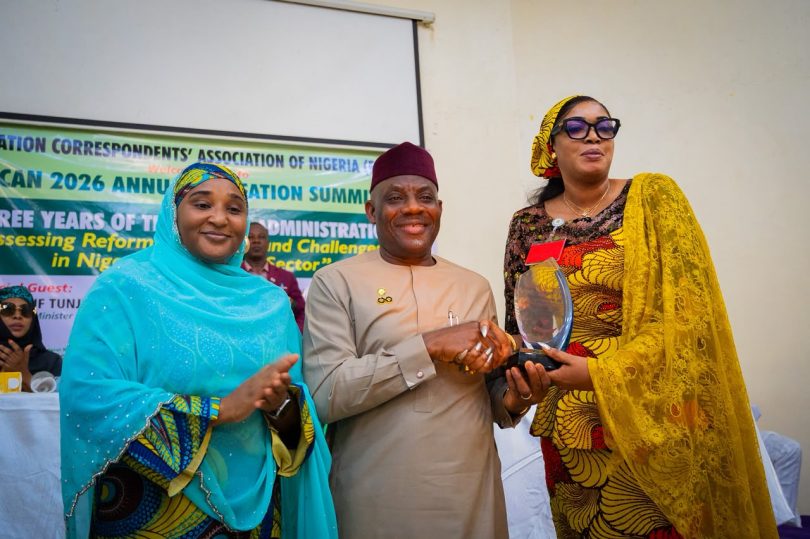
Garba congratulated the organisers of the summit and recipients of the awards presented during the event.
Earlier, ECAN Chairman, Mr. Chuks Ukwuatu, welcomed participants to the Summit and said the event was organised to provide an objective assessment of the achievements, reforms and challenges in the education sector.
Ukwuatu urged constructive engagement among policymakers, development partners and the media.