After months in detention at Israel’s Damon Prison, Hala, a nickname used to protect the identity of a 30-year-old Palestinian former prisoner, said crossing the Israeli military checkpoint felt unreal.
“My first breath outside felt like I was being born again,” she told The New Arab, describing the confusion that followed her release.
“It wasn’t just freedom. It was confusion. I kept asking myself if I was really out or if it was another moment they would take away.”
For ten months, Hala had been held under administrative detention, a mechanism that allows Israeli authorities to imprison Palestinians without formal charges or trial based on undisclosed ‘secret files’.
Like many women detained in recent years, her case was linked to social media activity. She said she was accused of “supporting Gaza” and “incitement”, although she never saw a formal indictment or any evidence against her, adding that the uncertainty itself became part of the punishment.
“They never explained anything,” she recalled. “They just told me my posts were dangerous. I kept waiting for a trial, for someone to tell me what I actually did. But nothing came. Only waiting.”
Inside Damon Prison, she said, uncertainty shaped daily life, with days marked by raids, headcounts and the changing mood of guards rather than any sense of routine or time.
“The hardest punishment is not knowing,” Hala said. “You lose the sense of time. You don’t know if you will leave in a week, a month or years. Your life becomes frozen, but your mind doesn’t stop working. That’s what breaks you slowly.”
She described overcrowded cells with little privacy, where several women shared rooms built for far fewer prisoners, and bunk beds were not enough for everyone being held there.
“Some of us slept on the floor,” she said. “There was always dampness in the air. The toilet was in the same room, and the smell never went away. You learn to live with discomfort as if it is normal, but it is not normal.”
At night, the women spoke quietly among themselves to avoid punishment from guards, with conversations often turning to the homes and families they had left behind.
“We talked about our homes,” Hala said, describing how these conversations became a way of coping.
“Our mothers, our children, the smell of food we missed, even small things like sunlight through windows. Sometimes one of us would cry quietly, and we would all gather around her. We tried to protect each other from breaking completely.”
She said the most frightening moments came during night raids, when guards would suddenly enter the cells without warning, and the prison would fill with “shouting, banging on doors, dogs barking.”
“We were forced to stand facing the wall,” she said. “We heard insults all the time. It was meant to humiliate us.”
Pausing briefly, she described how the fear often continued long after the raids had ended.
“There were threats,” she said. “Some were sexual threats, words meant to destroy your sense of safety. Even if nothing physically happened, the fear was real. You feel exposed, powerless, like your body is no longer yours.”
She said that sense of fear did not end when the raids stopped.
“They wanted to make us afraid of everything,” she added. “Even after the raids ended, the fear stayed. Some women couldn’t sleep afterwards. Our bodies would shake for hours. We would try to comfort each other, but the fear stayed in the room.”
Systematic abuse
Since 7 October 2023, Palestinian prisoners’ rights organisations say conditions inside Israeli prisons have sharply deteriorated, with reports documenting increased isolation, restrictions on family visits, collective punishment measures and reduced access to legal and humanitarian monitoring.
According to Palestinian prisoners’ institutions, more than 9,350 Palestinians are being held in Israeli prisons and detention centres as of early 2026, with nearly half detained without formal charges under administrative detention or classifications that allow indefinite imprisonment without trial.
Women, however, face additional pressures, according to the Palestinian Prisoners Club, which says 39 Palestinian mothers are currently detained alongside students, journalists, lawyers, teachers and other professionals.
The organisation says many are being held in conditions it describes as “systematically degrading,” involving isolation, repeated searches, medical neglect and psychological pressure.
Shackled, isolated, and starved
Lawyer Hassan Abbadi, who follows cases involving female prisoners, told The New Arab that Damon Prison reflected a broader deterioration in conditions across Israeli detention facilities.
“It is as if they are completely cut off from the world,” he said. “No family visits, no newspapers, no television, not even radio. The only connection is through lawyers, and even that is limited.”
Hassan estimates that Damon currently holds around 86 Palestinian female prisoners, most from the West Bank and Jerusalem, with many held under administrative detention or kept under investigation for extended periods without clear charges.
“Since the escalation after 7 October, the level of ill-treatment has increased significantly, with conditions worsening since the start of the war, including night raids, police dogs, stun grenades, beatings, insults, and repeated humiliation,” he pointed out.
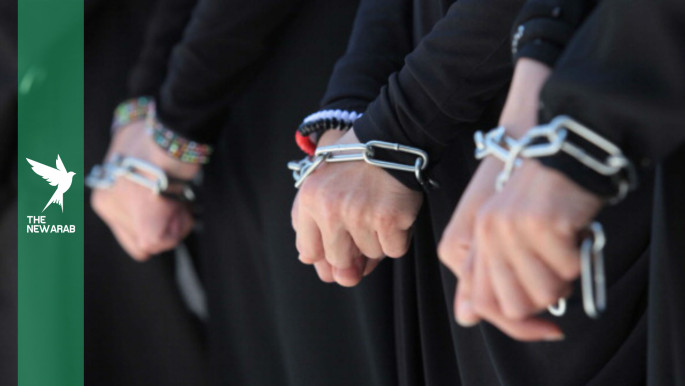
Describing scenes he said had become routine inside the prison, Hassan said women were often shackled, blindfolded and, at times, dragged on the ground.
“There are frequent strip searches,” he warned. “There are also sexual threats used as psychological pressure, even when no physical assault occurs.”
He added that overcrowding had further worsened conditions, with cells holding far more prisoners than they were designed to accommodate.
“In some cases, 14 women are placed in rooms with only four beds,” he shared. “Some sleep on the floor. Ventilation is poor. Humidity is high. Toilets are inside the cells, which creates constant health problems.”
Hassan also said food conditions had deteriorated significantly in recent months.
“There is no meat or chicken for long periods,” he said. “Meals are mostly lentils, chickpeas or small portions of eggs. Even basic hygiene items are limited. Sometimes dozens of prisoners share a single bar of soap. Sanitary pads and clothing are insufficient.”
Medical care, he warned, remains one of the most serious concerns inside the prison, particularly for detainees with chronic illnesses.
“Treatment is often reduced to painkillers,” he said. “Even when prisoners are taken to clinics, surveillance cameras are installed inside examination rooms, violating privacy. There are detainees with chronic illnesses and even cancer who do not receive adequate treatment.”
Hassan also recalled the case of prisoner Fatima al-Saqr, the sister of former Hamas leader Saleh al-Arouri, saying the psychological pressure she faced had a severe impact on her health.
“She was subjected to psychological pressure after guards repeatedly told her about her brother’s killing,” he said. “She went for days without sleep. She cried constantly. When I met her, she was completely exhausted.”
He added that another prisoner later told him she had finally managed to sleep after several days awake, a moment he described quietly as showing how psychological pressure alone can break a person.
Fear and waiting
Beyond the prison walls, families say the effects of detention continue at home.
In a village in the occupied West Bank, the husband of another detained woman, known as Umm Mohammed, described the night soldiers arrested his wife in front of their children.
“It was after midnight,” he recalled. “Soldiers stormed the house, shouting and breaking things. The children woke up terrified. My youngest daughter held on to her mother and refused to let go, but they took her anyway.”
Since then, he said, family life has changed completely, with the children continuing to ask when their mother will return.
“At night especially, my youngest daughter believes she will return if she stays awake long enough,” he said.
He also noted that the family has had no direct contact with his wife since her detention and has relied solely on information relayed through their lawyers.
“All I know is that she is exhausted, mentally and physically,” he said. “The searches, the insults, the conditions. I feel completely helpless.”
The psychological strain on the children, he added, had become increasingly visible.
“My eldest has become withdrawn,” he mentioned. “One child wets the bed again. Loud sounds terrify them. Even a knock on the door makes them panic. They ask me if I will be arrested too.”
Alongside his concerns for his family, he criticised what he described as a lack of meaningful international action over prison conditions.
“Honestly, what hurts more is not only what is happening to her, but the silence around it,” he said. “International institutions speak about human rights, about laws, about the protection of civilians. But in reality, where are they now? What do these words mean when my wife is inside there, and my children are breaking apart here?”
In sharing this, he highlighted that official statements and reports had done little to improve conditions.
“We hear statements, we hear concerns, and we hear calls for restraint,” he clarified. “But in practice, nothing changes. No protection arrives. No visits are allowed. No real pressure is applied. It feels like these institutions are watching from a distance, documenting suffering instead of stopping it.”
He questioned why international law was not being enforced.
“If international law is real, then why does it not reach these prisons?” he stated. “If human rights conventions exist, why are they not enforced? My wife is not a number in a report. She is a mother. She is a human being. But inside those walls, she is treated as if none of that matters.”
One of the hardest parts, he explained, had been trying to hold the family together in his wife’s absence.
“Every night I try to be both father and mother,” he said. “But I cannot replace her. The children need her voice. They need her presence. I can only try to hold what is left together.”
Describing a home shaped by uncertainty and fear since her arrest, he added: “The house is quiet, but it is not peaceful. It is full of waiting. Full of fear. Full of questions that no one answers.”
Despite everything, he explained that the children remained focused on one thing.
“They just want her to come back,” he said softly. “That is all they think about. That is all they ask for. And I don’t know what to tell them anymore.”
Imprisoned memories
Palestinian prisoners’ rights groups say these accounts reflect a broader pattern of collective punishment, particularly targeting women accused of social media activity or political expression online.
In public statements, the groups have accused Israeli authorities of using administrative detention as a tool for prolonged imprisonment without accountability, particularly since the escalation of Israeli violence in late 2023.
International humanitarian organisations have also raised concerns about restricted access to detainees and limitations on independent monitoring inside prisons.
For Hala, however, the experience remains personal, and she said the effects of prison had continued long after her release.
“You leave the building,” she reflected, “but the prison stays inside you. Loud noises still make me tense. I wake up sometimes thinking I am still there.”
After a brief pause, she described what remained the hardest part of returning home.
“What stays with you is not only what happened,” she tells The New Arab.
“It is the feeling that it could happen again. But inside the prison, every woman held on to one thought: to see her children, to see her family, outside the bars. That thought was the only thing that kept us alive.”
Sally Ibrahim is The New Arab’s correspondent from Gaza